

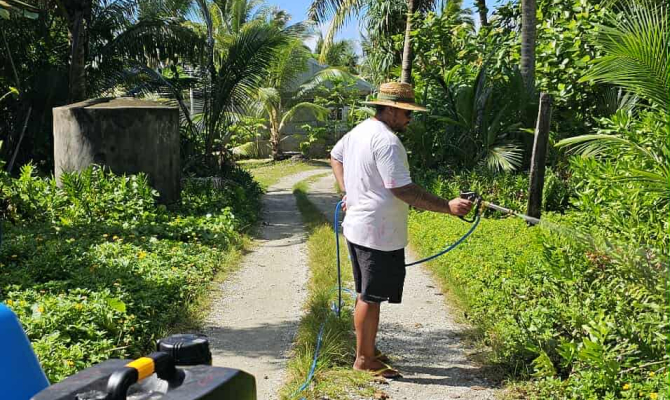
25 September 2025, Tokelau - One of the Pacific’s most remote island groups, Tokelau, is facing a quiet but persistent environmental challenge with the spread of the invasive Singapore daisy (Sphagneticola trilobata). Once introduced as an ornamental ground cover, the plant has now become a serious ecological threat. Its dense mats smother native vegetation, disrupt fragile coastal ecosystems and even hinder the growth of traditional crops that communities rely on for food security.
Communities in Tokelau have observed how quickly the weed has spread, outcompeting native plants, reducing biodiversity and making it difficult for natural regeneration to occur. Left unmanaged, the Singapore daisy can dominate landscapes, threatening both the environment and livelihoods of communities.
Tokelau has renewed its battle against the invasive Singapore daisy with support from the Secretariat of the Pacific Regional Environment Programme (SPREP) through the Pacific Regional Invasive Species Management Support Service (PRISMSS) with funding provided by the Governments of New Zealand and United Kingdom.
The fast-spreading plant has long threatened Tokelau’s biodiversity, smothering native vegetation, fuelling ant populations, and limiting land use. Earlier efforts at manual removal proved exhausting for the small island nation, but the revival of the PRISMSS War on Weeds (WOW) programme now provides a targeted intervention.
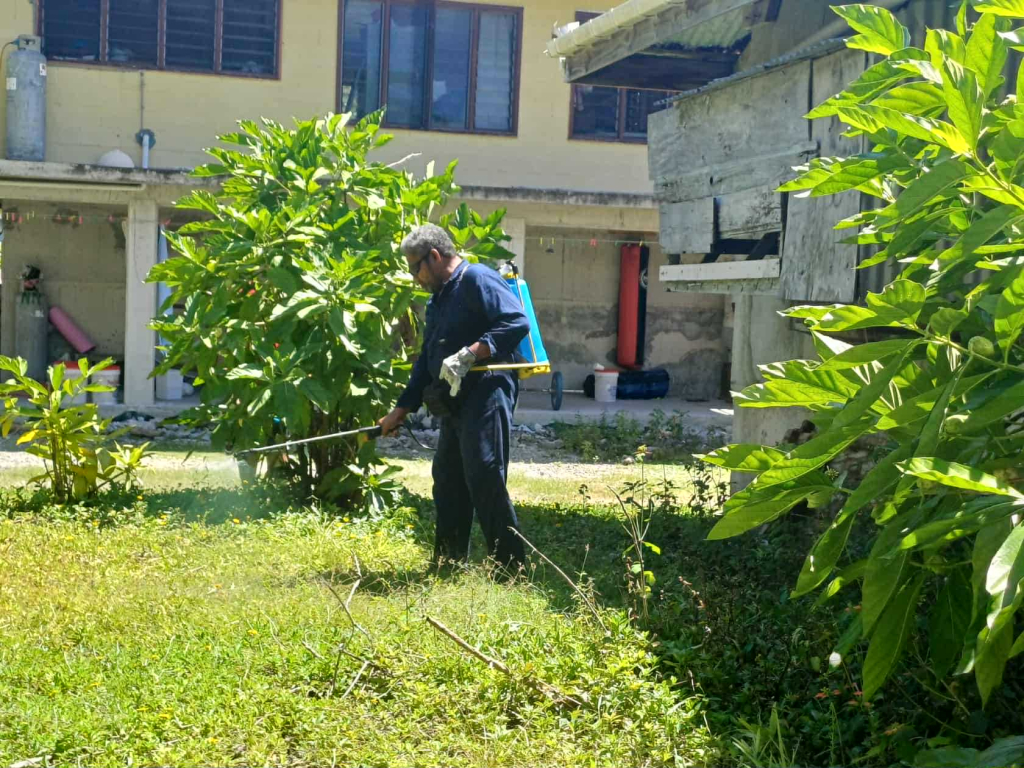
Through the WOW programme, PRISMSS provides technical expertise, training, and practical tools to help Pacific Island countries like Tokelau manage invasive weeds such as the Singapore daisy. The WOW programme focuses on building capacity of communities in safe and effective weed removal techniques, including manual clearing and responsible use of herbicides where appropriate.
PRISMSS has equipped Tokelau’s three atolls namely Nukunonu, Atafu, and Fakaofo, with motorised spraying units, effective herbicides, safety gear and training. These resources will assist in making eradication faster, safer, and more effective. The equipment was officially handed over to the Government of Tokelau in June 2025, marking a milestone in strengthening local capacity to combat invasive species.
Mr Iaheto Lui of the Nukunonu Taupulega-Tokelau Council of Elders shared that, “the Singapore daisy has caused us many problems as it is difficult to manage and spreads so fast. With the help from SPREP through PRISMSS and the WOW programme providing chemicals, tools, and equipment, we can finally see a way forward to get rid of this invasive weed.”
SPREP Invasive Species Adviser Mr David Moverley commented that, “this programme shows what can be achieved when communities, governments, and partners come together with the right tools and knowledge.”
“Singapore daisy has been a long-standing challenge in Tokelau, but with the renewed War on Weeds, Tokelau is now better equipped to restore its native biodiversity and strengthen resilience against future threats.”
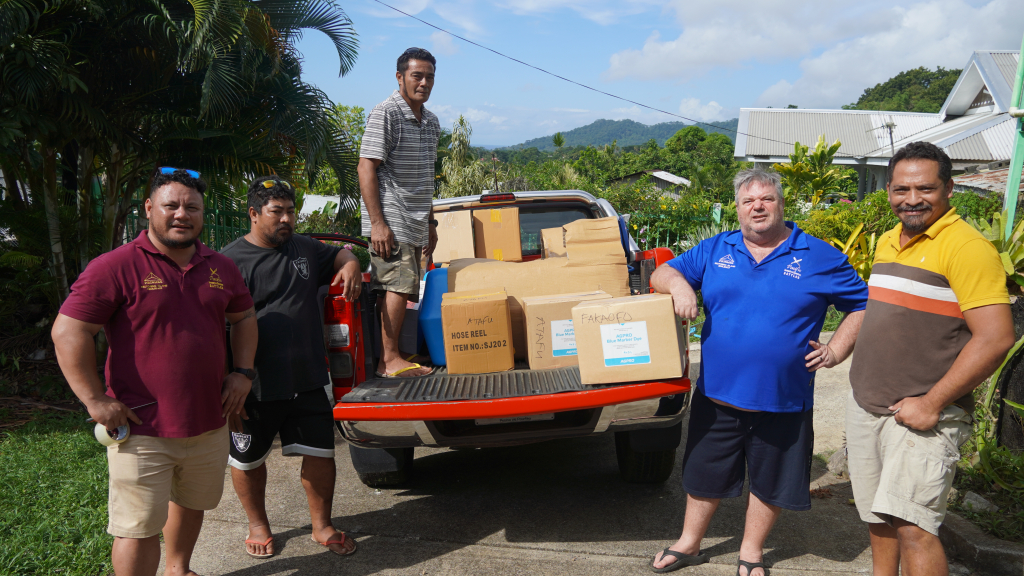
The WOW Programme goes beyond tools and chemicals. It equips communities to safely apply herbicides, manage equipment, and take ownership of invasive species management in their countries and territories. This community-driven approach strengthens local resilience to biodiversity threats and climate change.
Tokelau’s renewed War on Weeds builds on earlier efforts dating back to 2012 and the battle against Singapore daisy is about more than just one plant. It’s about protecting native biodiversity unique to small islands, safeguarding food security, traditional crops and preserving ecosystem resilience in the face of climate change.
If left unchecked, invasive weeds like the Singapore daisy will slowly impact on Tokelau’s biodiversity and weaken its natural resilience. With the determination of local communities, supported by the regional expertise of PRISMSS and its WOW programme, Tokelau is now better equipped not just to manage this threat, but to protect and restore its unique ecosystems.
--------------------------------------------------------------------------------------------------------------------------
About PRISMSS: The Pacific Regional Invasive Species Management Support Service (PRISMSS) is a coordinating mechanism designed to facilitate the scaling up of operational management of invasive species in the Pacific. PRISMSS, which is led by the Secretariat of the Pacific Regional Environment Programme (SPREP) brings together experts to provide support within the Pacific region with a focus on protection of indigenous biodiversity and ecosystem function. As a service provider, PRISMSS provides a comprehensive suite of support services in a cohesive, effective, efficient, and accessible manner to Pacific Island countries and territories.
Restoring Island Resilience (RIR): The PRISMSS - Restoring Island Resilience (RIR) is a New Zealand-PRISMSS collaboration project that aims to improve Pacific Island Countries and territories livelihoods and resilience to climate change by reducing the impact of invasive species on natural and agricultural ecosystems through the six PRISMSS programmes.
PRISMSS Powered by: New Zealand Foreign Affairs & Trade, UK International Development, GEF, United Nations Environment Programme & SPREP
PRISMSS Partners: Birdlife International, Earth Sciences New Zealand, New Zealand Department of Conservation, Island Conservation, Bioeconomy Science Institute-Manaaki Whenua Landcare Research, Pacific Community and SPREP
PRISMSS Programmes: Natural Enemies Natural Solutions (NENS), Predator Free Pacific (PFP), Protect Our Islands (POI), Protect Our Marine Areas (POMA), Resilient Ecosystems Resilient Communities (RERC), War On Weeds (WOWs)
For additional information please contact Mr Dominic Sadler, PRISMSS Manager on dominics@sprep.org or Mr Nitish Narayan, PRISMSS Communications & Liaison Officer on nitishn@sprep.org