

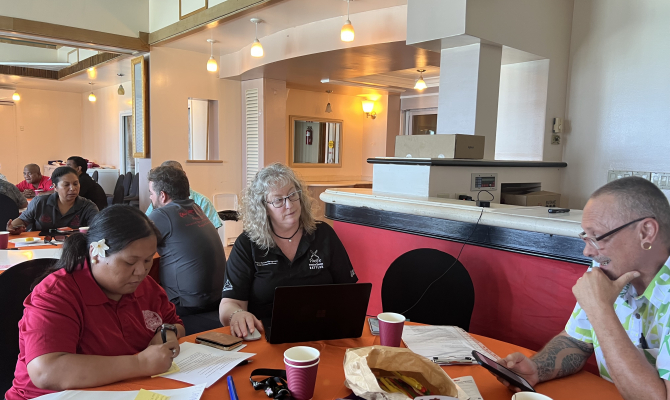
Hosted by the Republic of Marshall Islands (RMI) Ministry for Natural Resources the Global Environment Facility Regional Invasives Project (GEF6 RIP) Terminal Review and Knowledge Sharing Workshop was held at the Marshall Islands Resort in Majuro bringing together stakeholders and partners to celebrate the six-year GEF 6 RIP activities successes, reflect on the challenges and journey and discuss ways that initiatives can be sustained.
The event enabled people behind those successes to be honoured and set a bold course to sustain and scale up impact on invasive species management across the Pacific. Country participants highlighted achievements and discussed strategies to replicate, expand, and sustain GEF 6 RIP results, including integration into the Secretariat of the Pacific Regional Environment Programme (SPREP) Centre of Excellence, the Pacific Regional Invasive Species Management Support Service (PRISMSS) through its Restoring Island Resilience project for sustainability.
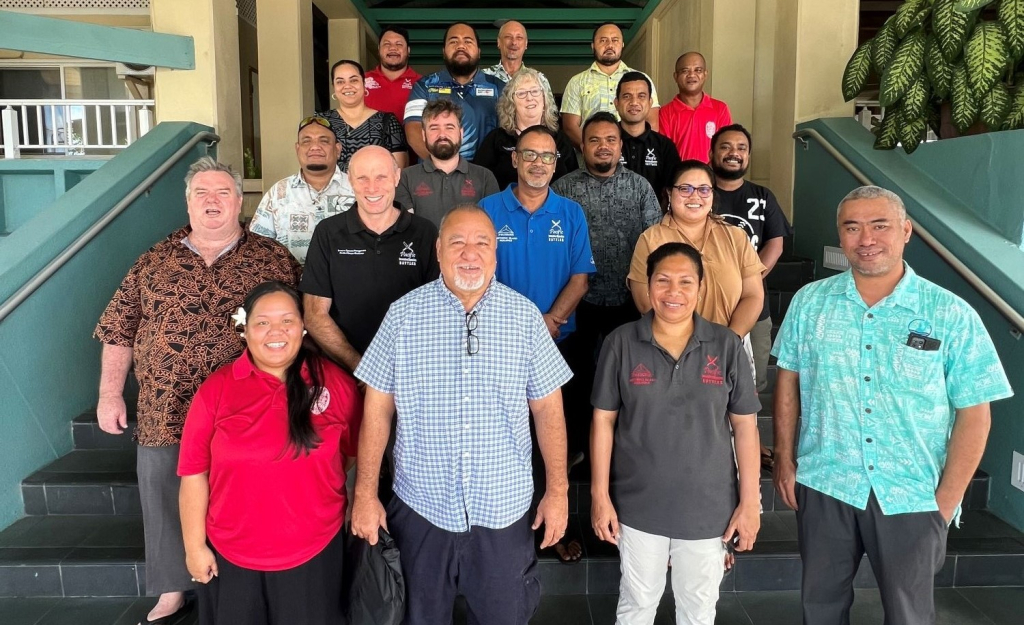
Hon. Anthony M Muller, RMI Minister of Natural Resources and Commerce, who attended the opening ceremony of the workshop shared that, “the Government of the Republic of the Marshall Islands values the strong partnership and support provided through the PRISMSS.”
“Through these collaborations, we are making meaningful progress in addressing priority invasive species such as rodents and myna birds, which threaten our unique biodiversity, food security and island livelihoods."
Funded by the GEF, implemented by the United Nations Environment Programme (UNEP), and executed by SPREP, this initiative has strengthened invasive species management, one of the leading causes of biodiversity loss and a key component of the global environmental crisis, in participating Pacific islands.
GEF6 RIP worked primarily in the Marshall Islands, Niue, Tonga and Tuvalu and supported a regional component delivered via PRISMSS which is supported by partners and funders including New Zealand Foreign Affairs and Trade, UK International Development, GEF, UNEP and SPREP.
SPREP Project Manager for GEF 6 RIP, Ms Isabell Rasch-Mulitalo reflected that, “over the past six years GEF6 RIP has shown what the Pacific can achieve when science, communities and partners come together.”
“We have removed invasive species from islands, strengthened national systems, trained local battlers, and proven that nature-based restoration delivers real benefits for biodiversity, food security and climate resilience.”
“The work isn’t finished as sustaining and scaling these gains through PRISMSS, continued funding and local leadership is essential if we are to protect our native species, rebuild ecosystems and secure our island and communities livelihoods.”
“We now move from demonstration to delivery by expanding what works, embedding capacity at national level, and ensuring long-term stewardship so the Pacific’s unique ecosystems can thrive.”
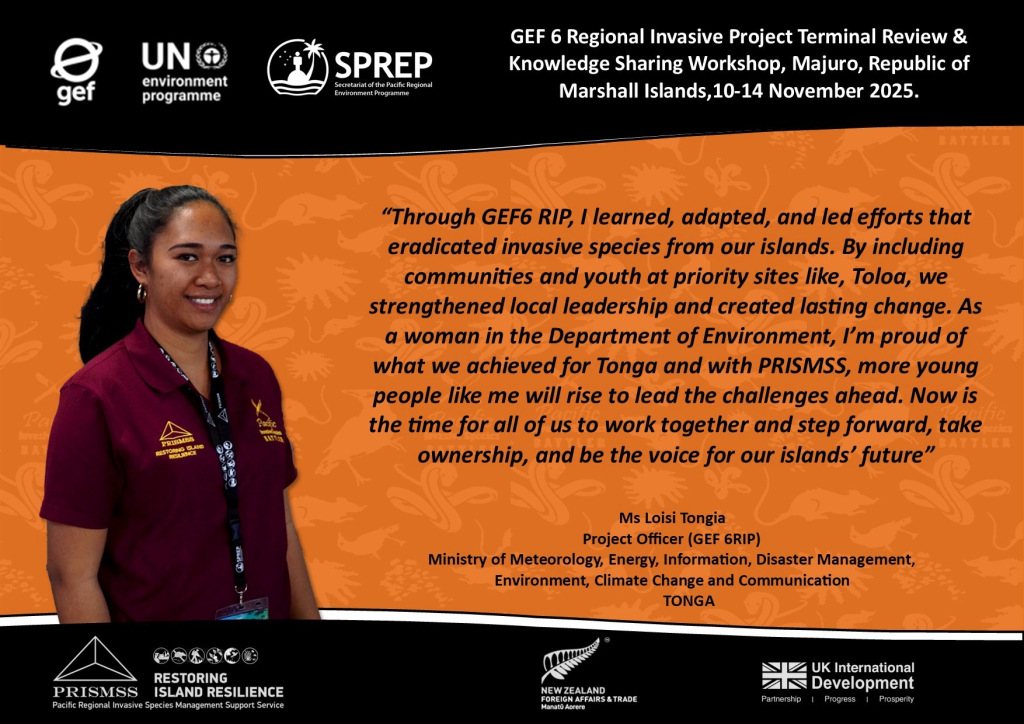
Ms Loisi Tongia, Project Officer (GEF 6RIP) based at the Tonga Ministry of Meteorology, Energy, Information, Disaster Management, Environment, Climate Change and Communication reflected, “through GEF6 RIP, I learned, adapted, and led efforts that eradicated invasive species from our islands.
“By including communities and youth at priority sites like, Toloa, we strengthened local leadership and created lasting change. As a woman in the Department of Environment, I’m proud of what we achieved for Tonga and with PRISMSS, more young people like me will rise to lead the challenges ahead.”
“Now is the time for all of us to work together and step forward, take ownership, and be the voice for our islands’ future.”
Mr Sam Panapa, National Invasive Species Coordinator Tuvalu Department of Environment shared, “the GEF6 RIP helped Tuvalu significantly strengthened its invasive species management and biodiversity protection.”
“A Technical Advisory Group now coordinates national efforts across government, NGOs, and communities, while the completed National Invasive Species Strategy and Action Plan (NISSAP) provides a clear guide for prevention, control, and management.”
“An Early Detection and Rapid Response system improves preparedness, and targeted actions for rat eradication from six islets, containment of yellow crazy ants on one islet, and control of ivy gourd have allowed native birds, plants, and ecosystems to recover."
“Extensive training and awareness programmes have helped us build national and community capacity and improved our biosecurity and monitoring.”
Ms Karen Stone, Director of the Vava'u Environmental Protection Association (VEPA) commented that, “the GEF 6 RIP initiative has been instrumental in strengthening VEPA’s capacity and community engagement efforts.”
“Through targeted support and training our team members and community ambassadors deepened their understanding of invasive species management and worked collaboratively to develop a localised identification tool to track native and non-indigenous species.”
“These achievements mark a significant step forward in empowering local actors to lead biodiversity protection efforts, as we remain committed to sustaining and expanding these initiatives, the continued support from PRISMSS will be vital to further build local capacity, foster research and ensure long-term resilience against invasive species.”
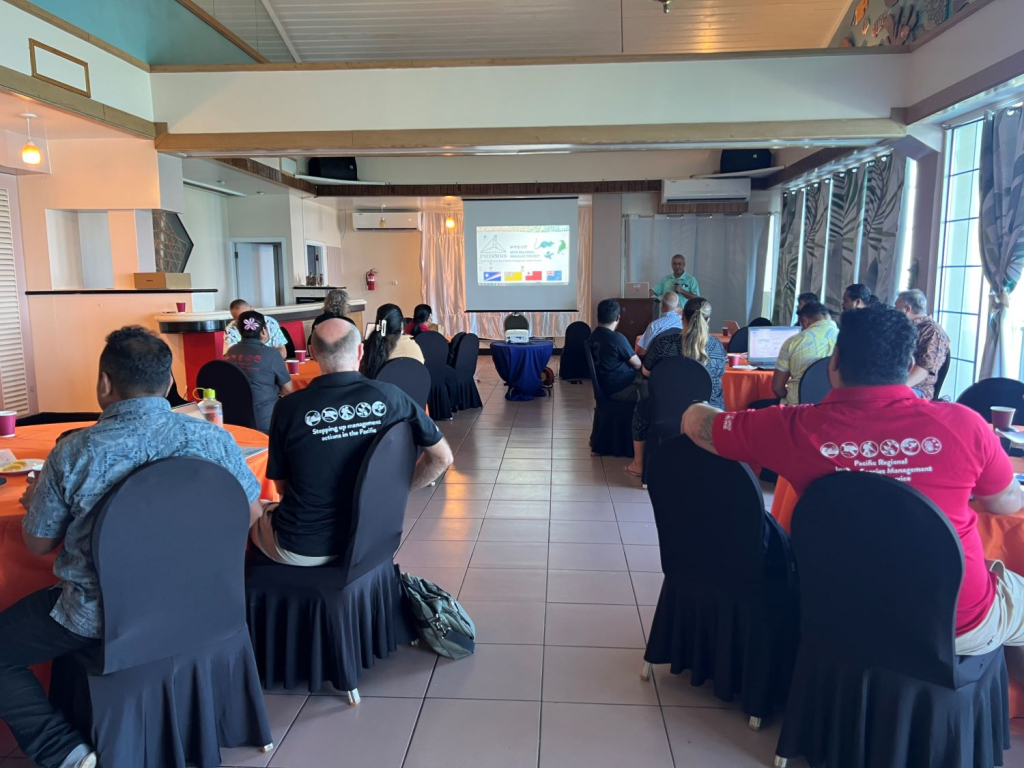
Delegates attending the meeting affirmed momentum for new funding avenues and projects including the GEF-8, Adaptation Fund and the Green Climate Fund, which are expected to further embed PRISMSS programmes and sustain regional cooperation. With new projects under development and consideration, PRISMSS is positioned to continue expanding its impact, ensuring that Pacific ecosystems and communities are better protected against invasive species threats.
SPREP Invasive Species Adviser, Mr David Moverley commented, “GEF6 RIP was a concerted effort to build an invasive species management support service for the region which was directed by SPREP Members in 2014.”
“The PRISMSS has become successful very quickly and has almost completed approximately USD 40 of management activities across the region with support from other donors, our PRISMSS partners and our SPREP Members. The project has contributed substantially national priorities and has delivered tangible, measurable wins across the Pacific from island-scale eradications to strengthened biosecurity systems and community-led restoration.”
“These achievements demonstrate that targeted investment, technical partnerships and local stewardship can enhance sustainable management of invasive species and restore vital ecosystem functions.”
“The challenge now is to sustain and scale that momentum by maintaining funding streams, embedding capacity within national institutions, and keeping communities at the centre of action. Only by continuing this collective effort can we safeguard biodiversity, bolster food security and build climate resilience for our Pacific island nations.”
With genuine partnerships and coordination PRISMSS will continue to enable Pacific countries to move beyond isolated projects to meaningful and sustainable region-wide initiatives, strengthening ecosystems and community resilience.
The GEF 6 Regional Invasives Project (RIP) is funded by the Global Environment Facility, implemented by the United Nations Environment Programme, and executed by the Secretariat of the Pacific Regional Environment Programme. The Project works primarily in the Marshall Islands, Niue, Tonga, and Tuvalu and has a regional component. Implementation of the GEF 6 RIP is supported by the Pacific Regional Invasive Species Management Support Services (PRISMSS). For more information on the GEF 6 Regional Invasives Species Project (GEF 6 RIP), please contact the Project Manager Ms Isabell Rasch-Mulitalo, at isabellr@sprep.org
About PRISMSS: The Pacific Regional Invasive Species Management Support Service (PRISMSS) is a coordinating mechanism designed to facilitate the scaling up of operational management of invasive species in the Pacific. PRISMSS, which is led by the Secretariat of the Pacific Regional Environment Programme (SPREP) brings together experts to provide support within the Pacific region with a focus on protection of indigenous biodiversity and ecosystem function. As a service provider, PRISMSS provides a comprehensive suite of support services in a cohesive, effective, efficient, and accessible manner to Pacific Island countries and territories.
Restoring Island Resilience (RIR): The PRISMSS - Restoring Island Resilience (RIR) is a New Zealand-PRISMSS collaboration project that aims to improve Pacific Island Countries and territories livelihoods and resilience to climate change by reducing the impact of invasive species on natural and agricultural ecosystems through the six PRISMSS programmes.
PRISMSS Powered by: New Zealand Foreign Affairs & Trade, UK International Development, GEF, United Nations Environment Programme and SPREP
PRISMSS Partners: Bioeconomy Science Institute, Birdlife International, Earth Sciences New Zealand, New Zealand Department of Conservation, Island Conservation, Pacific Community and SPREP.
PRISMSS Programmes: Natural Enemies Natural Solutions (NENS), Predator Free Pacific (PFP), Protect Our Islands (POI), Protect Our Marine Areas (POMA), Resilient Ecosystems Resilient Communities (RERC), War On Weeds (WOWs) For additional information please contact Mr Dominic Sadler, PRISMSS Manager on dominics@sprep.org or Mr Nitish Narayan, PRISMSS Communications & Liaison Officer on nitishn@sprep.org