

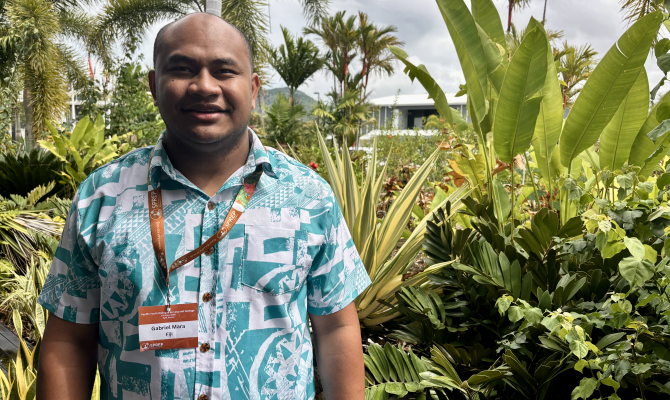
By Inoke Rabonu, Fiji Sun
The Pacific is struggling to keep pace with the accelerating impacts of climate change, and youth leaders say they must be equipped to step into critical roles before it’s too late.
Gabriel Mara, 29, one of Fiji’s youngest climate policy experts and international negotiators, says the number of communities in need of support is growing too rapidly for governments and organisations to keep pace.
Mara is part of the Secretariat of the Pacific Regional Environment Programme’s (SPREP) Pacific Youth Dialogue on Loss and Damage currently held in Apia, Samoa.
He previously served as a Climate Change Officer – Adaptation with Fiji’s Ministry of Environment and Climate Change and is now a negotiator and coordinator within the UNFCCC and Group of 77 and China negotiation spaces.
“When I was in my previous role in Government, what I saw was that the need was quickly increasing over our ability to keep up,” Mara said.
“We don’t have the capacity, the resourcing, the money, the materials to really keep up with the level of modification, adaptation or even relocation.”
Ultimately, Mara believes that building and supporting the next generation of Pacific climate leaders was non-negotiable.
“Youths are the future. In fact, not even of the future but of the present,” he said.
“Everything that’s impacting us now, we will inherit it. That’s why it’s so important that youths are well informed, they know what they’re doing, technically sound, and they’re able to confidently assume not only these roles, but these spaces.”
While his work is now at a global scale, Mara said his motivations were deeply personal.
“Growing up, I was raised… by both my parents, but also my grandparents. And seeing them, how they rely so much on the sea, and being in the village, it makes me want to preserve that. Because… my identity is very much rooted to the land and to the ocean. And I do not want to see it go out,” he said.
“Everybody here are youths that are in government, and youths working in the CSO and NGO space… I’m here to hear the different perspectives from the diversity in the room,” he said.
BID FOR AN AUSTRALIA-PACIFIC COP
He added that a united, well-networked Pacific is key to amplifying its voice and influence, especially as the region looks to the proposed Pacific COP, to be co-hosted with Australia in 2026.
“It’s very critical. Apart from the fact that climate change is impacting us, of all the SIDS regions… the Pacific SIDS is the one that is affected the most,” Mara said.
“A Pacific COP is somewhere that I believe we can also lead. Even co-facilitate certain agenda items during negotiations, where the Pacific negotiators can step up and assume these roles of leadership within the climate regime.”
But he acknowledged major hurdles, especially around resourcing, capacity, and continuity in representation, that still hold the region back in global forums.
“You need a little time to perfect what you are doing,” he said. “Often when there’s a high turnover… there’s no continuity. Or if there is, very little continuity. And often that creates a gap.”
“Technically, we are sound. We just need to find our voice in this leadership approach within the multilateral system.”
The inaugural Pacific Youth Dialogue on Loss and Damage, guided by the theme “Navigating our Future” is held from 7- 8 August, Taumeasina Resort, Samoa. This precedes the Pacific Regional Loss and Damage Dialogue 2025 to be held from 11-12 August at the same venue in Samoa.
The inaugural Pacific Youth Dialogue on Loss and Damage and the Pacific Regional Loss and Damage Dialogue 2025 are made possible with funding support from the Loss and Damage Capability and Capacity (LDCC) Project with the Government of New Zealand.
Hosted by Secretariat of the Pacific Regional Environment Programme (SPREP), the dialogues bring together Pacific governments, youths, civil society, academia, NGOs, and the private sector to collectively advance the region’s priorities on Loss and damage.
This story was produced by the Pacific Media Team covering the meetings. Their attendance is made possible with funding support from the Loss and Damage Capability and Capacity (LDCC) Project with the Government of New Zealand.
For more information, please contact SPREP Climate Change Adaptation Adviser, Ms Filomena Nelson filomenan@sprep.org , SPREP Climate Change Loss and Damage Officer, Ms Jessica Rodham jessicar@sprep.org or Media and Public Relations Officer, Mr Keni Lesa sosikenil@sprep.org