

By Ednal Palmer, In-Depth Solomons
A collated climate science data has delivered a stark warning to the Pacific Islands: the window to keep global warming within the 1.5°C limit is closing fast - and irreversible consequences are looming.
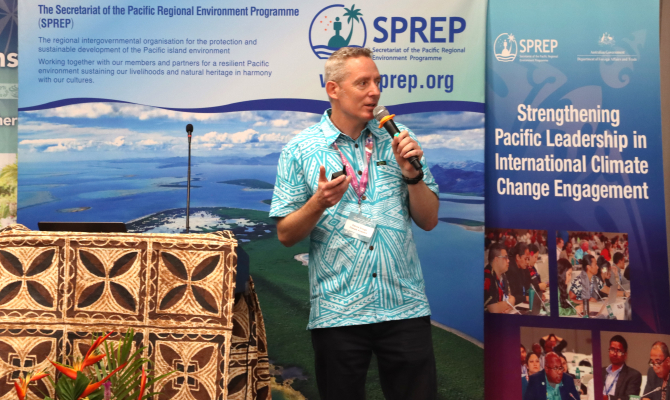
Speaking to regional delegates at a Pacific Climate Change Roundtable in Apia Samoa, on climate science, Paddy Pringle, Pacific Senior Adaptation Expert of Climate Analytics, did not mince words: “Things are not looking good.”
The data, rigorously reviewed and validated, underscores the urgent need for swift action to reduce emissions and bolster adaptation strategies—particularly for vulnerable Pacific nations already feeling the strain.
Sobering Trends in the Data
The science is clear:
Rapid warming: The Earth’s temperature has been rising at an average of 0.2°C per decade since the 1970s.
Imminent threshold breach: Without drastic cuts to greenhouse gas emissions, human-induced warming will likely reach 1.5°C by 2029–2030.
Ocean heat crisis: Warming sea surface temperatures are devastating coral reefs, disrupting marine ecosystems and coastal livelihoods.
Melting ice and rising seas: Antarctic ice melt is directly impacting the Pacific, with sea level rise accelerating—unevenly—across the globe.
Invisible danger: Lethal heat events, still underrepresented in climate policy discussions, are becoming an increasing threat to human health and survival.
Biodiversity at risk: Accelerating warming is driving habitat destruction and species loss, threatening ecosystems from coral reefs to forests.
Scientists warn that exceeding the 1.5°C guardrail could trigger dangerous tipping points—irreversible shifts in Earth’s climate systems with cascading, unpredictable effects.
Once crossed, these thresholds could lock the planet into a future of worsening extremes.
Adaptation Limits
Scientists describe hard limits (where no further adaptation is possible) and soft limits (where adaptation is technically possible but not currently feasible due to financial, technological, or governance constraints).
“Some changes we are seeing are beyond what we can adapt to,” Pringle noted, “and the impacts are getting worse.”
The Secretariat of the Pacific Regional Environment Programme (SPREP) is now intensifying efforts to document climate science within the Pacific context, working closely with partners to ensure science-based policies inform urgent decision-making.
Pacific Nations Leading Adaptation Efforts
Despite their vulnerability, Pacific island nations are taking ambitious steps.
Marshall Islands has developed a National Adaptation Plan that sets out key climate strategies, targets, decision pathways, and timelines to safeguard, population, communities and ecosystems.
Nauru, in 2020, launched its Higher Ground Initiative, a climate-resilient housing, land planning, and environmental rehabilitation program, guided by a thorough climate vulnerability assessment.
These initiatives serve as vital models for other regions, proving that adaptation—while challenging—is possible with coordinated planning and strong community involvement.
The Clock Is Ticking
The message from the scientific community is clear: halting warming at the lowest possible peak this century is critical—not just for coral reefs and polar ice, but for the survival of countless communities and ecosystems.
Every fraction of a degree matters, and every year of delay increases the risk of crossing irreversible thresholds.
The Pacific is on the frontlines of climate change. Its people are already adapting, innovating, and pushing for stronger global commitments. But without rapid, deep cuts to emissions worldwide, adaptation alone will not be enough.
Delegates agree that the Pacific is heading into uncharted territory. The time for incremental change has passed. This is the moment for urgent, transformative action.
The Pacific Climate Change Roundtable (PCCR), guided by the theme “1.5 to stay alive and thrive,” is taking place at Taumeasina Island Resort from 13-15 August. The PCCR is attended by Pacific governments, youths, civil society, academia, NGOs, and the private sector to engage collectively through the use of interactive activities to share their experiences amongst peers, bolster their networks and utilise the event to initiate new partnership opportunities.
The PCCR follows the Pacific Regional Loss and Damage Dialogue 2025 and the inaugural Pacific Youth Dialogue on Loss and Damage, at the same venue in Samoa.
This story was produced by the Pacific Media Team covering the meetings. Their attendance is made possible with funding support from the Loss and Damage Capability and Capacity (LDCC) Project with the Government of New Zealand.