

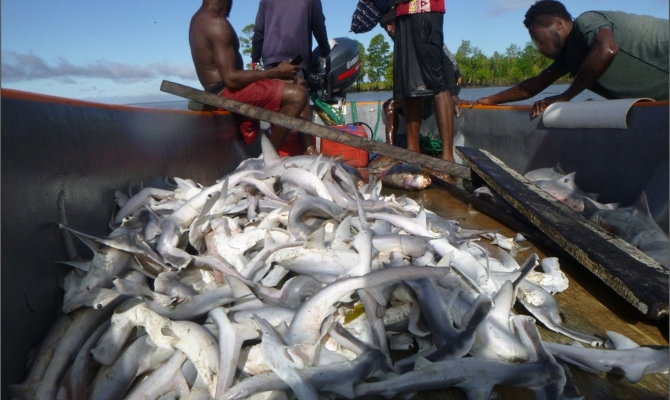
21 October 2025, Port Moresby - The Secretariat of the Pacific Regional Environment Programme (SPREP) continues to support activities in the Pacific to tackle issues around by-catch and other threats to threatened marine species.
In Papua New Guinea (PNG) last week, SPREP facilitated a multistakeholder workshop bringing together for the first time officials from the National Fisheries Agency (NFA), Conservation Environment and Protection Agency (CEPA), Gulf Province and Kikori District to discuss the environmental consequences of the fishmaw fishery.
Community representatives were also flown in from Kikori and Kerema villages to attend the workshop.
Previous funding by the European Union through the Pacific European Union Marine Programme (PEUMP) 2019-2025 to SPREP supported research on by-catch in Kikori to understand the extent of the by-catch issue in the highly lucrative fishmaw fishery. Working with Kikori communities, researchers were able to build a picture of the impact to the dolphins and sharks and other species found in Kikori.
The research found the situation quite dire with the risk to dolphins considered by the International Whaling Commission, also presenting at the meeting to require an emergency response.
In addition, the fishery itself is being overfished and is on the verge of collapse.
“It is clear that without substantial intervention, PNG stands to lose these dolphins altogether as this is their stronghold and the only place in the Pacific where they occur,” said Mr Amena Yauvoli, SPREP Director of Biodiversity Conservation and Fiji Office.
“They do occur in Australia in the northern territory and Australia is supporting this work through a funding agreement with SPREP. For the sharks, many species are listed as critically endangered and are on the CITES appendix I, prohibiting trade in their meat and products.”
.jpg)
The workshop held at the Crown Hotel in Port Moresby allowed the researchers to share knowledge so that a collective understanding of the impacts of the fishmaw fishery on threatened species of dolphins, sharks and rays, could be developed.
The community also presented their concerns, based on pre-workshops, facilitated by Piku Biodiversity Network held in Kikori. SPREP had engaged a facilitator, Mr Frank Weisenberger to run a workshop that allowed the participants to discuss in detail their goals for the fishery and to secure their communities’ future and steps needed to manage the threats.
“Clearly the community are concerned, they don’t want to kill dolphins or rare sharks such as sawfish,” said SPREP’s Threatened and Migratory Species Adviser, Ms Karen Baird.
“The issues are very complex with the community relying on funds from fishmaw to support their families and to deal with issues such as the impacts of climate. One participant has already had to move his village as a result of climate change.”
The biggest issue is overfishing, which contributes to both a crashing fishery and high bycatch.
“There is currently no national fishmaw management plan, and our biggest achievement was agreement around many of the components of a management plan which the community itself will now work to develop in consultation with the wider community. This management plan will eventually be passed into local government law and a national fish maw plan will also be developed through the National Fisheries Authority.”
The community expressed their appreciation for the opportunity for the first time to be involved in a multi-stakeholder workshop and to hear their concerns and work together to come up with potential solutions.