

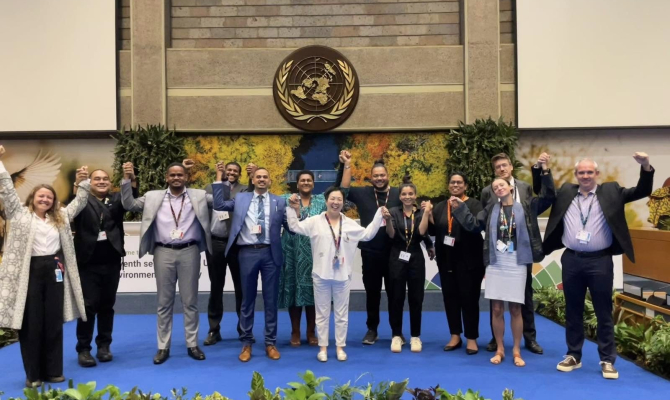
12 December 2025, Nairobi - Pacific delegations at the seventh session of the UN Environment Assembly (UNEA-7) are celebrating a breakthrough in Nairobi with Fiji securing an agreement on their resolution, “Accelerating Global Action to Promote the Climate Resilience of Coral Reefs.”
The breakthrough was achieved on Wednesday night at the ongoing UNEA-7 negotiations, the first of 15 resolutions under negotiation at the meeting.
The milestone signals global recognition of Fiji’s leadership on Ocean and climate action. The “Accelerating Global Action to Promote the Climate Resilience of Coral Reefs” resolution calls for enhanced international cooperation and financing to protect coral reef ecosystems from mounting threats like climate change, pollution, and overexploitation.
Fiji’s technical team, led by the Permanent Secretary for Environment and Climate Change, Dr Sivendra Michael, and the Director of Environment, Ms Senimili Baleicakau, navigated complex scientific, environmental and geopolitical issues to bring all countries on board.
“Fiji extends its sincere appreciation to all countries and partners for their constructive engagement, flexibility, and support,” a statement issued by the Fiji delegation said.
“This early success underscores Fiji’s leadership in multilateral environmental diplomacy and reaffirms our commitment to protecting the world’s coral reefs and the communities that depend on them.”
The week before, during the opening plenary of the Seventh Open-Ended Committee of Permanent Representatives, Fiji made the case for the resolution to the global community, echoing the call by all Pacific countries for urgent action on Ocean health and the protection of our Blue Pacific Continent.
“We face a stark reality: scientific projections warn that by 2030, we could lose over 90% of the world's coral reefs if current trends continue,” Fiji’s statement said.
“This alarm must drive us to move beyond rhetoric to tangible implementation that centers on the well-being of our people and the integrity of our ecosystems, aligning with the theme of UNEA-7: 'Advancing sustainable solutions for a resilient planet.'”
Fiji urged the multilateral process to confront the evidence that the triple planetary crisis—characterised by a global warming rate of approximately 0.2°C per decade and over eight million tons of plastic waste entering our Ocean annually— continues to accelerate, often outpacing the global response.
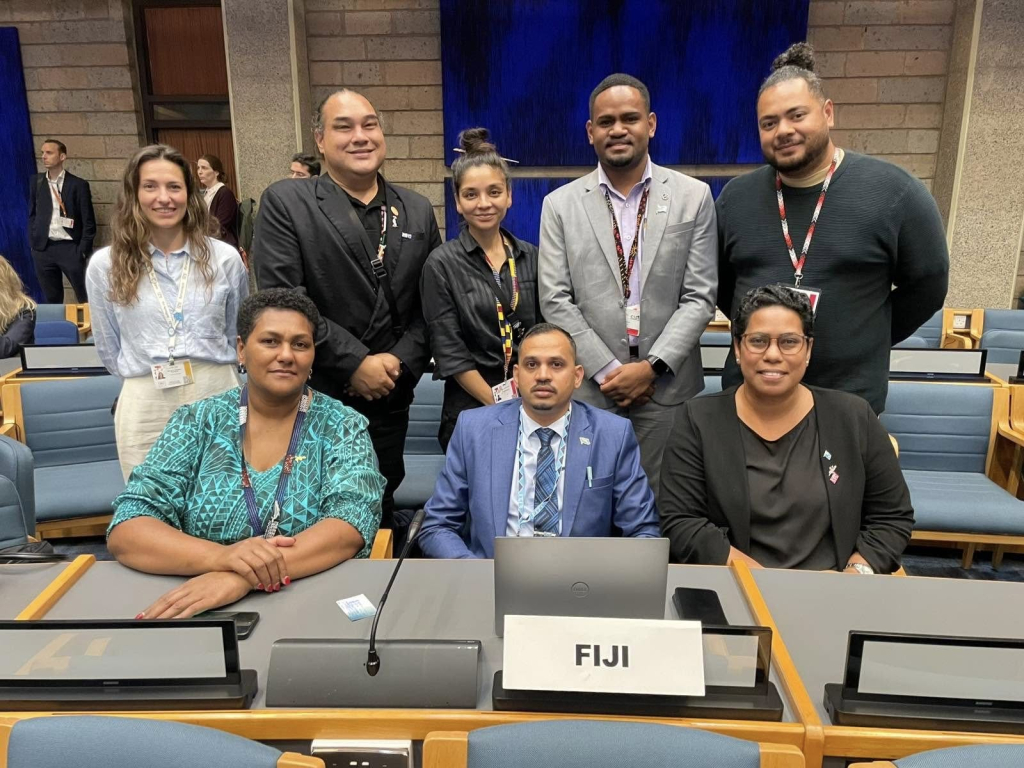
“It is our firm belief that effective multilateralism, grounded in the best available science and inclusive of all stakeholders—including Indigenous Peoples and local communities—remains our most powerful tool,” Fiji urged.
It is in this spirit of constructive cooperation and urgent necessity that Fiji, alongside our co-sponsors Palau, Kenya, Barbados, Colombia, and Australia, and with the backing of the Pacific Small Island Developing States, has tabled the draft resolution titled: "Accelerating global action to promote the climate resilience of coral reefs."
“This coalition promises significant economic and social dividends. By enhancing coral reef resilience, we strengthen the local economies that depend on them, boosting tourism, sustaining fisheries, and securing food sources, thereby inspiring additional support and participation in our joint efforts.”
Fiji and Pacific delegations are amongst 6,000 participants from more than 180 countries, gathering at UNEA-7 to discuss sustainable solutions at a time when the world continues to struggle with the worsening impacts of the triple planetary crisis of climate change, pollution, and biodiversity loss.
UNEA meets biennially to set priorities for global environmental policies and develop international environmental law. The Assembly provides leadership, catalyses intergovernmental action on the environment, and contributes to the implementation of the UN 2030 Agenda for Sustainable Development.
UNEA-7 is negotiating 15 draft resolutions on issues ranging from saving the world’s glaciers to reining in massive seaweed blooms and reducing the environmental impact of artificial intelligence.
While not legally binding, UNEA-7 resolutions help countries find common ground and have in the past laid the groundwork for precedent-setting international agreements.
The Secretariat of the Pacific Regional Environment Programme (SPREP) is providing support to amplify Pacific voices at UNEA-7.