

By Puaseiese A Pedro, Office of Prime Minister Tuvalu
“This is not just a presentation, it’s a survival plan for our nation.”
So declared Bear Solomon, Climate Change Coordinator of the Republic of the Marshall Islands RMI, when he delivered an impassioned challenge to the international community, highlighting the urgent need for adaptable solutions to combat climate change.
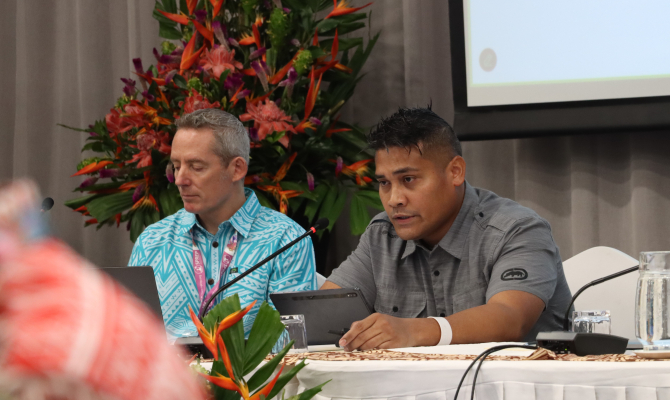
Speaking during Day 2 of the Pacific Climate Change Roundtable (PCCR) in Samoa, Solomon outlined the pivotal role of stakeholder engagement in "transformational adaptation."
RMI has embarked on a mission to enhance its adaptation pathways, engaging with over 362 community members from diverse backgrounds, youth, fishermen, traditional leaders, and women, to craft a National Adaptation Plan (NAP) that reflects the voice of the people.
“We wanted to collect community observations on climate change and their desires to remain in their homelands rather than migrate,” Solomon noted, reinforcing the commitment to preserving the cultural identity of the Marshallese people.
Through these consultations, several adaptation priorities emerged, culminating in an ambitious framework that prioritises the implementation of nature-based solutions alongside robust institutional frameworks.
“Our adaptation plan focuses on strengthening existing policies and institutions to make them climate-resilient,” Solomon explained, underscoring the holistic approach RMI is taking.
RMI’s adaptation pathway is carefully structured into three developmental phases, addressing immediate challenges while laying the groundwork for long-term solutions aimed at protecting its islands and preserving its heritage.
“In the short to medium term, we are taking tangible steps to elevate and reclaim land to secure our communities' futures,” he said, as he shared the vision for infrastructure that will withstand the increasing threats posed by climate change.
While acknowledging the potential for internal migration due to rising sea levels, predicted to impact communities significantly, Solomon insisted that this should only be seen as a last resort. “We do not take migration lightly, it is a last resort in our adaptation strategy,” he said, illustrating the delicate balancing act between adaptation and cultural preservation that RMI must navigate.
The commitment to community engagement is central to RMI’s strategy. Solomon noted.
“This experience highlights a valuable lesson, deeper collaboration between civil society and government can help break down silos,” a sentiment that reflects a broader strategy of inclusivity and unity in tackling climate challenges. The adaptability of the NAP ensures that it can evolve alongside the pressing realities of climate change, with plans to update the document every ten years to reflect changing conditions and technologies.
Facing limited funding and capacity, Solomon acknowledged that while challenges persist, opportunities also abound. The RMI is at the forefront of implementing innovative, community-led approaches that empower local populations to manage their resources and environment sustainably. “Transformational adaptation is a way forward for low-lying nations like the Marshall Islands,” he declared, reiterating their resolve to remain resilient amidst climate adversity.
Solomon invited ongoing collaboration and knowledge-sharing among nations, emphasizing the importance of platforms like the PCCR to foster meaningful dialogue.
“Together, we can share experiences, exchange ideas, and strengthen our partnerships in facing these challenges,” he encouraged, underscoring the urgency of a collective response to the climate crisis.
The Pacific Climate Change Roundtable (PCCR), guided by the theme “1.5 to stay alive and thrive,” is taking place at Taumeasina Island Resort from 13-15 August. The PCCR is attended by Pacific governments, youths, civil society, academia, NGOs, and the private sector to engage collectively through the use of interactive activities to share their experiences amongst peers, bolster their networks and utilise the event to initiate new partnership opportunities.
The PCCR follows the Pacific Regional Loss and Damage Dialogue 2025 and the inaugural Pacific Youth Dialogue on Loss and Damage, at the same venue in Samoa.
This story was produced by the Pacific Media Team covering the meetings. Their attendance is made possible with funding support from the Loss and Damage Capability and Capacity (LDCC) Project with the Government of New Zealand.