

14 November 2025, Belem - The need for adaptation solutions and actions required to respond to current and future climate change impacts is a key priority for Pacific countries at COP30 currently underway in Belem Brazil.
Adaptation is on top of the agenda at the ongoing climate negotiations. A key expectation in Belem is for parties to reach agreement on indicators for measuring progress towards the Global Goal on Adaptation (GGA) that was established in the Paris Agreement.
This would be the culmination of a process meant to narrow down a set of 100 indicators that match the 11 targets of the 2023 GGA Framework.
In particular, the indicators relating to means of implementation (MoI) remain a subject of much debate, leading the relevant experts to outline options for political decisions makers to sort out.
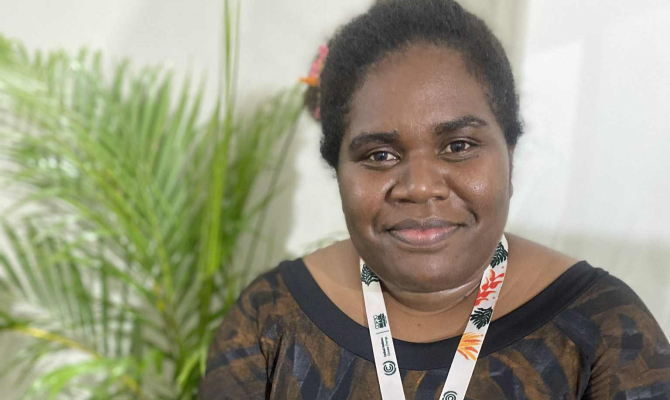
Against this backdrop, the work for the Pacific Small Island Developing States (PSIDS) lead on Adaptation, Ms Melissa Horokou, of the Solomon Islands, and her team of negotiators from the Pacific, with support from the Secretariat of the Pacific Regional Environment Programme (SPREP) and One CROP, has been cut out.
As we approach the end of the first week of COP30, Ms Horokou gives us an update on Adaptation:
QUESTION: What are the key messages and key asks from the Pacific when it comes to Adaptation at COP30?
ANSWER: On the GGA, there is a high level of expectation that we take forward a robust set of GGA indicators at this COP. For the Pacific, we acknowledge that these set of proposed 100 indicators need further work and that is something that we want to see happen. Reporting on these indicators are already voluntary and in the instance where we choose to report, it shouldn’t be a reporting burden for PSIDS knowing we already have other multiple commitments to report on and this will only be an additional burden.
Aside from that, PSIDS are looking forward to engage fully in the discussions on the indicators at this COP. This is important because while we are in a position to track adaptation at the national level, when it comes to the global level we don’t have a systematic way of doing that. So the indicators will provide a basis for us to track adaptation at a global level in a systematic manner and also to analyze where the gaps are when it comes to adaptation.
On NAPs, we have countries from PSIDS whom are in the process of formulating their NAPS and others whom have submitted their NAPs. We are now moving into the implementation of NAPs and we want to ensure that parties and PSIDS have the Means of Implementation (MOIs) in place to enable them to fully implement and report on each respective NAPs.
QUESTION: Why is your work on adaptation critical for our Pacific communities, in this COP space?
ANSWER: Given that the COP process is based on consensus, even if we’re not here, there will still be an outcome. It’s important we take our seat at the table, we are represented and we have a voice because we don’t want an outcome that will put us in a situation where we don’t have control over decisions people make that directly impact our communities, who are already struggling with the impacts of climate change. As we reflect on where we come from in the islands, adaptation is key and if our voice is not here, then the decisions made here are not reflective of our needs and priorities.
QUESTION: How are things going at COP30? Progress or lack of progress?
ANSWER: On the GGA, there is a divergence of views on whether to adopt or not to adopt the indicators. Others say they don’t want to adopt while some say they want to adopt. There is also a general understanding that further technical work is needed on the indicators and we acknowledge the need for safeguards.
In terms of the NAPs and MOIs, I think progress in the past few years in terms of securing MOIs for the implementation of NAPs has been slow. This time around, there seems to be general understanding and discussions under NAPS is progressing.
QUESTION: How do you see the next few days playing out? And what will it take to get a good outcome for the Pacific?
ANSWER: Things are going to get heated, it’s going to be busier especially when you have all these parties and trying to get them come to a common ground. We’ve been having informal consultations, but as a way to find the middle ground we will go into informal informal and we hope to see positive results from these process.
The pressure is high and for us Pacific negotiators we have to reflect our priorities and ensure they’re in there. The COP30 presidency have their set of priorities and we as PSIDS also have ours. We’re committed and we are resolute to come out of this COP with the best outcome possible.
The 30th Conference of the Parties to the UN Framework Convention on Climate Change (UNFCCC) is taking place from 10-21 November 2025 in Belem, Brazil.
It is being attended by Pacific leaders and their delegations, who are advocating for the survival of Pacific communities who continue to be at the forefront of climate change impacts.
Support for our Pacific Islands at COP30 from members of the Council of Regional Organisations of the Pacific (CROP) is through the One CROP mechanism led by the Secretariat of the Pacific Regional Environment Programme.
Members of one CROP include: The Secretariat of the Pacific Regional Environment Programme (SPREP) – Lead, Pacific Islands Development Program, Pacific Islands Forum Fisheries Agency, Pacific Island Forum Secretariat, Pacific Community.
A key part of amplifying the One Pacific Voice at COP30 is the Moana Blue Pacific Pavilion and the Pacific Delegation Office. The Moana Blue Pacific Pavilion at COP30 is a Pacific partnership with the Governments of Australia and New Zealand managed by the Secretariat of the Pacific Regional Environment Programme (SPREP).
The Pacific Delegation Office at COP30 is a Pacific partnership with the New Zealand Government managed by the Secretariat of the Pacific Regional Environment Programme (SPREP).
To learn more about the Pacific at COP30 please visit: https://www.sprep.org/cop30