

By Inoke Rabonu, Fiji Sun
Pacific nations must urgently embrace the conversation on a just transition to renewable energy if we want a fair and just climate future, says George Carter, Senior Fellow at The Australian National University.
Dr Carter is also the Deputy Head of the Department of Pacific Affairs at the University.
“The elephant in the room is the fact that a great percentage of our energy is still from fossil fuels,” Dr Carter said in an interview on the sidelines of the Pacific Climate Change Roundtable in Apia, Samoa.
“When we say renewable energy, people are afraid… we don’t want a windmill here, we don’t want a solar panel here. But that’s what the just transition is about. We need to socialise those ideas.”
Carter, who is from Samoa with Kiribati and Tuvalu heritage, works with Pacific negotiators to translate technical science, policy and traditional knowledge into strategies for global climate advocacy.
He said the Pacific has led the world for 40 years in “bringing forth environmental integrity values and norms” and elevating “the voiceless views of those who are on the margins.”
But he warned the region’s focus on adaptation has left a blind spot.
“We haven’t really taken on board that conversation about mitigation, about just transition,” he said.
“That’s because less than one percent of greenhouse gas emissions come from the Pacific. But mitigation allows us to talk about our energy consumption, our energy mix.”
He called for “mitigation literacy” so Pacific communities can discuss renewable energy without fear, pointing to the need for infrastructure such as electric vehicle charging stations and grid systems that allow households to feed solar power back into the main supply.
“Our governments are not going into renewable energy because people are not demanding it,” he said.
On cost, Carter said renewable energy prices are dropping so quickly that “price is no longer an excuse.”
He noted that in Australia, electric vehicles are now cheaper than some diesel models.
“Every year this technology becomes cheaper and cheaper. It’s like the internet — the more people have access, the more the price drops.”
Carter will take this message to next month’s Pacific Islands Forum leaders’ meeting, alongside calls for ambitious net-zero targets from all member states, stronger ocean-climate mechanisms, and continued focus on loss and damage and climate security.
“The Pacific will always advocate for net zero because it’s possible,” he said.
“We also need to push for areas we haven’t advanced yet — like climate security and traditional knowledge — to be part of the global conversation.”
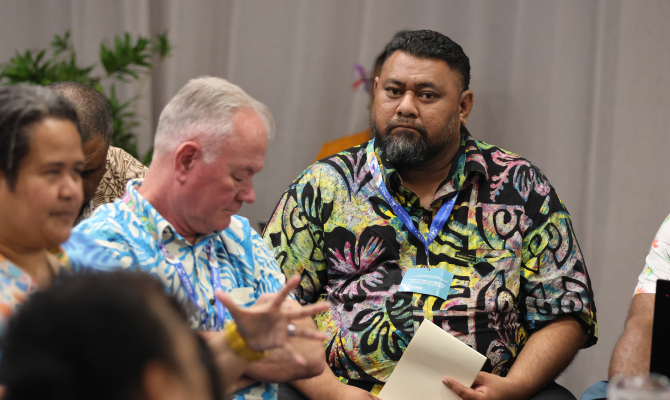
The Pacific Climate Change Roundtable (PCCR), guided by the theme “1.5 to stay alive and thrive,” is taking place at Taumeasina Island Resort from 13-15 August. The PCCR is attended by Pacific governments, youths, civil society, academia, NGOs, and the private sector to engage collectively through the use of interactive activities to share their experiences amongst peers, bolster their networks and utilise the event to initiate new partnership opportunities.
The PCCR follows the Pacific Regional Loss and Damage Dialogue 2025 and the inaugural Pacific Youth Dialogue on Loss and Damage, at the same venue in Samoa.
This story was produced by the Pacific Media Team covering the meetings. Their attendance is made possible with funding support from the Loss and Damage Capability and Capacity (LDCC) Project with the Government of New Zealand.