

3 September 2025, Apia, Samoa – The importance of traditional knowledge in informing policies and solutions to climate change was highlighted during a side event on the second day of the 32nd Secretariat of the Pacific Regional Environment Programme’s (SPREP) Meeting of Officials being held in Apia, Samoa.
Hosted by the Climate and Oceans Support Program in the Pacific Phase 3 (COSPPac3) project and the Promoting Pacific Islands Nature-based Solutions (PPIN) project, the side event brought together officials from around the region who are attending the SPREP Meeting, as well as partners and staff, to explore and discuss activities currently happening in countries that promote and recognise traditional knowledge as a guide for modern resilience.
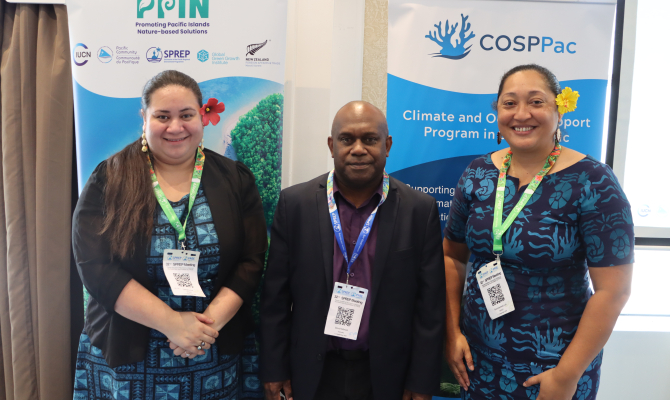
The panelists included the Director General for the Ministry of Climate Change of Vanuatu, Mr. David Gibson, PPIN Project Coordinator, Ms. Utulei Lui, and COSPPac 3 Traditional Knowledge Adviser, Ms. Siosinamele Lui.
According to Ms. Siosinamele Lui, while both projects work in different spaces – COSPPac in the Pacific Meteorology space and PPIN in Biodiversity Conservation, the two can learn a lot from each other and their lessons learned from working with communities and communities who are owners of, and still practice, traditional knowledge.
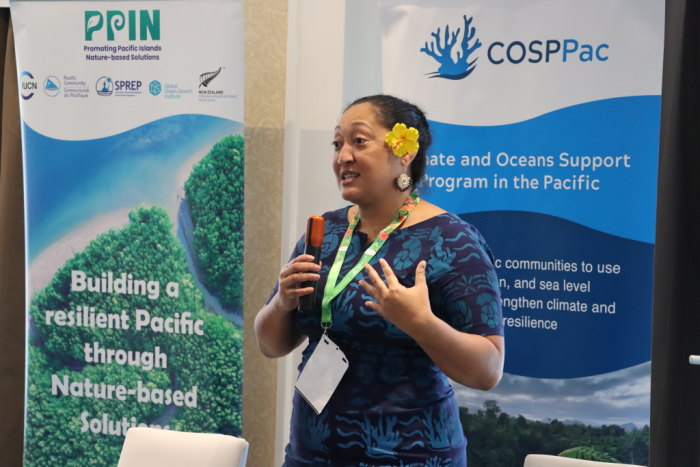
“In the Meteorological space, we define traditional knowledge as knowledge that is based on repeated observation, know-how, skills, and practices that are developed, sustained, and passed down between generations,” Ms. Siosinamele Lui said.
“Pacific National Meteorological and Hydrological Services (NMHSs) recognise the importance of traditional knowledge when it comes to predicting the changes in weather and climate, as this is how our ancestors were able to adapt and be resilient to the changes in climate long before the introduction of modern weather forecasting systems in the Pacific,” she added.
There have been several tools that have been developed by the COSPPac programme over the span of 12 years, that have been deployed to countries to assist them in getting their traditional knowledge activities off the ground.
Countries such as Niue, Tonga, and Vanuatu have already started incorporating traditional knowledge into their monitoring and forecasts, with Vanuatu currently taking the lead in the Pacific in this work.
Mr. David Gibson highlighted some of the activities that the Vanuatu Meteorological and Geohazards Department have been undertaking with support from COSPPac and the Vanuatu Klaemet Infomsene blong Redy, Adapt mo Protekt (Van-KIRAP) project, which includes the development of Vanuatu’s National Traditional Knowledge Strategy, the development of the Vanuatu Traditional Knowledge indicators handbook, as well as the deployment of a citizen science app called the Climate Watch app, whereby community members can record and submit traditional knowledge indicators for the VMGD team to verify.
In Niue, the Niue Meteorological Service has been working with the youth, specifically the Niue Girls Brigade, to plant ufi plots which can be used to predict the outcomes of the coming cyclone season.
According to Niuean traditional knowledge, if the ufi plant grows upwards, that is an indicator that Niue will not be affected by a tropical cyclone in the coming season. However, should the ufi grow along the ground, then communities will need to prepare for the occurrence of a tropical cyclone.
Discussions on how traditional knowledge can also help with Nature-based Solutions (NbS) to climate change were also had during the side event, with PPIN Project Coordinator, Ms. Utulei Lui stating that the strength of our future responses lies in combining our traditional wisdom with modern policy development.
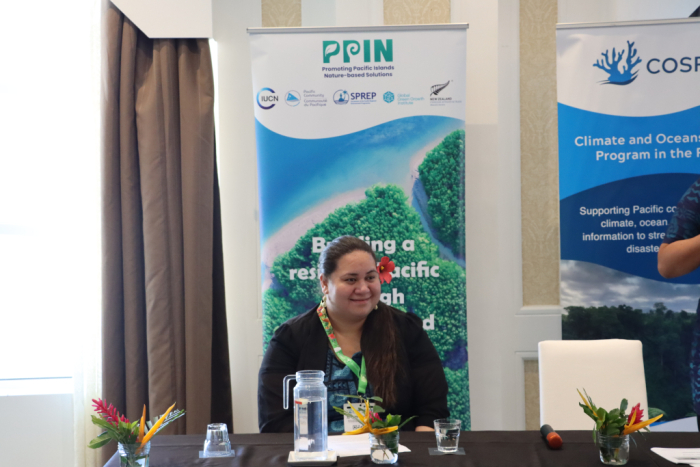
“For generations, our Pacific communities have lived in close relationship with our environment. While that knowledge continues to guide how people manage land, forests, and costs, governments have the responsibility of creating formal frameworks that can direct resources, coordinate institutions, and attract climate finance,” Ms. Utulei Lui said.
“This is where Nature-based Solutions provide real opportunity,” she added. “They act as a bridge, connecting community practice with national policy. If framed correctly, NbS can take what is already proven in villages and scale it up through instruments such as national adaptation plans, sector policies, or disaster risk frameworks.”
The PPIN project is currently working with Fiji, Tonga, and Vanuatu to support the development of NbS guidelines that will complement existing or upcoming national frameworks.
In Fiji, PPIN is working with the iTaukei Land Trust Board to develop a Natural Resources and Environment Management policy that aims to include provisions that provides a better way to address environmental concerns with development through NbS.
Tonga is looking to make a stronger connection between its National Adaptation Plan and the newly updated Tonga Agriculture Food and Forestry Sector Plan, and PPIN is supporting the development of a NbS Guideline that leverages NbS as an approach to adaptation.
Vanuatu is currently in the process of developing their first National Adaptation Plan, and PPIN is supporting that effort by developing a NbS Best Practices guide to support the objectives of the NAP.
For more information, please contact Ms. Siosinamele Lui at siosinamelel@sprep.org or Ms. Utulei Lui at utuleil@sprep.org.
The Thirty Second SPREP Meeting of Officials (32SM) and Associated Meetings are taking place at Sheraton Aggie Grey[‘s Hotel and Bungalows in Samoa, from 1-5 September.
Guided by the theme “Sustaining our Pacific Environment in Harmony with our Cultures”, the 32SM and Associated Meetings bring together SPREP Members to discuss strategic issues pertaining to the organisation, and to approve the 2026-2027 Work Programme and Budget.
The 21 Pacific island Members of SPREP are: American Samoa, Commonwealth of the Northern Marianas, Cook Islands, Federated States of Micronesia, Fiji, French Polynesia, Guam, Kiribati, Marshall Islands, Nauru, New Caledonia, Niue, Palau, Papua New Guinea, Samoa, Solomon Islands, Tokelau, Tonga, Tuvalu, Vanuatu, and Wallis and Futuna. The five Metropolitan Members of SPREP are: Australia, France, New Zealand, United Kingdom, and the United States of America.
In our efforts to fulfill our vision of a ‘resilient Pacific environment, sustaining our livelihoods and natural heritage in harmony with our cultures’, SPREP is extremely grateful to our valued Members, partners, donors, our CROP family, and stakeholders.
For more information on the 32SM, visit https://www.sprep.org/sprep-meeting/2025/32-meeting-of-officials or contact sprep@sprep.org.