

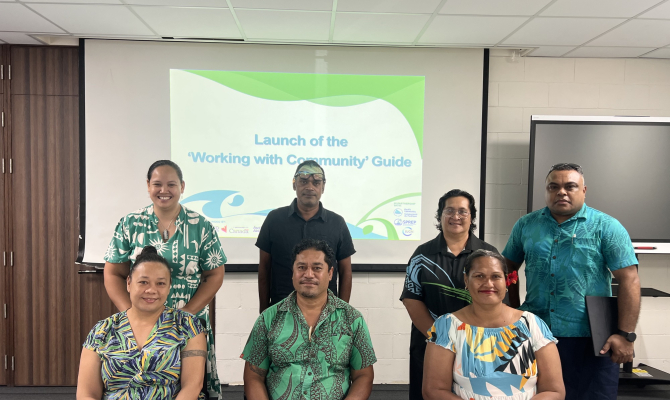
26 September 2025, Apia, Samoa - A new resource was launched in a hybrid webinar event held on the 25th of September in Samoa. The webinar event provided a first glance at the resource ‘Working with Nature for Community Climate Adaptation: A Guide for Facilitating Community Discussions on Nature-based Solutions in Pacific Islands’, giving participants an insight into how the resource was created, and to hear directly from community practitioners and community representatives who had already used it to explore practical applications of NbS in our respective communities for future sustainable livelihoods.
Developed in collaboration with regional partners, the guide was designed to help Pacific communities start conversations about NbS, drawing on traditional knowledge and deep relations with nature, to strengthen peoples and community resilience to climate change. By providing practical tools, the resource will support organisations, facilitators and practitioners to start conversations with local communities about NbS and what is being done to safeguard ecosystems while enhancing food security, watershed management, and community wellbeing.
“This resource is a useful guide to help our people focus on our finite resources and our biodiversity preservation for our future generations. So the main purpose of this tool in my perspective is that it asks the question which the community holds answers to. That’s where it should come from,” said Mr Ioane Etuale from Samoa Conservation Society. Mr Etuale was among the early testers of the facilitator resource and worked with the Luatuanu’u Youth Group to carry out a test. run, who was a speaker during the webinar, sharing his insights with over 80 participants joining both virtually and in person at the Pacific Climate Change Center based at SPREP.
The published guide, which is only available online at the moment (but may be available soon in hard copies), is accompanied by a suite of online materials which will help facilitators bring discussions to to practical solutions in community settings, available in both English and French. It features: a full Facilitator Video with a step-by-step overview of practical guidance with communities; an introduction to the concept and benefits of Nature-based Solutions; insights on encouraging sustainable practices and collective action; a storytelling tool illustrating effective and ineffective ways to share messages; and guidance on ensuring inclusive and equitable approaches to NbS projects.
Ms Michelle Abel, a member of the Live & Learn Environmental Education (LLEE) team that led the development of the resource, in collaboration with SPREP, said, “In developing this toolkit, we were thinking first and foremost about the facilitators and community groups working on the ground. The process was about creating something practical, engaging, and easy to use; a resource that meets people where they are and supports inclusive conversations on climate change adaptation.”
Also on the panel of the webinar were Ms Makerita Toafa Sio, a community leader from Luatuanuu who was among those involved in the early testing of the resource; Ms Nunia Thomas-Moko, Director of Nature Fiji-Mereqeti Viti; and Ms Marcela Bellettini, Fundraising and Communications Manager for BirdLife International Pacific – who each gave their perspective of how the guide can be used in their roles working with projects and communities in the Pacific.
Mr said Mr Mahé Charles, Coordinator of the Kiwa Initiative Secretariat, shared: “Our vision is that this tool, developed based on a needs assessment and considering the experience of Kiwa projects, etc, will support facilitators and practitioners in designing locally-relevant actions that strengthen social and ecosystem resilience at the community level. Through this guide and all the other resources funded by the Kiwa Initiative, we hope to learn from the end-users so that we ensure that our collective work supports effectively impactful activities at the community level, in all the different contexts of the region.”
The guide and videos were further accompanied by visual and interactive resources that could be used in presentations or printed for in-person trainings or workshops. These include 18 posters and a set of activity cards, which were carefully designed to be used in the field to help demonstrate the interconnectedness of ecosystems and communities. While available in English and French, the visual resources are unique in that they also include blank spaces where facilitators could write NbS terminology and definitions in their own languages.
This resource was developed with the technical review and input of experts from SPREP, LLEE, Pacific Community (SPC), Kiwa Initiative partners and project teams across the Pacific, including Conservation International, OneReef, BirdLife International, the Wildlife Conservation Society, the Pacific Organic and Ethical Trade Community, Live & Learn Fiji, SPC, and SPREP—who were instrumental in its co-design. For the full list of acknowledgements, please refer to the guide.
The Working with Nature guide and suite of materials and resources are available now on the Kiwa Initiative website, SPREP Digital Library, and Live & Learn Environmental Education website. You can also now watch the visual guide online here, or if you would like to watch the webinar, click here.
The Kiwa Initiative, launched in 2020, is a multi-donor programme that strengthens climate resilience in the Pacific through Nature-based Solutions by protecting, restoring, and sustainably managing biodiversity. With a budget of over €75 million, it is funded by France, the European Union, Canada, Australia, and New Zealand. The initiative is managed by Agence Française de Développement (AFD) and implemented in partnership with the Pacific Community (SPC), the Secretariat of the Pacific Regional Environment Programme (SPREP), and the International Union for Conservation of Nature (IUCN). Together, these partners support regional and local actions that build resilience, safeguard ecosystems, and enhance the sustainable livelihoods of Pacific communities.
For more information on the resource or the Kiwa Initiative, please contact
Michelle Abel, Live & Learn Environmental Education’s Director of Knowledge & Learning, and Communications - michelle.abel@livelearn.org
Angelica Salele-Sefo, SPREP’s Kiwa Development Coordinator - angelicas@sprep.org