

By Sanjeshni Kumar, Pacnews
Samoa is moving to strengthen its approach to climate-induced loss and damage, aiming to turn its new national funding mechanism into a fully functional lifeline for communities already living with irreversible climate impacts.
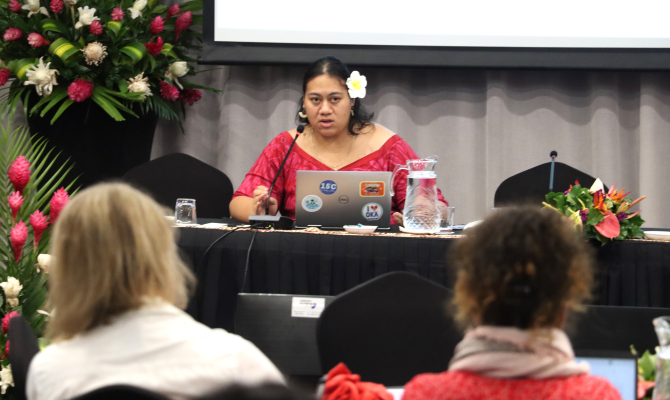
Speaking at the Second Pacific Loss and Damage Dialogue in Apia, Principal Climate Change Officer at the Ministry of Natural Resources and Environment (MNRE), Bernadette Amosa, said loss and damage remains in its early stages within Samoa’s national policy framework.
At present, she said, Samoa’s climate change policy is the only document that explicitly mentions loss and damage, and even then, only in relation to research and data collection.
“There is a gap in concrete guidance on how to operationalise loss and damage through targeted interventions or financing mechanisms,” she told delegates.
Samoa’s climate actions are currently framed under the second Nationally Determined Contribution (NDC), the NDC Implementation Roadmap and Investment Plan, the Low Emission Development Strategy (LEDS), which has no loss and damage component, and national resilience plans such as the National Adaptation Programme of Action (soon to be replaced by a National Adaptation Plan) and the Community Integrated Management Plan. But loss and damage has yet to be fully integrated into these frameworks.
The country’s Loss and Damage Fund was launched with support from New Zealand’s Ministry of Foreign Affairs and Trade, in collaboration with key line ministries, and began operations with an initial investment of US$3 million. The fund is designed to move Samoa “beyond just discussions” into implementing loss and damage responses.
More than half of the fund, 70 percent, will be directed to government ministries for development projects, with 10 percent each going to small grants, civil society organisations, and private sector initiatives through the Samoa Chamber of Commerce.
The aim, Amosa said, is to make the fund inclusive, so “every group is able to access and do work to support their own initiatives towards loss and damage.”
To qualify, projects must address impacts directly caused by climate change and show they are beyond adaptive capacity and cannot be recovered through existing adaptation or disaster risk management measures. Applications must include clear objectives, timelines, budgets, and risk measures.
Proposals will first be reviewed by a technical advisory committee, including technical ministries and the Chamber of Commerce, before going to a newly established Climate Resilience Committee, an overarching national body intended to unify all climate-related committees under one structure. This committee will also be tasked with actively sourcing additional funding for the Loss and Damage Fund.
The fund will target areas such as infrastructure rehabilitation, community relocation, agricultural loss, economic impacts, and mental health — “heavy on the mental health,” Amosa stressed, “because many people have never been tested throughout their whole lifetime.”
Amosa also highlighted the importance of research and innovation to improve vulnerability assessments, quantify losses, and develop tools such as early warning systems and climate-resilient crops, an area Samoa is prioritising as it begins to move from policy discussion to on-the-ground action.
She acknowledged that stakeholder feedback has raised concerns about clarity and the risk of confusion between loss and damage, adaptation, and disaster risk management.
“Loss and damage is not an abstract policy debate; it is a big reality.
“We don’t want to duplicate the same initiative in different technicalities. Every effort must support tangible improvements for our people,” she said.
The Pacific Regional Loss and Damage Dialogue 2025 is held from 11-12 August at Taumeasina Island Resort. It follows the inaugural Pacific Youth Dialogue on Loss and Damage, held from 7- 8 August, at the same venue in Samoa.
The Pacific Regional Loss and Damage Dialogue 2025 and the inaugural Pacific Youth Dialogue on Loss and Damage are made possible with funding support from the Loss and Damage Capability and Capacity (LDCC) Project with the Government of New Zealand.
Hosted by the Secretariat of the Pacific Regional Environment Programme (SPREP), the dialogues bring together Pacific governments, youths, civil society, academia, NGOs, and the private sector to collectively advance the region’s priorities on Loss and damage.
This story was produced by the Pacific Media Team covering the meetings. Their attendance is made possible with funding support from the Loss and Damage Capability and Capacity (LDCC) Project with the Government of New Zealand.
For more information, please contact SPREP Climate Change Adaptation Adviser, Ms Filomena Nelson filomenan@sprep.org , SPREP Climate Change Loss and Damage Officer, Ms Jessica Rodham jessicar@sprep.org or Media and Public Relations Officer, Mr Keni Lesa sosikenil@sprep.org