

22 October 2025, Nadi - Fiji’s economy, culture, and quality of life rely on its pristine natural environment. The country’s unique terrestrial and marine ecosystems are vital not just for ecological health but for socio-economic progress.
However, the global dramatic growth in chemicals production and trade presents a significant risk. Chemical pollution poses a threat to Fiji’s economy, culture and quality of life by endangering coral reefs, freshwater systems, soil health, fisheries, tourism, and food security.
Fiji’s struggles are shared by neighbouring countries across the Pacific Ocean, who often lack adequate infrastructure to effectively monitor the import and use of these chemicals.
According to the World Health Organization (WHO), approximately two million lives are lost per year due to exposure to selected chemicals. Two third of agricultural land is contaminated with pesticides.
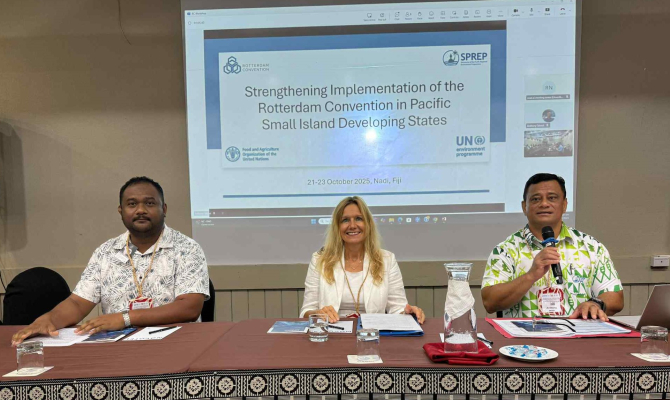
To address these challenges, the Secretariat of the Rotterdam Convention and the Secretariat of the Pacific Regional Environment Programme (SPREP) are facilitating a three-day training in Fiji to strengthen the implementation of the Rotterdam Convention in Pacific Small Island Developing States (PSIDS).
The Rotterdam Convention promotes shared responsibility and cooperative efforts amongst parties in the international trade of certain hazardous chemicals in order to protect human health and the environment from potential harm. With 167 parties, it exists to contribute to the environmentally sound use of those hazardous chemicals, by facilitating information exchange about their characteristics, by providing for a national decision-making process on their import and export and by disseminating these decisions to Parties.
Mr Jimmy Clint Gaunavou, of Fiji’s Ministry of Environment and Climate Change, said for the Pacific, the challenge posed by chemical pollution is profound.
“The Rotterdam Convention offers us the essential tools to meet this challenge,” he said when he opened the training at the Novotel Hotel in Nadi.
“This Convention is transformative because it empowers us. It establishes a legally binding Prior Informed Consent (PIC) procedure, which acts as a fundamental barrier, enabling a country to formally be informed about, and subsequently consent to or refuse, the importation of dangerous chemicals. This is not a "Black-list," but rather an essential "watch list" of industrial chemicals and pesticides whose import needs to be carefully considered and agreed upon.”
Fiji is working towards becoming a party of the Rotterdam Convention.
.jpg)
Ms. Christine Fuell, Executive Secretary ad interim of the Rotterdam Convention, said one of the goals for the work in Nadi this week is to support countries like Fiji on their path towards ratification and implementation of the Convention.
“The Convention unites us in the objective to promote shared responsibility and cooperative efforts in the international trade of hazardous chemicals,” said Ms Fuell.
“It also aims to contribute to the environmentally sound use of hazardous chemicals by facilitating information exchange about their characteristics and by providing for a national decision-making process on their import and export.”
The Cook Islands, Republic of Marshall Islands and Samoa were amongst the first Pacific countries to ratify the Rotterdam Convention. The Kingdom of Tonga, Tuvalu and Vanuatu joined in the years that followed.
“We hope to welcome Fiji, Kiribati and the Solomon Islands soon to our growing community,” added Ms Fuell.
SPREP hosts the Pacific Regional Centre for Training and Technology Transfer for the Joint Implementation of the Basel and Waigani Conventions in the South Pacific region. SPREP Director of Waste Management and Pollution Control, Mr Anthony Talouli, said the effectiveness of the Rotterdam Convention depends on all parties working through robust cross-sectoral cooperation.
“I hope the sessions this week will not only enhance your knowledge on the Rotterdam Convention but also develop and build understanding on the synergies between Rotterdam and the Basel and Stockholm Conventions,” said Mr Talouli.
“Your work will contribute significantly to our emerging Cleaner Pacific 2036 regional strategy, addressing waste and pollution challenges from 2027 to 2036, ensuring collective efforts are aligned and mutually reinforcing.”
For Pacific SIDS, Mr Talouli reminded that the Rotterdam Convention holds exceptional importance, concluding: “Unlike industrialised nations, we are not manufacturers but receivers and users of chemicals, making us uniquely vulnerable. Remember, we are not just implementing a convention – we are safeguarding the future of our Pacific peoples.”