

By Inoke Rabonu, Fiji Sun
The global need to address climate-related loss and damage far outweighs the funding currently available, says the Fund for Loss and Damage (FRLD) programming and country engagement lead.
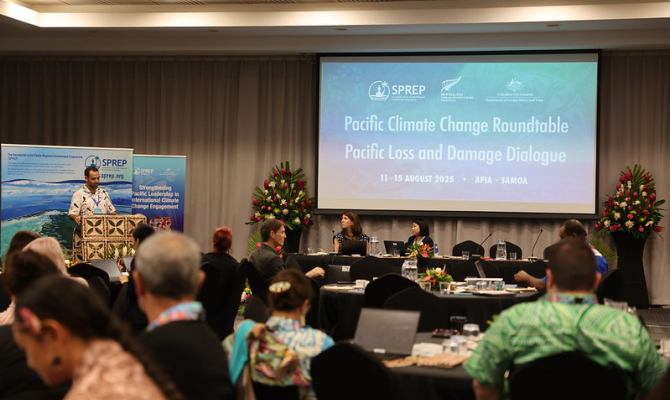
Speaking to participants of the SPREP’s Pacific Loss and Damage dialogue in Apia, Samoa, Jihyea Kim said the FRLD has so far secured about US$768 million in early pledges, “a drop in the ocean” compared to the scale of needs.
Just US$250 million is set aside to be disbursed for the fund’s initial two-year start-up phase.
Its start-up phase, called the Barbados Implementation Modalities, will pilot grant-based interventions from 2025 to 2026, with at least 50 per cent allocated to Small Island Developing States and Least Developed Countries.
The fund’s approach will be country-led and inclusive of communities, civil society, and non-state actors, with an emphasis on building on existing national systems rather than creating new ones.
A call for proposals is expected in the coming months.
However, the programme lead cautioned that funding will be limited in the early phase, making prioritisation essential.
“This fund cannot operate alone in supporting countries. The need is too big, and the available funding is too limited,” Kim said.
She stressed the importance of complementing existing disaster, climate, and humanitarian financing.
Established to assist developing countries most vulnerable to climate change, the FRLD is the only multilateral climate fund dedicated to both economic and non-economic loss and damage.
About the Fund
The Loss and Damage Fund is a financial mechanism designed to assist vulnerable developing countries in addressing the impacts of climate change, including both economic and non-economic losses. Established at COP27 in Sharm el-Sheikh, Egypt, the fund was operationalised at COP28 in Dubai.
It aims to provide crucial financial support to help these nations recover from climate-related disasters, from sudden events such as extreme weather to slower-onset changes like rising sea levels.
One of the issues is the absence of a global definition for “loss and damage.” But this will not stop the Fund for Loss and Damage (FRLD) from supporting vulnerable countries, says its programming and country engagement lead.
“There is no established loss and damage definition, which does complicate our work in operationalising the fund,” Ms Kim said.
“But in the absence of one is where creativity, I think, can begin.”
She said the FRLD wants to hear directly from nations on what loss and damage means in their own contexts.
“We are looking to the countries to tell us what you think is loss and damage.
“What are the priorities and needs in your countries, in your context? And from that, we are going to learn and we are going to use that as a way, perhaps, for us to convene a more informed discussion about how we can start defining loss and damage as a topic.”
This flexibility, she said, could benefit countries facing unique challenges.
“If there were established definitions, then perhaps we would be forced to put ourselves in certain boxes or categories or shapes formed by the definitions. But in the absence of one is where creativity, I think, can begin.”
The FRLD will address both economic and non-economic loss and damage, using its start-up phase to learn from incoming proposals. A call for proposals is expected in the coming months.
The Pacific Regional Loss and Damage Dialogue 2025 is held from 11-12 August at Taumeasina Island Resort. It follows the inaugural Pacific Youth Dialogue on Loss and Damage, held from 7- 8 August, at the same venue in Samoa.
The Pacific Regional Loss and Damage Dialogue 2025 and the inaugural Pacific Youth Dialogue on Loss and Damage are made possible with funding support from the Loss and Damage Capability and Capacity (LDCC) Project with the Government of New Zealand.
Hosted by the Secretariat of the Pacific Regional Environment Programme (SPREP), the dialogues bring together Pacific governments, youths, civil society, academia, NGOs, and the private sector to collectively advance the region’s priorities on Loss and damage.
This story was produced by the Pacific Media Team covering the meetings. Their attendance is made possible with funding support from the Loss and Damage Capability and Capacity (LDCC) Project with the Government of New Zealand.
For more information, please contact SPREP Climate Change Adaptation Adviser, Ms Filomena Nelson filomenan@sprep.org , SPREP Climate Change Loss and Damage Officer, Ms Jessica Rodham jessicar@sprep.org or Media and Public Relations Officer, Mr Keni Lesa sosikenil@sprep.org