

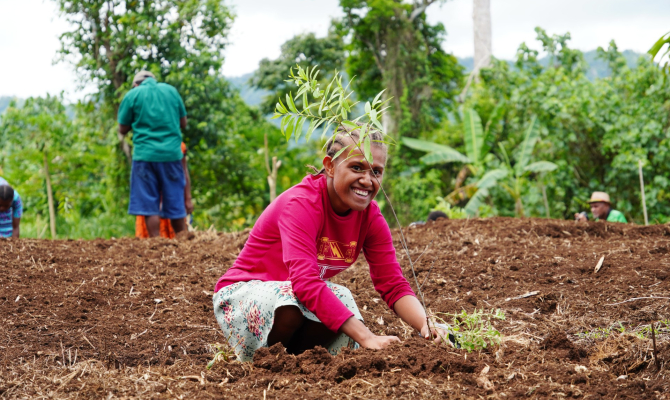
Port Vila, Vanuatu – Climate change is already affecting people’s livelihoods, food security, infrastructure, and cultural heritage across Vanuatu. In response, the country is working to strengthen its policies and planning so communities can better prepare for and adapt to these impacts.
Government agencies, civil society organisations, community representatives, development partners, and technical experts recently met in Port Vila for a two-day Validation Workshop. The aim was to better include Nature-based Solutions (NbS) in Vanuatu’s National Adaptation Plan, while also improving forestry and coastal protection policies. Nature-based Solutions refer to actions that protect, restore or sustainably manage ecosystems such as forest, reefs, and mangroves to help people adapt to climate change.
“The workshop comes at a critical time as Vanuatu advances development of its first National Adaptation Plan and continues to strengthen national responses to climate change impacts,” said Ms. Utulei Lui, Promoting Pacific Island NbS (PPIN) Project Coordinator with the Secretariat of the Pacific Regional Environment Programme (SPREP).
She explained that the PPIN project supports Pacific Island countries to include NbS in their policies and planning so ecosystems can play a stronger role in climate resilience and sustainable development.
Through presentations, group discussions, and plenary sessions, participants reviewed and refined recommendations on policy alignment, coordination between agencies, and capacity building. The process also helped build a shared understanding of how NbS can enhance resilience across priority sectors.
Participants said the workshop clarified roles, improved collaboration, and showed that NbS is both a policy concept and a practical approach already being applied in Vanuatu.
Anne Marie Sarisets, Senior Forestry Officer with the Vanuatu Department of Forestrty, noted that while the NbS terminology was new, many forestry and agroforestry initiatives already reflect NbS principles. “We had already been carrying out NbS activities,” she said. “But we need to clearly identify NbS in our projects and frameworks. This workshop helped me see the bigger picture and understand our responsibilities in highlighting NbS.”
Community representative Doraleen Raymond from Tasivanua Environment Network welcomed the opportunity to engage with government agencies and experts. She said inclusive dialogue strengthens community conservation efforts and improves collaboration. “Being part of this workshop showed me how important it is to share our experiences and understand who does what. It also helps community organisations work more effectively with government departments and support our communities.”
Mr Harry Kalkoa of the Grace of the Sea Marine Conservation Group added that the workshop helped communities frame activities such as marine restoration and mangrove planting within NbS approaches, strengthening project proposals and improving access to financing. “This workshop has given me a starting point for integrating the NbS concept into our conservation work, especially as we plan to restore mangroves,” he said.
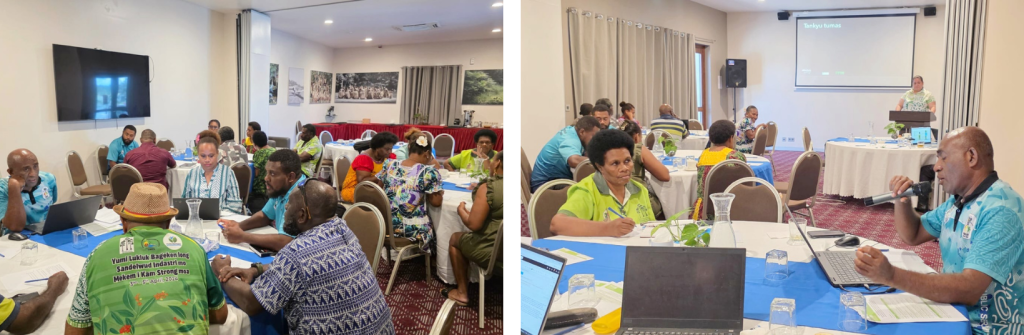

With nearly 40 participants from key ministries, the National Advisory Board on Climate Change and Disaster Risk Reduction, NGOs, and development partners, the workshop reinforced the importance of a multi-sectoral approach to climate adaptation. The validated recommendations are expected to guide decision-making, investment, and collaboration, supporting more coordinated implementation of NbS across Vanuatu.
“As Vanuatu faces increasing climate risks, integrating NbS into national planning is a strategic opportunity to protect ecosystems while strengthening community resilience,” Ms. Lui said. She added that the workshop marked an important step in ensuring adaptation policies are informed by local knowledge, scientific evidence, and cross-sector collaboration.
She also highlighted ongoing initiatives such as the Pacific Ecosystem-based Adaptation to Climate Change (PEBACC+) project, which demonstrates the effectiveness of NbS through community-led restoration, mangrove rehabilitation, and catchment management across the country. “These examples show that NbS can deliver practical benefits for communities on the frontlines of climate change.”
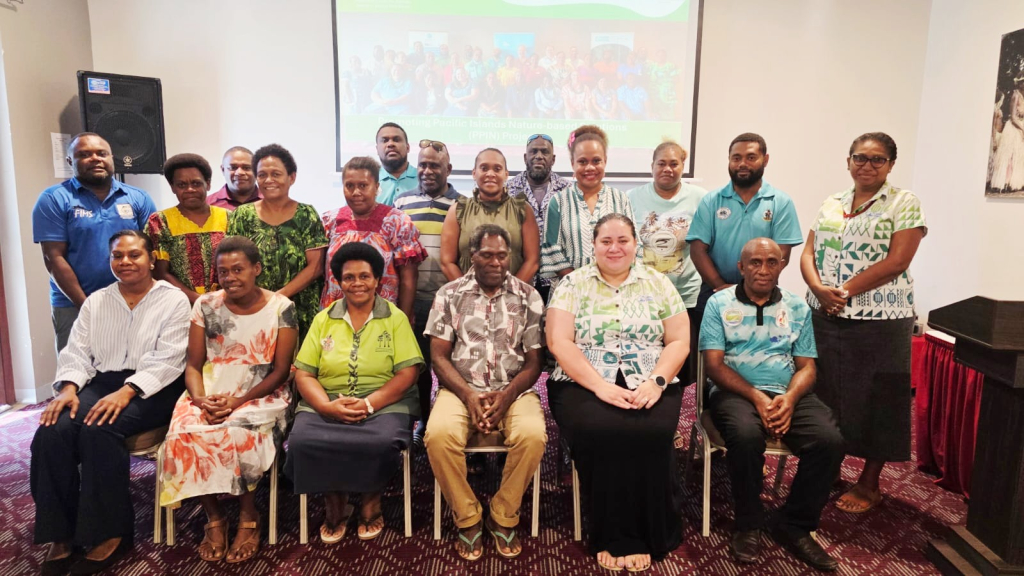
The workshop, held on 4-5 February 2026, was facilitated by SPREP through the PPIN project in collaboration with the Government of Vanuatu. It was co-financed by the PEBACC+ project implemented by SPREP and funded by the Kiwa Initiative and the French Facility for Global Environment. This collaborative approach reflects SPREP’s commitment to aligning NbS initiatives in Vanuatu and ensuring lessons learned contribute to a coordinated national approach to climate adaptation.
The PPIN project is funded by New Zealand’s Ministry of Foreign Affairs and Trade (MFAT). It aims to support NbS policy and legislation development, build regional awareness and capacity, and strengthen cooperation among Pacific Island countries. The project is managed by the International Union for Conservation of Nature (IUCN) in partnership with the Pacific Community (SPC), SPREP, and the Global Green Growth Institute (GGGI).
For more information, contact Utulei Lui, PPIN Coordinator, utuleil@sprep.org/ sprep@sprep.org