

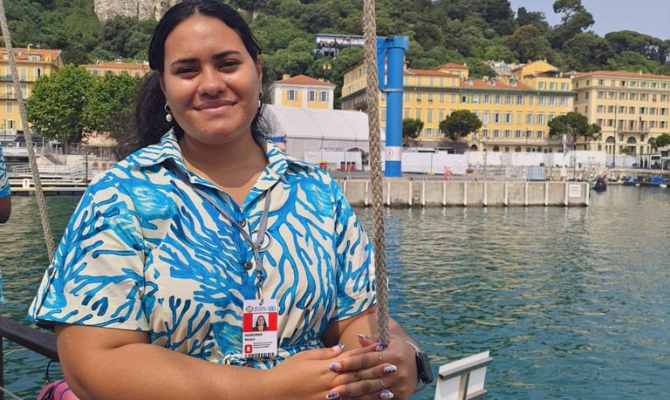
Opinion piece by Ms Nolani Hazelman, Pacific Youth Wetlands Coordinator – Young Professionals Programme, SPREP.
“Leaving the great Victoria Falls, I carry with me a sense of hope…. Our journey to protect wetlands does not end here but will continue into our communities and shared determination for survival.”
Ms Hazelman attended the 15th Conference of the Parties to the Convention on Wetlands that took place from 23 to 31 July 2025 in Victoria Falls, Zimbabwe. We share her experience, and the voices of our Pacific Youth.
“Stepping into the white walls of the 15th Meeting of the Conference of Parties to the Ramsar Convention on Wetlands (COP15) in Victoria Falls, I felt excitement, but also the weight of responsibility we have to our Pacific islands. This was not just another international meeting. It was a space where decisions about the world’s wetlands, including those that serve major purpose to Pacific islands, would be shaped, debated, rejected, and carried forward.
As a Pacific Youth Wetlands Coordinator, I arrived not only to represent my role but to carry and support the voices of young people across our region. Those who live beside mangroves, depend on freshwater systems, and protect coastal ecosystems that are increasingly threatened by climate change and human activities. On a personal level, COP15 was more than policies and resolutions, but a test with how far the Pacific and their youth have come, and how much further we need to go.
The energy of the meeting was inspiring, but what struck me most was the diversity of perspectives. From seasoned negotiators, indigenous knowledge advocators, to grassroots youth leaders, each country or person carried their lived experiences about wetlands. Seeing huge country delegations and how big other regions are compared to our region when they are together was a bit intimidating. I was reminded that the Pacific may be small, but our unique experiences carry lessons the world urgently needs to hear.
Ramsar COP15 was a milestone in advancing Pacific priorities on a global stage. The Pacific delegation came together with a clear voice and a message of ensuring that the unique challenges of small island wetlands are not overlooked in global conservation frameworks. A joint regional opening statement was delivered by Papua New Guinea’s youth delegate, highlighting unique wetland types present in the region that are currently under severe threats from impacts of climate change and human activities. Emphasising on integration of indigenous knowledge, the Oceania region called for outcomes that reflect conservation driven by governments and local communities.

Some key interventions I would like to highlight include:
• A joint Oceania statement delivered by Vanuatu, calling for the adoption of the 5th Strategic Plan. Noting that this is a critical framework for conserving, wisely using, and restoring wetlands globally to achieve sustainable development, and where possible supports the global environmental agenda on biodiversity, climate, and water. The development can also offer an opportunity to strengthen the role of indigenous peoples and traditional knowledge.
• A joint regional statement delivered by Fiji on behalf of the region pushing for the strongest possible increase of different contribution scenarios presented in the draft resolution, highlighting that it is the only realistic pathway to ensure the Convention’s stability and effectiveness. Oceania also endorsed the proposal that core budget contributions of Contracting Parties be guided by the most recent United Nations scale of assessments.
• Advocating for stronger involvement of youth in Ramsar activities, Oceania, represented by the Fiji youth delegate, delivered a strong statement supporting the adoption of the Youth resolution, encouraging Contracting Parties to empower youth and indigenous peoples as equal partners in wetland governance. There was also a call to extend the Youth Working Group’s mandate into the 2025 - 2028 triennium to lead the implementation of Resolution XV. 12 and the Youth Working Group Workplan, and to push Contracting Parties to nominate National Youth Focal Points so that youth are represented at decision-making processes revolving wetlands.
Supporting countries with the adoption of the youth resolution was a personal highlight for myself. This ensures that youth are not a side conversation but are now included in formal agendas. The presence of Pacific youth voices in the plenary, side events and discussions affirmed our experiences are increasingly recognised as essential to shaping solutions.
With funding support from the GIZ Management of Blue Carbon Ecosystems in the Pacific Island Countries (MACBLUE) and the Government of Australia, I also had the opportunity to co-organise a side event led by youth across the regions. This had been in the works since early February, and after many late nights of planning online, it was finally time to put into action. The side event “Resolution to Action: Youth Leadership and the Future of the Convention on Wetlands,” was a testament to show how far the Convention and youth have come since the adoption of the first youth resolution on its kind at COP14 in 2022. Presenting opening remarks on behalf of Subgroup 4 of the Youth Working Group, I expressed progress of the Youth Working Group Workplan and the implementation of the youth resolution into countries. I then portrayed great youth initiatives across the region to show the world what we are doing in the face of severe impacts of climate change.
COP15 was also an opportunity to help youth strengthen professional networks. I had the chance to connect in person with the Ramsar Secretariat and the Pacific Parties, whom I had only been in contact with over emails and virtual meetings. I think this fostered a sense of familiarity which helped during the regional meetings, which were conducted every morning before plenary sessions. That familiarity set a united front, showing that the Oceania region was a team to look out for! From a small room for regional meetings to the big plenary tent, Oceania presented statements to convey the message that action must be taken to better the Convention’s support for the region.
As I look back on Ramsar COP15, I am constantly reminded that while resolutions were adopted and milestones were reach, there is still so much to be done to ensure that wetlands remain a mainstream topic for countries. For me personally, the next step is to keep the momentum going. Strengthening a Pacific network of youth engaged in wetlands, supporting national focal points, and creating spaces and opportunities where youth can actually participate or lead action. COP15 may have ended, but it has marked a stronger, more connected Pacific wetlands movement, one that I am committed to helping shape.
I would like to acknowledge the Oceania delegation, and how great they were at representing not only their countries, but the region. Although small, interventions and messages were very clear. Delegations also including a youth representative was a big move; in showing the world how easy it is to include youth in policy and decision-making processes with the groundwork to back it up. For the three of them, this was their first ever COP experience. From assisting with draft statements to delivering interventions for the region, it was almost as if they had done this before!
Leaving the great Victoria Falls, I carry with me a sense of hope. After all the conversations at COP15, I am reminded that even in complex global process, change begins with contention, whether it be between regions, between generations, and between people and nature. For the Pacific, wetlands are not just ecosystems, but is deeply incorporated in our heritage, culture, and resilience. And for youth such as myself, our place is at the centre of decision-making. Our journey to protect wetlands does not end here but will continue into our communities and shared determination for survival.
Lastly, I would like to acknowledge with appreciation the Government of Australia through the Department of Climate Change, Energy, the Environment and Water (DCCEEW) for funding my position as the Pacific youth wetlands coordinator here at SPREP.” - Nolani Hazelman