

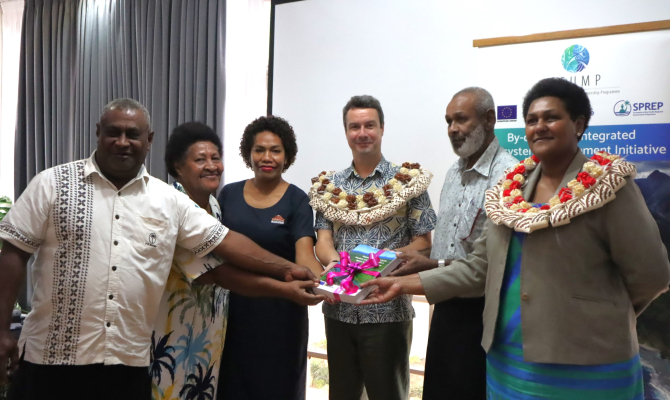
22 July 2025, Suva, Fiji - A plan to strengthen the health and resilience of the Navua catchment and Beqa lagoon and improve the livelihoods of the people living in these areas was launched by the Ministry of Environment and Climate Change and the Secretariat of the Pacific Regional Environment Programme (SPREP) in Deuba on 22 July 2025.
“The Integrated Ecosystem Management Plan for the Navua catchment and Beqa lagoon is a tool that communities can use to guide their development decisions,” said Director for Environment, Senimili Baleicakau.
The Director commended the plan, stating, “I am pleased to see that communities are at the heart of the IEMP process—not only as stakeholders but as co-designers and custodians. Their participation has ensured that the Plan reflects traditional knowledge, local priorities, and lived realities.”
The management plan is based on science, taking into account traditional knowledge, and gives communities access to information about their natural environment and provides options for enhancing both ecological and social resilience across the Navua catchment and Beqa lagoon.
“Communities across Fiji, and the Pacific, are facing big challenges and questions about their future as they deal with changes in climate, economies, and cultures. They are approached by investors and developers who are seeking access to land, natural resources, and development projects. Many of these projects promise income to the community and the country. But we must always look at the long-term impacts of these projects and balance income with sustainability,” said Director Baleicakau.
“Too often, there is insufficient data and analysis upon which these communities can make their decisions. They rely on the information from the developers and from environmental impact assessments. One of the roles of SPREP and the government is to assist communities with ensuring that decisions that will impact the environment and long-term sustainability and resilience of communities are based on sound science, data, and analysis.”
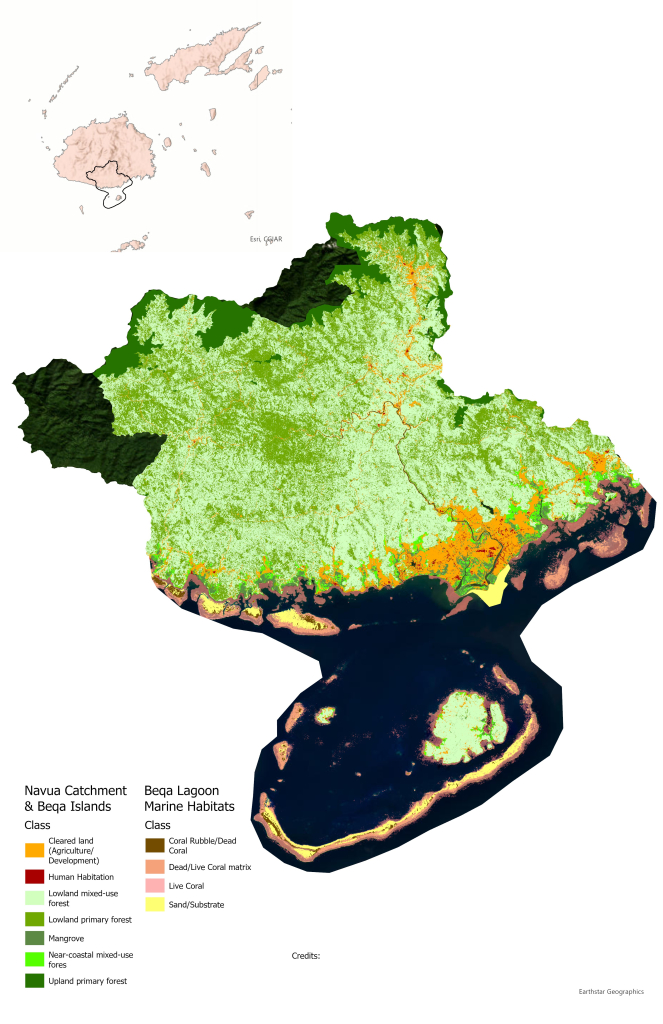
Developed in consultation with 162 individuals across 52 communities in the Namosi, Serua and Rewa provinces, the Integrated Ecosystem Management Plan (IEMP) outlines option for sustainable development options of the entire ecological system. This recognises that upstream activities can impact residents downstream and in Beqa Lagoon.
The Navua River catchment drains an area of 1387 km2 from the Namosi highlands right to the mouth of the Navua River and into Beqa Lagoon. River catchments and coastal areas like this, form connected ecological systems and it is important that these ecological systems be managed as a connected system. What happens upstream impacts downstream activities like agriculture and fishing.
The IEMP identifies interventions that reduce climate risk and build community capacity to withstand floods, erosion, saline intrusion, and biodiversity loss. Measures identified in the IEMP include riparian buffer restoration, mangrove protection, watershed rehabilitation, and establishment of protected areas.
“All of these options are nature-based solutions – restoring forest habitats, protecting biodiversity, marine ecosystems, and forest ecosystems, managing our waste, and working with nature – are all steps that can increase the resilience of our communities.,” said Director Baleicakau. “Nature based solutions should be one of our first choices when addressing our development needs – they are more resilient, less expensive and easier to maintain than hard engineering solutions.”
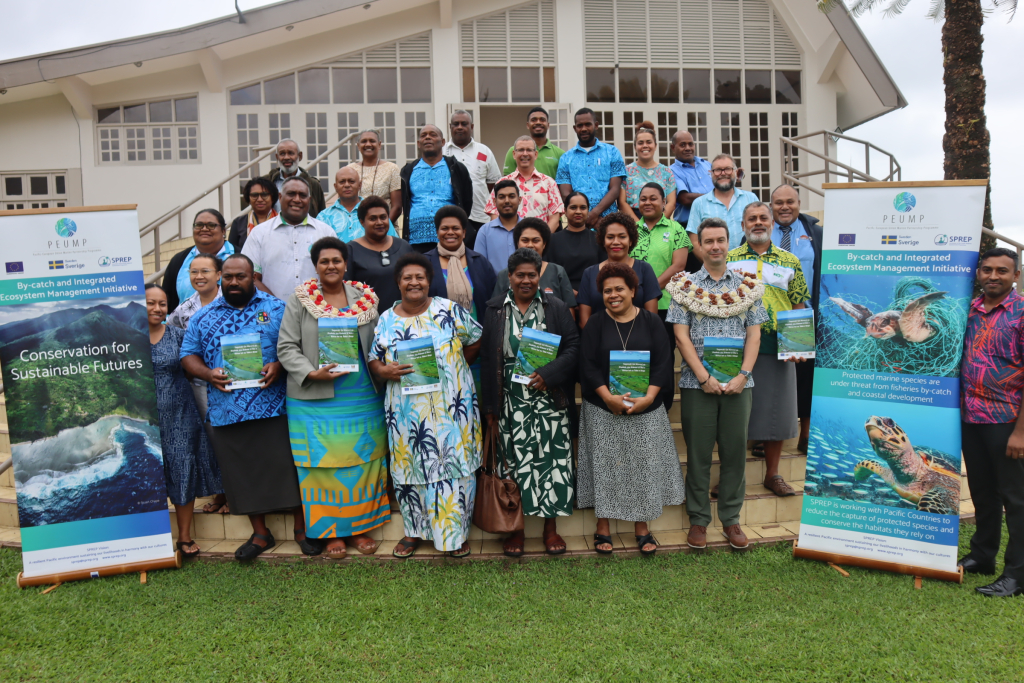
SPREP’s Project Manager for the By-catch and Integrated Ecosystem Management (BIEM) Initiative, Ken Kassem, stated that communities are now equipped with maps, data, and tools that empower them to engage confidently with government and developers, safeguarding both ecosystems and livelihoods.
“One of the roles of SPREP is to assist the Fiji government and people with ensuring that decisions that will impact the environment and long-term sustainability and resilience of communities are based on sound science, data, and analysis,” he said.
“The Integrated Ecosystem Management Plan that is being launched today is a prime example of such science, data, and analysis. The rapid biological assessments, ecosystem and socioeconomic resilience assessments and analysis that informed this plan are all being made available to everyone and will be available on SPREP’s virtual library website. These are important tools for decision making for all communities and stakeholders as they move forward.”
The launch event was an opportunity for attendees to become familiar with the results of the various assessments and to discuss the partnerships that will be needed to implement the IEMP.
Representatives from the three provinces shared on their own experiences in using nature based solutions to improve the resilience of their ecosystems. Tree planting and revegetation activities are seen to be a significant factor in improving biodiversity and reducing soil erosion. Several communities mentioned the need for fruit trees to be planted in conjunction with timber plants.
The launch was attended by members of the communities representing the three provinces, government ministries, non governmental organisations and private sector representatives, including the Fiji Hardwood Corporation.
The rapid biological assessment conducted as part of the IEMP process, has identified that there has been reduction in ecosystem function and biodiversity in the catchment and the Beqa lagoon and that this in turn has consequences on the services provided by the area to local communities. Larger industries like tourism, agriculture and commercial fishing require intact natural ecosystems to be sustainable. Food and water supply for local communities also depend on intact forests and healthy waterways. Degrading natural systems also degrades the sustainability and long-term viability of the social and economic values of the region. With the increase in development activities in the upper Navua catchment area and along the riverbanks, through roads, logging, mineral exploration and agriculture, communities are keen to understand ecosystem connections and long term implications.
The IEMP development process was led by SPREP through the By-catch and Integrated Ecosystem Management (BIEM) Initiative of the Pacific-European Union Marine Partnership (PEUMP) Programme funded by the European Union and the Government of Sweden.
Erik Lindebo, Team Leader for Climate Change and Natural Resources at the Delegation of the European Union to the Pacific also attended and highlighted the importance of SPREP’s role in driving this important effort forward with national and community partners. “SPREP’s commitment to sustainable ecosystem- based management over the past seven years has been an important pillar of the PEUMP programme and we are convinced that this work will contribute to building sustainable future for all.”
The PEUMP Programme addresses some of the most serious challenges faced by the region. Among these are the increasing depletion of coastal fisheries resources; the threats to marine biodiversity, including negative impacts of climate change and natural disasters; the uneven contribution of oceanic fisheries to national economic development; the need for improved education and training in the fisheries sector; and the need to mainstream a rights-based approach and to promote greater recognition of gender issues within the sector.
This seven-year programme is funded by the European Union and the Government of Sweden. The programme provides direct assistance to regional organisations to support regional and national level activities in the Pacific.
Access the BIEM virtual library and download the IEMP and related reports here.
For further information, contact BIEM Project Manager, Kenneth Kassem, kennethk@sprep.org