

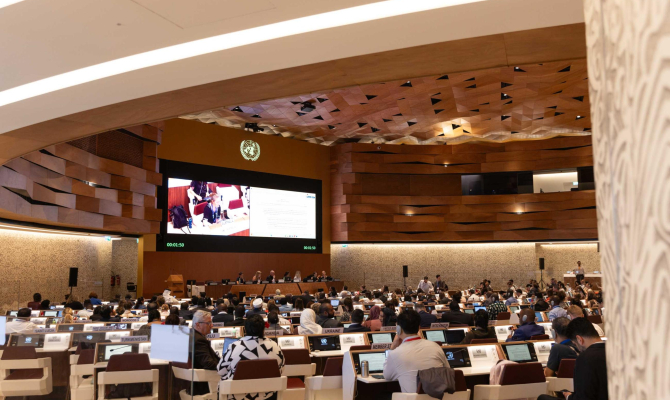
As a scorching heatwave sweeps across Geneva, tensions inside the United Nations’ Palais des Nations are also rising. Delegates from Pacific Small Island Developing States (SIDS) have raised concerns over the swelling size and complexity of the draft text, warning that it risks diluting the ambition the plastic treaty was meant to deliver.
On Day 4 of the second part of the fifth session of the Intergovernmental Negotiating Committee (INC-5.2) process in Geneva, Switzerland, talks have moved behind closed doors into informal groups. These smaller groups are tasked to find compromise on deeply contentious issues, most notably caps on virgin plastic production, controls on hazardous chemicals used in plastics, and fair financing mechanisms.
An "assembled text" compiling areas of convergence across the various contact and informal groups is expected to be finalised later today, in time for a plenary "stocktake" scheduled for tomorrow. But with hundreds of brackets still unresolved and overlapping proposals on the table, Pacific negotiators fear the process could derail if clarity and ambition are not restored.
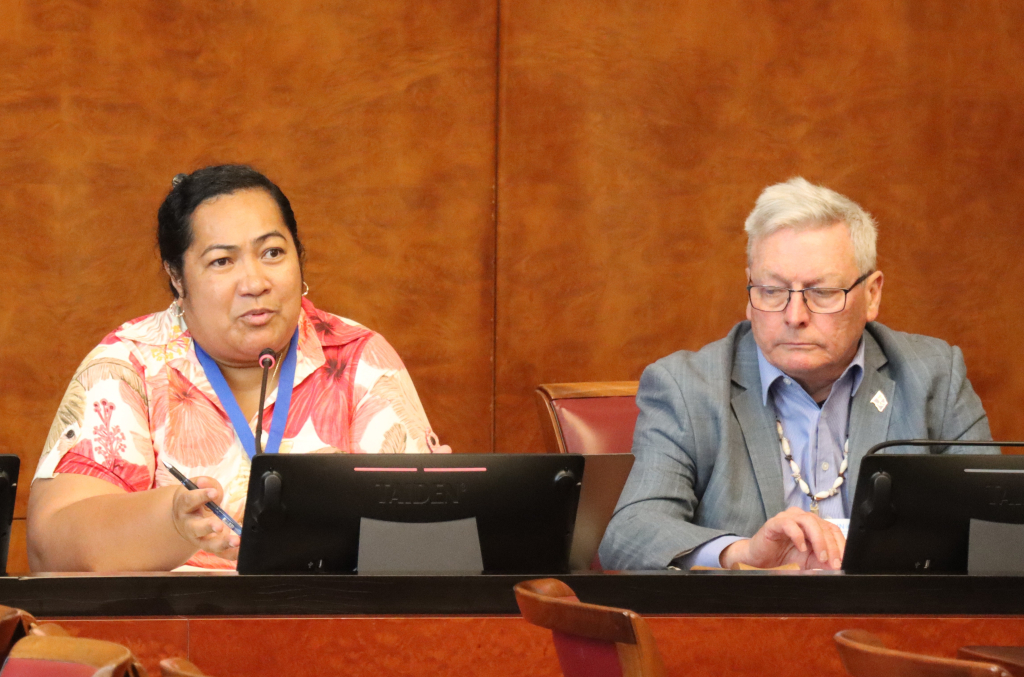
“We are racing against the clock to submit refinements by 6 p.m. today ahead of tomorrow’s plenary stocktake, and these informal groups are critical in helping us untangle this heavily bracketed, complex text to reach a workable draft,” said Ms. Pepetua Latasi, Chair of PSIDS and Tuvalu's Permanent Secretary for the Ministry of Home Affairs, Climate Change and Environment.
“Pacific countries are holding the line because we are on the frontlines of this crisis. An overwhelming majority of countries want an ambitious treaty. By making tough decisions, walking across the floor and finding compromise, we can finalise an instrument that delivers on the mandate given to us by UNEA 5.2.”
Showing commitment to that ambition, Tuvalu officially joined the High Ambition Coalition (HAC) to End Plastic Pollution, becoming its 73rd member. The Pacific’s presence in the HAC now includes Tuvalu alongside the Cook Islands, Federated States of Micronesia, Fiji, Palau, and Solomon Islands.
The HAC is a group of like-minded countries who took the initiative to form a Coalition of ambitious countries following the adoption of resolution 5/14 “End Plastic Pollution: Towards an International Legally Binding Instrument” by the UN Environment Assembly in March 2022.
The Coalition, co-chaired by Norway and Rwanda, is committed to develop an ambitious international legally binding instrument based on a comprehensive and circular approach that ensures urgent action and effective interventions along the full lifecycle of plastics.
Tuvalu’s inclusion in the Coalition strengthens the ‘One Pacific’ voice at INC-5.2.
More 3,700 participants from 184 countries are attending the negotiations in Geneva. IN-5.2 takes place from 5 – 14 August, follows INC 5, which took place in November/December 2024 in Busan, Republic of Korea. That meeting was preceded by four previous sessions: INC-1, which took place in Punta del Este in November 2022, INC-2, which was held in Paris in June 2023, INC-3, which happened in Nairobi in November 2023, and INC-4, held in Ottawa in April 2024.
The second part of the fifth session of the Intergovernmental Negotiating Committee to develop an international legally binding instrument on plastic pollution, including in the marine environment (INC-5.2), is taking place from 5 to 14 August 2025 at the Palais des Nations in Geneva, Switzerland.
The Pacific Islands are represented by the Cook Islands, Federated States of Micronesia, Fiji, Kiribati, Marshall Islands, Nauru, Niue, Palau, Papua New Guinea, Samoa, Solomon Islands, Tonga, Tuvalu and Vanuatu through the support of the Government of Australia through the Pacific Ocean Litter Project (POLP), and the United Nations.
They are supported by the Secretariat of the Pacific Regional Environment Programme (SPREP), working with partners from the Pacific Islands Forum Secretariat (PIFS), Office of the Pacific Ocean Commissioner (OPOC), The Pacific Community (SPC), Forum Fisheries Agency (FFA), Environmental Investigation Agency (EIA), Centre for International Environmental Law (CIEL), University of Wollongong, WWF and Massey University.
Photos: SPREP and Kiara Worth/IISD-ENB