

By Inoke Rabonu, Fiji Sun
Relocation remains one of the hardest and least desirable options for the Marshall Islands despite worsening climate impacts, says the country’s Climate Change Coordinator, Bear Solomon.
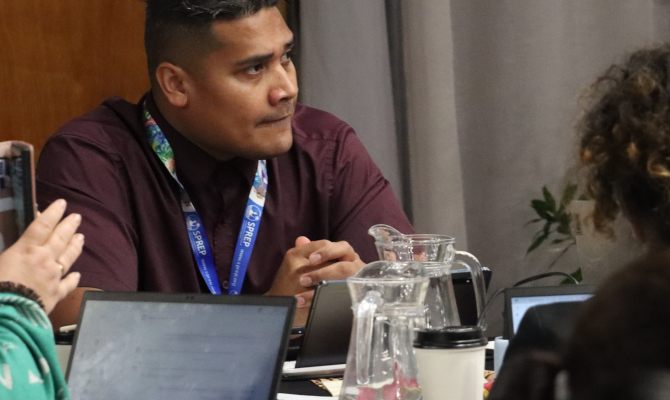
Speaking on the sidelines of the Pacific Regional Loss and Damage Dialogue hosted by SPREP in Samoa, Solomon said that while relocation has been discussed, and even experienced in the past due to nuclear testing, it is viewed only as a final measure.
“It’s not a very happy topic to talk about, but it is the elephant in the room we need to discuss,” he said.
“That is our last resort… everybody needs to be on the same page for us to start relocating. Man, it’s a hard job.”
With the Marshall Islands’ land largely under private ownership, Solomon said getting agreement from all landowners is a major barrier.
“That’s one of the things we need to address first before we can do any action.”
The low-lying atoll nation is grappling with more frequent and severe inundations, longer droughts, and increasingly destructive weather events.
Severe flooding in 2024 damaged homes, schools, agricultural areas, and even runways, cutting off essential cargo and air access.
“Our water wells are flooded because of the inundations,” Solomon said.
“It’ll take six years for the water wells to be good again to use… and here comes another impact.”
Recovery from such disasters is slow, with some areas still rebuilding.
“We really need financial support and technical assistance for these kinds of disasters,” she said.
While relocation planning is embedded in the country’s National Adaptation Plan, current actions focus on awareness, feasibility studies, and nature-based solutions as a first line of defence.
“Before we start the hard adaptation, which is land reclamation, we’re doing nature-based solutions for now,” Solomon explained.
He said platforms like the Loss and Damage Dialogue are “very helpful, crucial, and critical” for amplifying the voices of vulnerable nations, sharing strategies, and seeking international support.
“Our communities are depending on us for real actions and new solutions for the impacts they have been facing and that are going to get a lot worse,” Solomon said.
The Pacific Regional Loss and Damage Dialogue 2025 is held from 11-12 August at Taumeasina Island Resort. It follows the inaugural Pacific Youth Dialogue on Loss and Damage, held from 7- 8 August, at the same venue in Samoa.
The Pacific Regional Loss and Damage Dialogue 2025 and the inaugural Pacific Youth Dialogue on Loss and Damage are made possible with funding support from the Loss and Damage Capability and Capacity (LDCC) Project with the Government of New Zealand.
Hosted by the Secretariat of the Pacific Regional Environment Programme (SPREP), the dialogues bring together Pacific governments, youths, civil society, academia, NGOs, and the private sector to collectively advance the region’s priorities on Loss and damage.
This story was produced by the Pacific Media Team covering the meetings. Their attendance is made possible with funding support from the Loss and Damage Capability and Capacity (LDCC) Project with the Government of New Zealand.
For more information, please contact SPREP Climate Change Adaptation Adviser, Ms Filomena Nelson filomenan@sprep.org, SPREP Climate Change Loss and Damage Officer, Ms Jessica Rodham jessicar@sprep.org or Media and Public Relations Officer, Mr Keni Lesa sosikenil@sprep.org