

by Puaseiese A Pedro, Office of Prime Minister Tuvalu
The Republic of Nauru has laid out a bold and ambitious roadmap to address the existential threats posed by climate change.
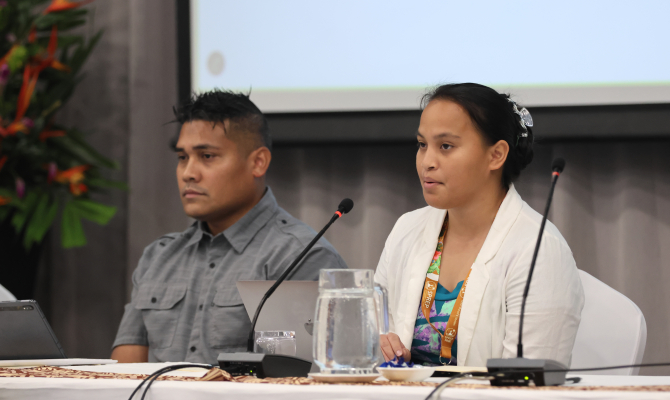
Speaking passionately in Apia to delegates attending the Pacific Climate Change Dialogue in Samoa, Ms. Kalvary Porte, Manager Climate Action/Department of Climate Change & National of Nauru, highlighted the pressing nature of climate-related migration and the need for robust development plans.
Porte urged the global community to take action that prioritises the preservation of Pacific Island homes.
“Make no mistake,” Porte said firmly, “we want to stay put in our homes, not be displaced by climate change.”
Her words captured the heart of Nauru’s climate discourse, emphasising the profound desire of islanders to maintain their cultural roots amidst escalating environmental challenges.
Porte outlined the immediate security threats faced by her country, including food and water shortages, destructive weather patterns, and the vulnerability of the local economy.
“Our viability as sovereign nations will be tested, not only by sea level rise but also by the effects on our economic stability,” she said, reinforcing the urgency with which Nauru must act.
Central to Nauru's response is the Higher Ground Initiative (HGI), a comprehensive strategy designed to secure the future of Nauru’s citizens through economic diversification, sustainable housing, and community resilience. Initiated in 2020, the HGI brings a whole-of-government approach, incorporating feedback from various stakeholders to ensure that the solutions are tailored to the needs of Nauruans.
Nauru is hoping to get assistance from the Green Climate Fund (GCF) to implement this project and the country is making progress with submissions on this.
“The challenge is to build resilient communities and an economy that can withstand a range of impacts,” Porte explained, highlighting the collaborative nature of the planning process, which resulted in over 1,000 pages of documentation detailing the initiative's plans.
Porte detailed the creation of the “Smart Village,” which will repurpose government-owned land to offer single-family homes, apartments, and office spaces.
These new structures will incorporate local building techniques and sustainable practices, including solar energy, rainwater harvesting, and sustainable food production models. “Good planning and good urbanism are the only ways to provide sustainable housing and increase food production,” she noted.
The approach taken by Porte and her team reflects a deep understanding of the intricate relationship between the environment, economy, and community well-being.
By integrating climate resilience into every aspect of development, Nauru aims to serve as a model for other vulnerable nations.
“From sustainable community designs that promote healthier lives to water and food security solutions, we are committed to bold, visionary actions,” Porte asserted.
As the island nation of Nauru stands on the frontline of climate change, Kalvary Porte's message is clear, the time for decisive action has come, and with plans in place, the implementation of these initiatives is now the immediate priority.
“We believe that to build something worthwhile, you need to be bold and visionary,” Porte concluded, calling for solidarity and support in the effort to secure a sustainable future for Nauru and its people.
The Pacific Climate Change Roundtable (PCCR), guided by the theme “1.5 to stay alive and thrive,” is taking place at Taumeasina Island Resort from 13-15 August. The PCCR is attended by Pacific governments, youths, civil society, academia, NGOs, and the private sector to engage collectively through the use of interactive activities to share their experiences amongst peers, bolster their networks and utilise the event to initiate new partnership opportunities.
The PCCR follows the Pacific Regional Loss and Damage Dialogue 2025 and the inaugural Pacific Youth Dialogue on Loss and Damage, at the same venue in Samoa.
This story was produced by the Pacific Media Team covering the meetings. Their attendance is made possible with funding support from the Loss and Damage Capability and Capacity (LDCC) Project with the Government of New Zealand.