

5 September 2025, Apia, Samoa - In the Pacific, from bustling conferences to thrilling sporting competitions, organisers are increasingly embracing sustainability as a core principle, not just a checkbox. The urgency is clear. Plastic pollution, poor waste management, and rising carbon emissions threaten the very environments that make the Pacific so unique.
With every challenge comes opportunity. Events, regardless of size or type, offer a powerful platform to inspire change and model responsible behaviour for thousands of attendees. This transformation was evident at the 2019 Pacific Games in Samoa and again in 2023 in the Solomon Islands. Both events showcased how strategic planning and practical sustainability measures like reducing single-use plastics and promoting eco-friendly transport can make a real impact.
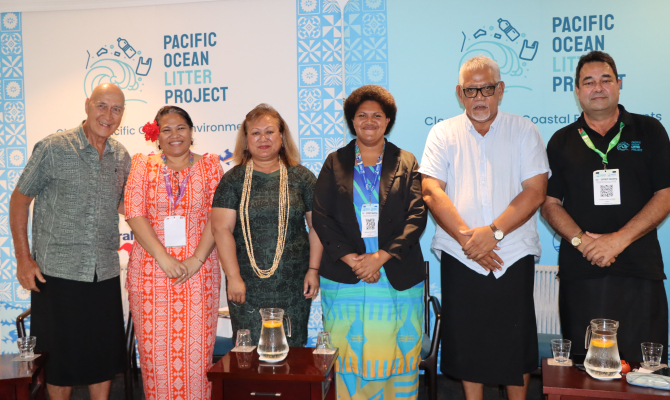
At a special side event, on the margins of the 32nd Secretariat of the Pacific Regional Environment Programme (SPREP) Meeting of Officials, a panel of diverse group of changemakers from across the environment, sports, tourism, government, industry, and community sectors came together to explore how sustainability can be woven into phases of event planning.
Their discussion centred on key themes including sustainability, social responsibility, collaboration, innovation, best practices, impact and on the value and usefulness of the draft ‘Guide for Greening Events’, developed under the Australian Government-funded Pacific Ocean Litter Project (POLP), being implemented by SPREP.
Asked for the motivation for the guidelines, Mr Andrea Volentras POLP Manager said. “We wanted to produce a product that event organisers could seek guidance from when planning for green events”
The event served as a validation platform, inviting feedback before the guide is finalised and published to help organisers across the region plan and execute environmentally responsible events by blending in traditional knowledge, modern policy, and community innovation.
The greening guidelines has been developed to support events of all scales, from village cleanups to regional summits using a structured three-phase approach. The planning phase which emphasises strategic development, sustainable procurement, and eco-conscious catering choices.
The draft guideline enables implementation that focuses on real-time event management, including catering oversight, awareness initiatives, transportation logistics and a post-event evaluation that involves rigorous auditing, detailed reporting, and ongoing monitoring through measurable KPIs.
A stakeholder responsibility matrix also ensures clear accountability across organisers, government bodies, communities, vendors, and sponsors. Key performance indicators track environmental impact like, daily waste weight, inclusivity such as gender and disability participation, and behaviour change and awareness.
Invited guests at the side event learnt that the International Olympic Committee’s Agenda 2020 is reshaping regional sports events with climate-positive goals by 2030.
Ms Sifuiva Maureen Epati-Tuimalealiifano, a panellist from the Oceania National Olympic Committee (ONOC) reflected during the side event that, “the Pacific region is setting a powerful example in sustainable sports event planning through the “Greening of the Pacific Games” initiative.”
“The key principles include environmental responsibility which minimises carbon footprints and waste, community engagement by promoting eco-friendly practices among athletes and volunteers and legacy planning by designing infrastructure for long-term community use.”
Participants at the event were informed that the Pacific tourism sector is undergoing a green revolution through a regional standards and certification program targeting single use plastic elimination by 2035. Ms Christina Gale from the Pacific Tourism Organisation provided an oversight on sustainable tourism by highlighting the programme that aims to eliminate plastic pollution by 2035 through a phased reduction of 25% by 2027, 50% by 2030, and full elimination by 2035.
“It promotes local procurement to support circular economy principles, while financial incentives under the EU Switch Asia program encourage sustainable practices.
“The initiative recognises industry leaders and empowers sector-wide transformation beyond government mandates, with growing visitor engagement seen in eco-friendly initiatives like Fiji Airways’ plastic-free inflight food and beverage service.”
Ms Michelle Baleikanacea from the Fiji Ministry of Environment and Climate Change shared that key reforms including stricter single-use plastic regulations with import controls and a tiered levy system are in the pipeline, alongside renewed efforts to finalise the long-pending National Integrated Waste Management Strategy by mid-2026.
“We are aligning with global sustainability goals while enforcing local plastic-free protocols, and inter-agency collaboration, tested in forums like the AP6 (Forum of Ministers and Environment Authorities of Asia Pacific Meeting), driving practical solutions such as alternatives to bottled water.”
“These efforts are already yielding visible results, including reduced waste at national rugby events through strong ministry involvement and active community engagement.”
Hosting events in the Pacific presents both opportunities and challenges for sustainability. With increasing concerns over plastic pollution, waste management, and carbon emissions, event organisers have a responsibility to minimise the environmental impact of events.
Greening events of any size and type such as meetings and conferences, and sporting competitions provide strategic opportunities to motivate and reinforce behaviour change among large numbers of people.
Participants of the event were encouraged to become a champion for change by implementing green event practices at their own events, workplaces, and communities and continue to connect and collaborate by building networks with others who are passionate about sustainability in the Pacific.
POLP will continue to engage in a meaningful and coordinated way with countries, partners and donors to implement a sustainable and an integrated approach, spanning policy, events, tourism, and community action by enabling clear frameworks, measurable outcomes, and shared responsibility.
The Thirty second SPREP Meeting of Officials (SM32) and associated meetings are taking place at Sheraton Aggie Grey’s Hotel & Bungalows in Samoa, from 1-5 September.
Guided by the theme “Sustaining our Pacific Environment in Harmony with our Cultures”, the SM32 and associated meetings bring together SPREP Members to discuss strategic issues pertaining to the organisation, and to approve the 2026-2027 Work Programme and Budget.
The 21 Pacific Island Members of SPREP are: American Samoa, Commonwealth of the Northern Marianas, Cook Islands, Federated States of Micronesia, Fiji, French
Polynesia, Guam, Kiribati, Marshall Islands, Nauru, New Caledonia, Niue, Palau, Papua New Guinea, Samoa, Solomon Islands, Tokelau, Tonga, Tuvalu, Vanuatu and Wallis and Futuna. The five Metropolitan members of SPREP are: Australia, France, New Zealand, United Kingdom and the United States of America.
In our efforts to fulfil our vision of ‘a resilient Pacific environment, sustaining our livelihoods and natural heritage in harmony with our cultures’, SPREP is extremely grateful to our valued Members, partners, donors, our CROP family, and stakeholders. For more information on the 32SM, visit https://www.sprep.org/sprep-meeting/2025/32nd-meeting-of-officials or contact sprep@sprep.org