

Fisheries in the Pacific is crucial for economic development and food security in most Pacific Island countries and territories, whose Exclusive Economic Zones (EEZ) exceed landmass. So much so that Pacific Island Leaders have developed the Regional Roadmap for Sustainable Fisheries, with seven goals for oceanic and coastal fisheries for the next ten years, to sustain harvests, add value to catches, increase employment associated with tuna fishing and processing, and allocate more tuna for local food security.
Complementary to this, through funding from the European Union-funded Climate Services and Related Applications (Intra-ACP ClimSA) Programme, the EU Joint Research Centre developed different type of mapping products in real-time to help fishermen to better locate the current favourable fishing grounds. This is key information in the intensifying climate-change induced marine heat waves that makes most offshore tuna and tuna-like species swimming away in cooler waters.
A generic index of Ocean Productivity available to Fish, OPFish, identifies the optimum areas of fish feeding by highlighting daily productivity features from satellite remote sensing. Other species-specific products, such as skipjack of mahimahi feeding habitats, are also being developed to better target specific seasonal catches. These habitat maps use, in addition to the productivity features, a combination of environmental variables such as sea surface temperature, salinity and chlorophyll, to analyse and predict in real-time the likely abundance of offshore fish species from the local (Samoa EEZ) to the regional scales (full south-west Pacific).
For fishermen, OPFish and the other fish species products are like treasure maps for fish. Instead of guessing, it uses information from satellites to find the best fishing spots. It analyses the ocean's 'mood', how warm it is, how salty, and where the fish's food is blooming, to show where fish are probably gathering for feeding. This means fishing trips can be planned with more confidence, making work safer, more efficient and resilient in the context of climate change intensification.
The OPFish indicator and species habitats use satellites to monitor the ocean environment. They look at key signs that fish need to thrive, particularly Sea Surface Temperature: to understand if surface waters are in their preferred temperature range and Chlorophyll features (fronts), which shows where the microscopic plants (phytoplankton) grow continuously to ensure small planktonic animals (zooplankton) are growing in numbers, attracting in turn the small and then larger fish.
By putting this information together, the OPFish indicator and species habitats create maps that highlight current potential zones of high fish abundance. This means Smarter Planning, which assists in deciding where and when to fish based on science, reducing time spent searching and avoiding unnecessary trips if fishing grounds are too far from the port, Saving Resources by using less fuel by directly heading to more productive areas and higher catches, and Better Safety by having a clearer picture of where to go can mean shorter trips in rough weather.
OPFish is a scientific partner designed to make fishing more productive and sustainable in an increasingly more difficult environment.
The OPFish indicator is just one of the products available within the Climate Station, which is a platform for retrieving, processing and visualising climate and Earth Observation datasets for the implementation of climate services.
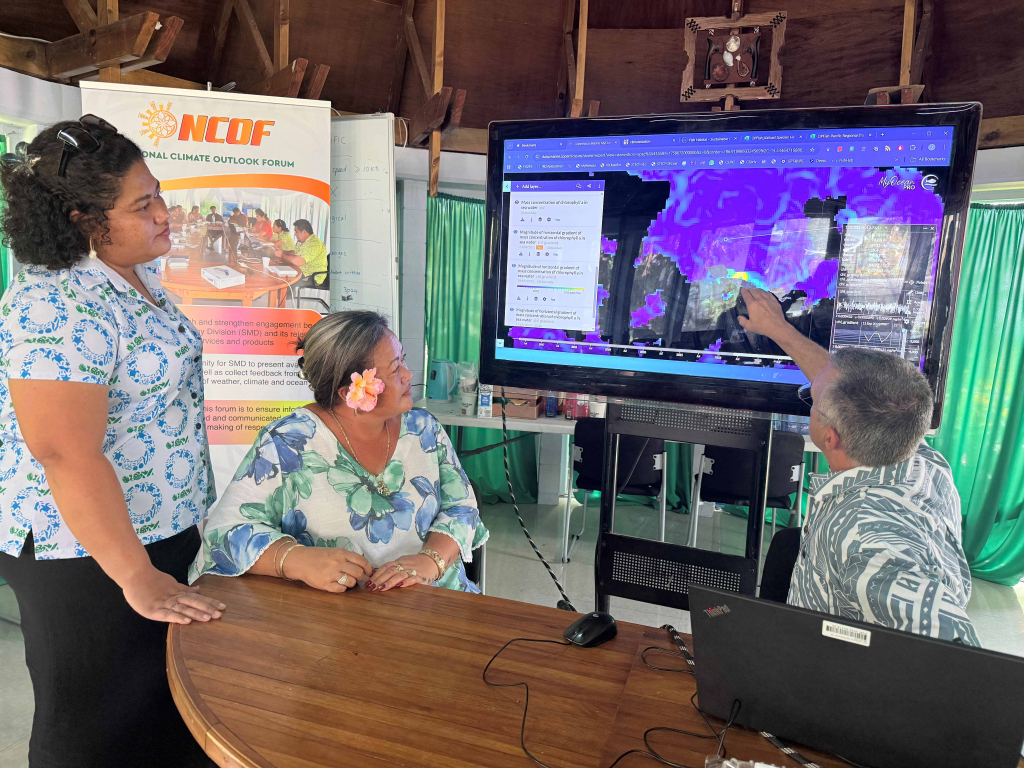
The Climate Station is a tool developed for National Meteorological and Hydrological Services (NMHSs) and has already been deployed to Regional Climate Centres since 2021, as a prototype. An introductory training for all Pacific NMHSs on the use of the Climate Station was held at the Pacific Climate Change Centre in Apia, Samoa, in May this year.
Following the introductory training, specific training is currently underway for Kiribati and Samoa, bringing together the national met service and the fisheries sector in the two pilot countries, to fully customise and use OPFish and species habitats to extract real-time information products for fisheries at a national level in the South-West Pacific.
"With ever-changing technology, I hope that all fisheries officers are informed and aware of these tools and skills, and use them accurately to ensure sustainable fisheries for now and in the future," shared Tererei Tekeraoi, Senior Verification Officer for the Kiribati Ministry of Fisheries & Ocean Resources.
“For the last 20 years, we’ve been using manual methods and traditional knowledge to find fish. Electronics and technology were not readily available, and when combined with the skill level of the crew, really limited our ability to maximise the fishing potential,” said Boat Owner and Fish Vendor from Apia, Samoa, Ms. Maselina Chu Shing.
“The OPFish and species habitats will be a game changer for fisheries. I never imagined this was possible, and I am grateful to the facilitator, Jean-Noël Druon for sharing skills, expertise and insights from the years of work put into developing these products,” Ms. Chu Shing added.
The support for enabling the deployment of the Climate Station for the Pacific Region and hosting the training was made possible with funding from the European Union’s Intra-ACP Climate Services and Related Applications (Intra-ACP ClimSA) Project, implemented by SPREP.
About ClimSA Pacific:
The Climate Services and Related Applications (ClimSA) Programme in the Pacific is a transformative initiative funded by the European Union and implemented by SPREP in partnership with the ACP Secretariat. ClimSA Pacific aims to strengthen climate information services, enhance early warning systems, and empower decision-making across key sectors through tailored, actionable climate products. By supporting National Meteorological and Hydrological Services (NMHSs) and regional coordination, ClimSA Pacific is building a more resilient and climate-informed Pacific community.