

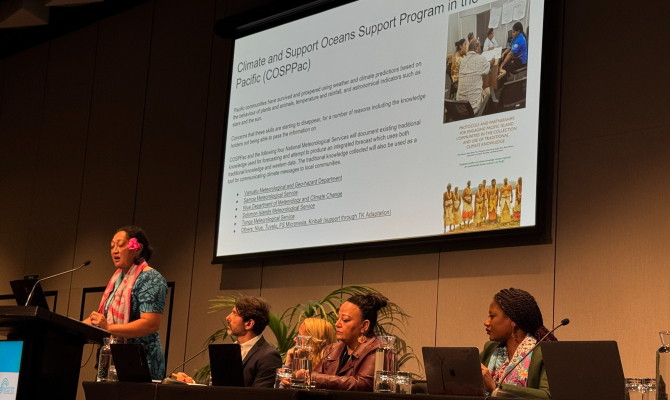
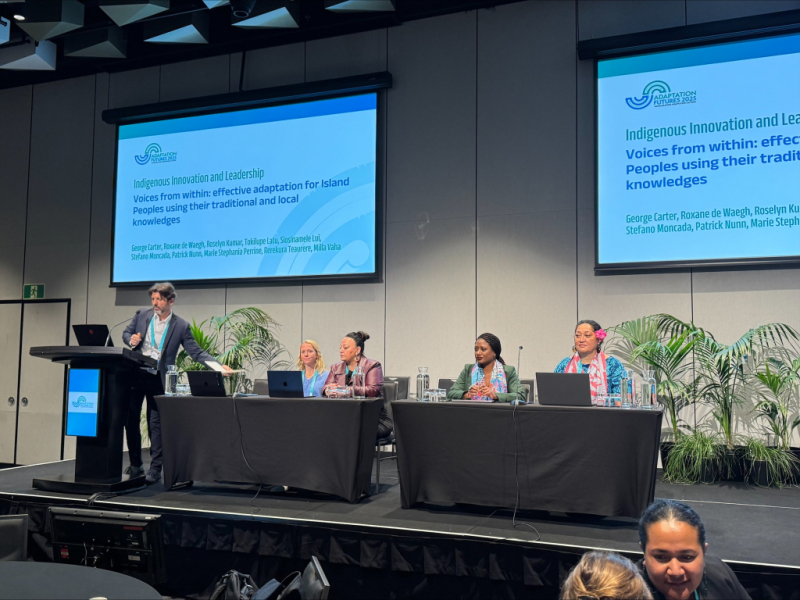
14 October 2025, Christchurch, New Zealand – The value of traditional knowledge held by Indigenous peoples in the Pacific and how these knowledge systems can inform climate policies for more resilient communities was further emphasised at the Eighth Adaptation Futures Conference in Christchurch, New Zealand.
The work of the Climate and Oceans Support Program in the Pacific (COSPPac) to integrate traditional knowledge into climate systems was highlighted during a session on Traditional Knowledge under the conference’s Indigenous Innovation and Leadership theme.
Ms. Siosinamele Lui, Traditional Knowledge Adviser for COSPPac3 at the Secretariat of the Pacific Regional Environment Programme (SPREP), presented this work as part of a paper co-authored with Sala Dr. George Carter of the Australian National University, titled “Advocating and Translating Traditional Knowledge to Inform Climate Policies.”
“Traditional knowledge is held mainly by our First Nations people, and they continue to pass on this knowledge and the right to own, govern, and be custodians of these systems from generation to generation,” Ms. Lui said.
“As Indigenous people, we already have our own knowledge systems and worldviews that are often not part of institutional governance. Yet we know we can contribute significantly to strengthening and building these systems, including climate policies.”
Ms. Lui acknowledged the growing recognition of the importance of Indigenous knowledge, but also highlighted the limited integration and documentation of these systems.
“In the Pacific, we’ve been able to collect and document traditional knowledge data, but little has been published globally. We have our own definitions, but there are still limitations in how traditional knowledge informs climate policies, nationally determined contributions, and climate project development,” she said.
This is where COSPPac’s support has been transformative in elevating this work to new heights.
COSPPac, one of the longest-running climate programmes in the Pacific, is funded by the Governments of Australia and New Zealand. It has successfully combined science with traditional knowledge through partnerships with Pacific National Meteorological and Hydrological Services (NMHSs) to issue early warnings.
“In the Pacific, our islands are isolated, and we don’t always have access to technology or monitoring equipment,” Ms. Lui said.
“But we do have in-depth knowledge. Knowledge we know like the back of our hand. Tapping into that brings more meaning and value to understanding the science and concepts we’re only now beginning to explore.”
COSPPac recognises that traditional knowledge is not only cultural, but also holds empirical value. The programme uses this data to support climate forecasting, fill scientific gaps, and build community-based early warning systems.
Accessing this knowledge respectfully has been key to COSPPac’s success.
“We recognise that effective community engagement depends on respect and understanding the rules of engagement. COSPPac has developed protocols that address data sovereignty and acknowledge that ‘free, prior, and informed consent’ may mean something different in our Pacific communities,” Ms. Lui explained.
This important work is now gaining global traction. Pacific traditional knowledge holders are engaging with the Local Communities and Indigenous Peoples Platform (LCIPP) under the UN Framework Convention on Climate Change (UNFCCC).
“This platform allows us, as a Pacific group, to contribute to climate leadership and bring our grassroots work into global policy spaces,” Ms. Lui said.
“We’re participating in discussions on climate indicators used by our communities and building capacity to ensure traditional knowledge continues to be monitored and collected.”
Ms. Lui concluded by emphasising the need for continuity and inclusion of traditional knowledge in global discussions on climate finance, loss and damage, and adaptation ensuring that community-led work informs policy at all levels.
The Adaptation Futures Conference 2025 is being held from 13–16 October at the Te Pae Christchurch Convention Centre in Christchurch, New Zealand.
For more information, please contact:
Ms. Siosinamele Lui – siosinamelel@sprep.org