


30 October 2025, Nadi - Senior maritime and environmental experts from across the Pacific region have gathered in Nadi Fiji for a four-day regional workshop and expert meeting focused on implementing the International Convention for the Control and Management of Ships' Ballast Water and Sediments (BWM).
Hosted by the Government of Fiji and co-organised by the International Maritime Organization (IMO) and the Secretariat of the Pacific Regional Environment Programme (SPREP), the meeting addresses the critical need for a unified approach to ballast water management in the region. Ballast water—water carried in ships' tanks to maintain stability, is a major pathway for the transfer of harmful aquatic organisms and pathogens, which pose a devastating threat to the Pacific’s unique marine biodiversity, fisheries, and public health.
The primary objective of the workshop is to develop and harmonise regional procedures for enforcing the BWM Convention, ensuring consistency across Pacific Island nations in measures like designating ballast water exchange areas and applying additional control measures.
"This workshop is vital for translating global standards into effective regional action,” said Dr. Theofanis Karayannis, Head of Marine Biosafety, Marine Environment Division, International Maritime Organization (IMO).
“Our goal is to ensure that Pacific Island nations have the necessary technical capacity and a harmonised approach to enforce the BWM Convention, safeguarding these precious marine ecosystems.”
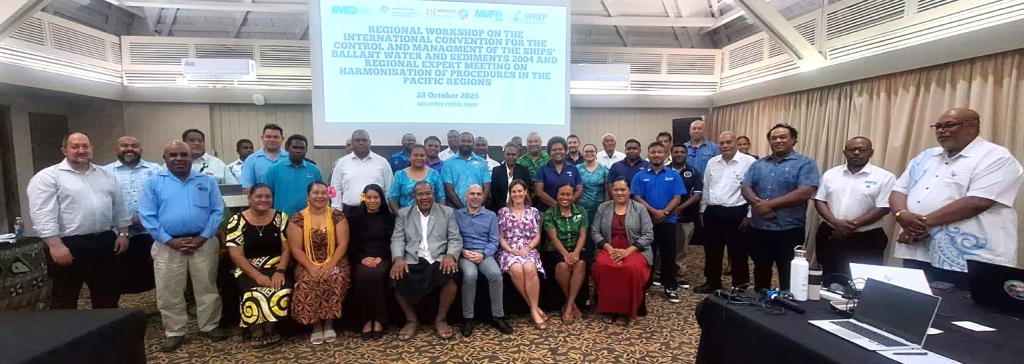
Mr Paula Baleilevuka, Permanent Secretary for Fiji’s Ministry of Public Works, Transport and Meteorological Services, said that as a hub for regional shipping and a nation deeply dependent on its marine resources, Fiji is proud to host the critical expert meeting.
“For Small Island Developing States like ours, where the ocean defines not just our geography but our identity, invasive marine species pose a profound threat — to our biodiversity, our fisheries, and our coastal ecosystems. These ecosystems sustain our communities, protect our shorelines, and support key sectors such as tourism and trade. Therefore, effective implementation of the BWM Convention is not simply a technical requirement — it is our moral and environmental responsibility to protect our shared Pacific heritage," said Mr Baleilevuka.
Dr. Mohammed Zullah, SPREP Pollution Adviser said invasive aquatic species are a silent, yet devastating threat to the Blue Pacific’s biodiversity and food security.
“The successful harmonisation of ballast water management procedures across our region, driven by this workshop, is a monumental step toward building resilience and protecting the ocean that connects us all," he said.
The outcomes of the Nadi meeting will form the basis for legislative reform and operational policy updates across participating Pacific Island countries, strengthening the region’s defence against marine invasive species.
Main photo credit: madscinbca / Adobe Stock