

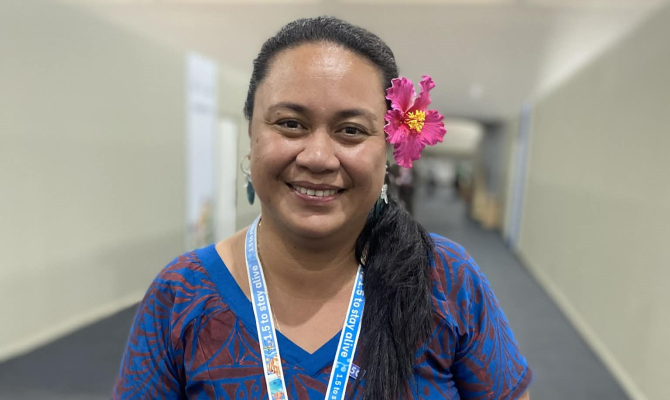
16 November 2025, Belem - The goal of 1.5 to stay alive for Small Island Developing States (PSIDS) is non-negotiable, this is for our survival.
Ms Vainalepa Toiata Apelu- Uili, of Samoa, lead negotiator for the AOSIS and Pacific Small Islands Developing States (PSIDS) for the Mitigation Workstream, says the success or failure of COP30 hinges on whether the decisions made keep the 1.5 degrees Celsius language intact.
“It’s going to take political will and strong ministerial engagement to defend the 1.5,” she said. “1.5 degrees Celsius for Small Island Developing States is non-negotiable.”
The call for 1.5 to stay alive refers to the promise of the Paris Agreement to limit warming to 1.5 degrees Celsius. Anything warmer and the impacts of climate change will be dire.
As negotiations wrap up for the first week of COP30 in Belem, Ms Apelu-Uili provides us with an update on the Mitigation Workstream:
QUESTION: Talofa Vainalepa, can you tell us what the key asks are from the Pacific at COP30?
ANSWER: 1.5 to stay alive for Samoa and Small Island Developing States (SIDS) is non-negotiable, this is vital, we need this 1.5 for our survival.
So here at COP30, and on top of our mitigation priorities is to defend the 1.5 limit/target. This is non-negotiable for our survival, it is anchored in the best available science by IPCC.
On the Mitigation Work Programme (MWP), this must continue with an immediate effectiveness review, not delayed until 2026. We want structured Mitigation Global Dialogue (GD) outcomes, ensuring actionable outputs linked to the Global Stocktake (GST) outcome.
On the Technology Executive Committee (TEC) and Climate Technology Centre and Network (CTCN), we resist expanding mandates of technical bodies to avoid distortion of their roles. On the Digital Platform concerns, we express concerns that the proposed platform does not duplicate existing mechanisms or undermine the MWP mandate.
QUESTION: How have negotiations progressed/or lack of?
ANSWER: As you’d expect in this process, things are moving very slow. It’s very frustrating. Week one has ended with an informal note forwarded to CMA for Week 2 negotiations
There are major divergences on issues such as the mandate and scope of the MWP, Global dialogues outcomes, in terms of the structure vs take note only. There are also divergence on the digital platform design and role.
Some parties have also argued that the 1.5 language is 'scientifically inappropriate' and want to delete GST references entirely. Others insist on non-prescriptive, facilitative approach, reject the 1.5 language, oppose early review of the MWP continuation.
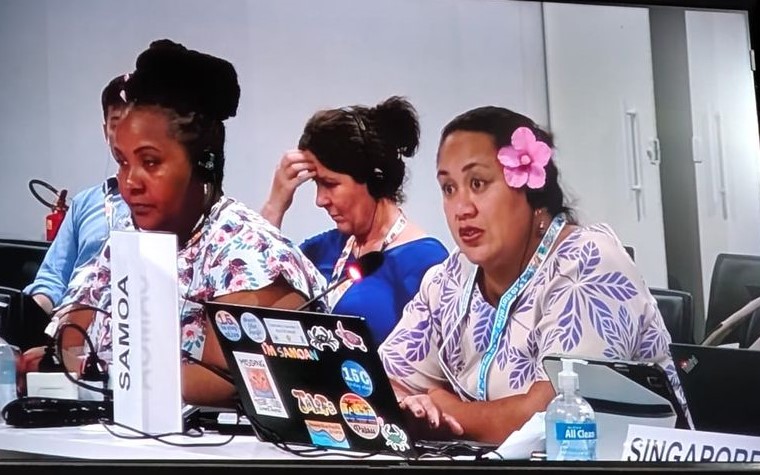
QUESTION: How do you see negotiations playing out in the remaining days of COP30. And what will it take for a positive outcome in as far as the Pacific is concerned?
ANSWER: It’s going to take political will and strong ministerial engagement to defend the 1.5 and secure structured GD outcomes, reinforce that MWP complements GST without imposing prescriptive measures and narrow the scope of the Digital platform.The bottom line for the Pacific is that the success or failure of this COP hinges on keeping that 1.5 language intact, ensuring MWP delivers real mitigation outcomes, and resisting dilution of ambition under the guise of flexibility.
We anticipate continued pressure from major emitter groups. But, COP30 must be the COP of truth, where the 1.5°C target—grounded in science—remains the ultimate goal.
The 30th Conference of the Parties to the UN Framework Convention on Climate Change (UNFCCC) is taking place from 10-21 November 2025 in Belem, Brazil.
It is being attended by Pacific leaders and their delegations, who are advocating for the survival of Pacific communities who continue to be at the forefront of climate change impacts.
Support for our Pacific Islands at COP30 from members of the Council of Regional Organisations of the Pacific (CROP) is through the One CROP mechanism led by the Secretariat of the Pacific Regional Environment Programme.
Members of one CROP include: The Secretariat of the Pacific Regional Environment Programme (SPREP) – Lead, Pacific Islands Development Program, Pacific Islands Forum Fisheries Agency, Pacific Island Forum Secretariat, Pacific Community.
A key part of amplifying the One Pacific Voice at COP30 is the Moana Blue Pacific Pavilion and the Pacific Delegation Office. The Moana Blue Pacific Pavilion at COP30 is a Pacific partnership with the Governments of Australia and New Zealand managed by the Secretariat of the Pacific Regional Environment Programme (SPREP).
The Pacific Delegation Office at COP30 is a Pacific partnership with the New Zealand Government managed by the Secretariat of the Pacific Regional Environment Programme (SPREP).
To learn more about the Pacific at COP30 please visit: https://www.sprep.org/cop30