

As Vanuatu continues to face growing threats from climate change including coastal erosion, declining marine biodiversity, and forest degradation, communities are coming together to strengthen their resilience through ecosystem-based solutions.
The Secretariat of the Pacific Regional Environment Programme (SPREP) is currently hosting a Cross-Site Ecosystem-based Adaptation (EbA) Learning Event in Port Vila, under the Pacific Ecosystem-based Adaptation to Climate Change (PEBACC+) Project. The three-day gathering unites community representatives from Lenakel, Port Resolution, and Port Vila to exchange practical experiences and strengthen collaborative approaches to Nature-based Solutions (NbS).
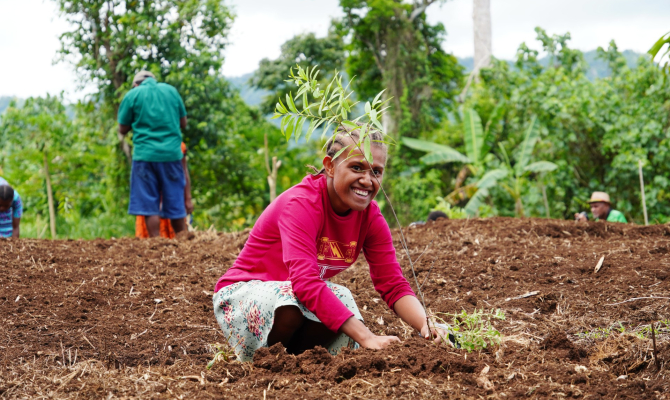
The learning event focuses on real-life practices that help communities restore ecosystems and protect livelihoods including marine and terrestrial conservation, agroforestry and forest restoration, and invasive species management. Participants engage in field visits, hands-on restoration activities, and peer learning exchanges designed to turn shared knowledge into practical action.
Ms Serah Nielyeba, a 28-year-old mother of two and an intern with the Department of Forestry in Tanna, shared her appreciation of the learning event. She said, “I’ve learned about agroforestry and the importance of protecting the forest. This learning event has inspired me to pursue my dream of practicing agroforestry. It’s meaningful to me because one day, when I am gone, my children will benefit from the trees we plant today. I now understand the true value of trees, their benefits are great, and they are vital for our future.”
Mr Alfred Reva, a participant from Port Resolution, added, “This training has helped me understand the different environmental challenges across Vanuatu. It’s given me knowledge I can take back to my community. Agroforestry is especially suited to Port Resolution because it allows us to make the most of small land areas for both farming and tree planting. I’ve learned how protecting our ecosystem creates the harmony we need with nature. I’m grateful for this opportunity and hope to share this knowledge with the next generation.
.JPG)
Funded through the Kiwa Initiative and the French Facility for Global Environment (FFEM), the PEBACC+ project works to build climate resilience across Fiji, Vanuatu, Solomon Islands, New Caledonia, and Wallis and Futuna.
“Communities in Vanuatu are on the frontlines of climate change,” said Mr William Bani, PEBACC+ Country Coordinator at SPREP. “This event helps them share what works, learn from one another, and build stronger networks for ecosystem-based adaptation. Today’s focus is on terrestrial ecosystems, and tomorrow we’ll turn to the marine environment. It’s all about equipping people with the knowledge and confidence to lead locally driven solutions.”
Close to 20 participants attended the learning event, and expected outcomes include a deeper understanding of effective EbA and NbS practices for coastal and forest ecosystems in Vanuatu; stronger community partnerships and collaboration across participating sites; practical action plans to enhance ecosystem management in Lenakel and Port Resolution; and documentation of lessons learned to guide ongoing and future adaptation work.
The Cross-Site EbA Learning Event from 13-14 November 2025, underscores SPREP’s commitment to promoting inclusive, gender-responsive, and community-driven approaches to climate adaptation ensuring that Pacific people remain at the heart of the solutions shaping their future.
PEBACC+ is a regional project implemented by SPREP and funded by the Kiwa Initiative through its donors the European Union, Agence Française de Développement (AFD), Global Affairs Canada, Australian Government Department of Foreign Affairs and Trade (DFAT) and New Zealand Ministry of Foreign Affairs and Trade (MFAT), with co-financing from French Facility for Global Environment (FFEM). This four-year project seeks to strengthen the resilience of ecosystems, economies, and communities to the impacts of climate change in Fiji, New Caledonia, Wallis and Futuna, Solomon Islands and Vanuatu. The project will develop, sustain, and institutionalize Ecosystem-based Adaptation to climate change in these five countries and territories.
For further information please contact:
William Bani, PEBACC+ Country Coordinator, SPREP; email: williamb@sprep.org or
Setaita Tavanabola, PEBACC+ Communications Officer, SPREP; email: setaitat@sprep.org