

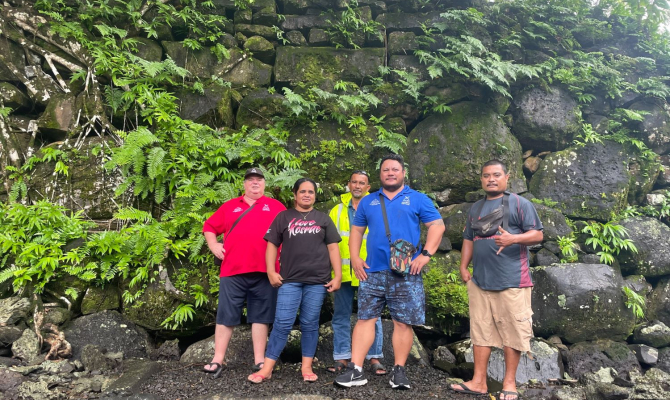
28 November 2025, Kosrae, Federated States of Micronesia - On the island of Kosrae, in the Federated States of Micronesia (FSM), lies one of the Pacific’s most extraordinary heritage sites, the Lelu Ruins, often called the “stone city.” For centuries, it has stood as a silent witness to Kosrae’s history, culture, and resilience, which is not only a treasure for the people of Kosrae, but also a beacon for preserving cultural and ecological heritage and where conservation is not optional, it is essential.
On Kosrae, centuries ago, coral and basalt were stacked into towering walls, forming the royal city of Lelu where, chiefs ruled, ceremonies echoed and the Pacific’s tides carried traders to its shores. Today, the ruins whisper under a different weight, not of kings, but of creeping vines and invasive weeds.
These invasives, strangers to Kosrae’s soil, climb the ancient stones, hide the stories carved into their foundations but the people of Kosrae have not forgotten. Now armed with knowledge, resources and guidance, they fight back led by the Kosrae Island Resource Management Authority (KIRMA) in partnership with the Secretariat of the Pacific Regional Environment Programme (SPREP) based Pacific Regional Invasive Species Management Support Service (PRISMSS).
Through the PRISMSS Resilient Ecosystems-Resilient Communities (RERC) programme under the Restoring Island Resilience (RIR) project the Lelu Ruins community is reclaiming and protecting their heritage while reminding the world that Pacific resilience is as old as the ruins themselves. The PRISMSS RIR project is funded by the by the New Zealand Ministry of Foreign Affairs and Trade (NZMFAT), the United Kingdom International Development.

During a recent mission to Kosrae, the SPREP Invasive Species team heard from Mr. Swanson Thompson, a member of the Lelu Ruins community, who reflected on the enduring significance of the site for the local community.
“I am one of the descendants of the landowners of the Lelu Ruins, through my mother’s Sigrah family, and am part of the Lelu Ruins Organisation, a collective of 11–12 families who steward this sacred site.”
“For me, the ruins are more than ancient walls they are living connections to our ancestors, a reminder of the generations who shaped Kosrae’s identity.”
At its peak in the 1400s, Lelu was home to around 1,500 residents, with Kosrae’s population spread across the island. The ruins became the centre of governance, where kings and chiefs ruled, and where social hierarchy was sharply defined, the king, twenty high chiefs, fifty low chiefs, and commoners.
Only the ruling elite lived within the stone city, while others resided across the island. There were several compounds, burial-related processing areas, dwelling areas, communal spaces, canoe landing sites, and channels that connected everything.
“Behind the vegetation lie sacred preparation sites, where royal bodies were processed before final ceremonies. Bones were carried to a small island near the swimming pool and placed into a deep blue hole, a ritual that sealed their passage into eternity.”
The earliest documented record of Kosrae dates to 1824, when French explorers mapped the ruins. Archaeologists have since identified more than 100 structures, including compounds, burial sites, canoe landings and ceremonial spaces.
“Even though the site has been abandoned for centuries, it remains a sacred place,” Thompson explained. “Over time, invasive weeds has reclaimed much of the site. Invasive species such as Merremia, bronze-leaf Clerodendrum, Mikania, and rats now threaten both the ruins and Kosrae’s biodiversity.

“I think the PRISMSS RERC programme will be very helpful for maintaining the site, especially removing invasive trees that damage the structures and controlling rats. Monitoring and research will also help.”
“I believe this project will be successful, and I am confident the landowners will be happy to support the work being done here.”
For Kosrae, maintaining Lelu Ruins is more than heritage preservation it is a pathway to sustainable development. Tourism revenue, ecological restoration and cultural pride all converge here. The Ruins is Kosrae’s most accessible tourist attraction and cruise ships bring hundreds of visitors twice a year.
“I personally host around 50 guests annually and here tourism revenue is managed by landowners, reinforcing local stewardship. Our ruins brings in visitors and revenue and focusing the project on this site will benefit Kosrae greatly,” Mr Thompson affirmed.
Families occasionally gather for cleaning projects, focusing on the entrance and northern side, where compounds and communal areas are located. These efforts, though modest, highlight the community’s commitment to keeping the site accessible.
“Traditional knowledge remains embedded in the landscape, there is a lot of traditional knowledge about these plants, especially among the older generations.”
“Native plants serve medicinal, household and cultural purposes such as the Kawak for asthma treatment, materials for roofing and weaving and plants used traditionally to stun fish apart from the firewood for daily life.”
SPREP Invasive Species Adviser reflected that, “this is where our donor support becomes transformative as by investing in invasive species management, our donors help protect not only the ruins but also Kosrae’s biodiversity where every contribution strengthens the bond between cultural heritage and ecological resilience.”
“The story of Lelu Ruins is not just Kosrae’s story it is humanity’s story as it is about how communities protect their heritage, how culture and ecology intertwine and how partnerships make this all happen.”
“Our work in Lelu Ruins means investing in both heritage and hope as visitors, it means experiencing one of the Pacific’s most remarkable wonders and for the community of Kosrae, it means honouring their ancestors while protecting their future.”
Protecting Lelu Ruins is not just about preserving stones it’s about safeguarding identity, history, and resilience. Invasive species management ensures that the community can still walk through Kosrae’s ancient capital and see the legacy of their ancestors.
--------------------------------------------------------------------------------------------------------------------------------------------------
About PRISMSS: The Pacific Regional Invasive Species Management Support Service (PRISMSS) is a coordinating mechanism designed to facilitate the scaling up of operational management of invasive species in the Pacific. PRISMSS, which is led by the Secretariat of the Pacific Regional Environment Programme (SPREP) brings together experts to provide support within the Pacific region with a focus on protection of indigenous biodiversity and ecosystem function. As a service provider, PRISMSS provides a comprehensive suite of support services in a cohesive, effective, efficient, and accessible manner to Pacific Island countries and territories.
Restoring Island Resilience (RIR): The PRISMSS - Restoring Island Resilience (RIR) is a New Zealand-PRISMSS collaboration project that aims to improve Pacific Island Countries and territories livelihoods and resilience to climate change by reducing the impact of invasive species on natural and agricultural ecosystems through the six PRISMSS programmes.
PRISMSS Powered by: New Zealand Foreign Affairs & Trade, UK International Development, GEF, United Nations Environment Programme & SPREP.
PRISMSS Partners: Bioeconomy Science Institute, Birdlife International, Earth Sciences New Zealand, New Zealand Department of Conservation, Island Conservation, the Pacific Community and SPREP.
PRISMSS Programmes: Protect Our Islands (POI), Predator Free Pacific (PFP), Natural Enemies Natural Solutions (NENS), War On Weeds (WOWs), Resilient Ecosystems Resilient Communities (RERC), and Protect Our Marine Areas (POMA)
For additional information please contact Mr Dominic Sadler, PRISMSS Manager on dominics@sprep.org or Mr Nitish Narayan, PRISMSS Communications & Liaison Officer on nitishn@sprep.org