

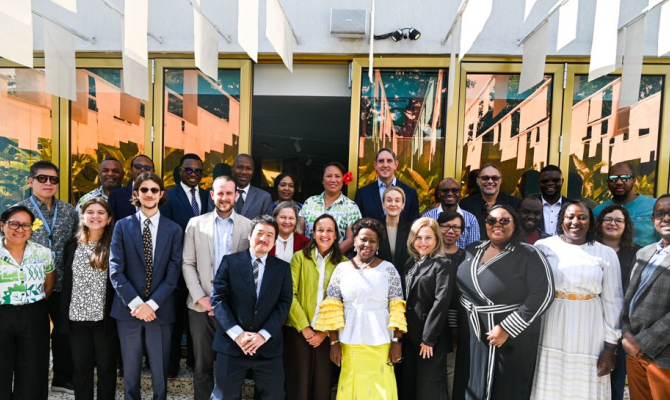
9 December 2025, Nairobi Kenya - After years of continuous partnership and capacity development to advance environmental governance across Africa, Caribbean and the Pacific regions, the African, Caribbean and Pacific Multilateral Environmental Agreements (ACP MEA) Phase 3 Project, concluded with the final Project Steering Committee meeting on 7 December 2025 in Nairobi, Kenya.
The Project Steering Committee, chaired by the European Commission, OACPS Secretariat and UNEP, brought together project coordinators and project managers from regional hubs: Africa, Caribbean, and the Pacific, alongside global partners such as FAO, MEA Secretariats and UNEP Regional Seas Branch, to reflect and highlight achievements, share lessons learned, and chart pathways for sustaining project outcomes beyond 2025.
It was also, an important opportunity to consolidate lessons learned, ensure that tools, knowledge products, and capacity gains remain accessible and beneficial for countries in the years to come.
In her keynote address at the opening session, Ms. Patricia Mbote, Director of the Law Division at the United Nations Environment Programme (UNEP), highlighted the enduring impact of the programme.
“Over the past decade ACP MEA Programme has stood out as the most significant partnership advancing environmental governance across Africa, the Caribbean and the Pacific,” she said. “Phase III has built on earlier achievements to deepen institutional capacity, reinforcement regional governance frameworks, and supporting countries in meeting their global commitments.”
Regional hubs delivered comprehensive presentations showcasing progress, success stories, and tangible impacts achieved under Phase III.
The representative of the European Commission’s Directorate-General for International Partnerships, acknowledged the significant contributions of ACP MEA Phase III to major global environmental milestones, including the Kunming–Montreal Global Biodiversity Framework, the Global Framework on Chemicals, and the BBNJ Agreement. He encouraged partners to preserve the strong networks established through the programme, sustain institutional processes, and continue using the tools and capacities developed.
He also underscored the need to focus on outcomes with the greatest strategic impact and to build synergies with ongoing regional and global initiatives. The European Commission conveyed its appreciation to all partners, past and present, for their commitment and collaboration throughout the programme.
Speaking on the achievements of the Pacific Region, Mr. Jope Davetanivalu, Director of Environmental Governance at the Secretariat of the Pacific Regional Environment Programme (SPREP), highlighted key milestones in the broad areas of Environmental Governance, Ocean Governance and MEAs Support. These include the development of key national and regional frameworks for member countries, strengthened capacity of the Geographic Information System (GIS) resulting in the successful launch of the Emma Luke Earth Observation, the growing success of the Pacific Network for Environment Assessment (PNEA) Community of Practice and the support to member countries in their engagement to MEAs conference of parties and regional preparatory meetings.
Providing an overview of progress under the Noumea Convention, Ms. Anastacia Amoa-Stowers, ACP MEA 3 Project Coordinator at SPREP, acknowledged the assistance of the ACP MEA Phase III project in supporting Tuvalu’s domestic process to ratify the Noumea Convention. The total number of Contracting Parties to the Noumea Convention is now thirteen. The next 19th Conference of the Contracting Parties to the Noumea Convention will formally welcome Tuvalu. Ms. Amoa-Stowers highlighted the growing potential of the Noumea Convention to support the implementation of the BBNJ Agreement, plastic pollution and regional ocean governance.
As the ACP MEA Programme formally concludes, the lessons learned and partnerships forged over the years will guide the next steps toward sustaining and building on the work achieved. SPREP and its partners remain committed to ensuring that the foundations laid through the project continue to strengthen environmental governance, accelerate ocean governance actions and resilience across the Pacific region.