

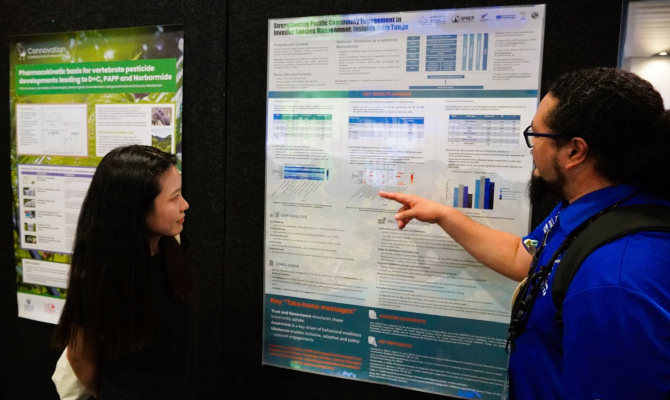
19 February 2026, Auckland, New Zealand - Invasive species are a major threat to Pacific islands, yet technical solutions alone are insufficient without community trust, inclusion and culturally grounded engagement. Drawing on new evidence from Vava’u, Tonga, a recent research traces a clear line between culturally grounded engagement and sustained biosecurity action in Pacific island communities. By having the right tools, the right people and the approaches are important when working with Pacific Island communities, the Vātalanoa approach is one of those adaptable Pacific grounded approaches.
The research, undertaken by SPREP led Pacific Regional Invasive Species Management Support Service (PRISMSS) demonstrates how Vātalanoa, a relational, Pacific led methodology, embeds inclusive engagement throughout the entire project cycle. When communities see their knowledge reflected, receive feedback and are actively involved, regardless of age, gender, education, or ability, participation increases, data quality improves, governance becomes more relevant and pathways to behaviour change strengthen.
Presenting an overview of the findings at the Islands Invasive Species Conference 2026 in Auckland, lead author Dr William Young, GEDSI & Traditional Knowledge Coordinator for PRISMSS, explained that “Vātalanoa is an adaptive, Pacific-led engagement framework that integrates social groups, knowledge domains, and the full project cycle to ensure inclusive, culturally grounded decision-making in invasive species management.”
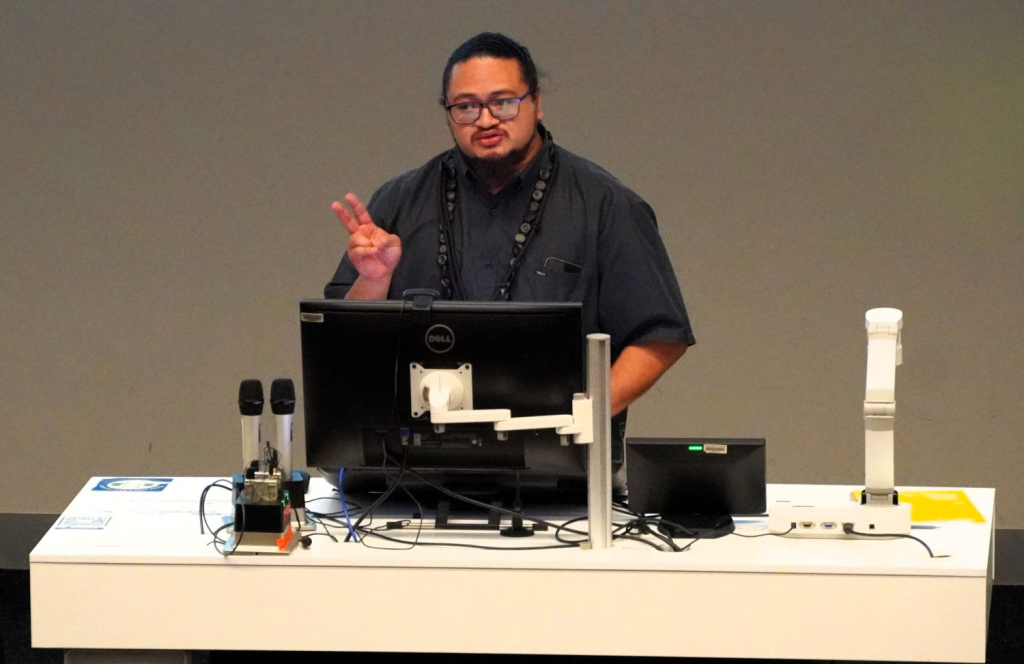
The research highlights the urgent need to expand biosecurity education and awareness, particularly among young people and individuals with lower levels of formal education.
Findings show that while communities express strong concern for environmental protection, many lack a clear understanding of core biosecurity concepts.
“To bridge this gap, the study recommends targeted education campaigns that use clear and accessible language, grounded in practical, real life examples that resonate with local experiences,” shared Dr William during the presentation at the conference.
“Integrating biosecurity topics into school curricula, youth programmes, and community workshops is essential, as is ensuring that all educational materials and communications are delivered in the local language most widely spoken. This approach supports comprehension, cultural relevance, and long term engagement.”
The study site in Vava’u revealed a risk landscape where climate hazards rank as dominant environmental concerns, with cyclones, storm surge, drought, pollution, and sea level rise occupying the top five places in community scoring.
A significant insight from the research was the motivation participation gap, a situation in which community members are highly motivated to contribute to biosecurity efforts but remain unaware of how or where to participate. Increasing the visibility of participation opportunities through trusted communication channels is therefore critical.
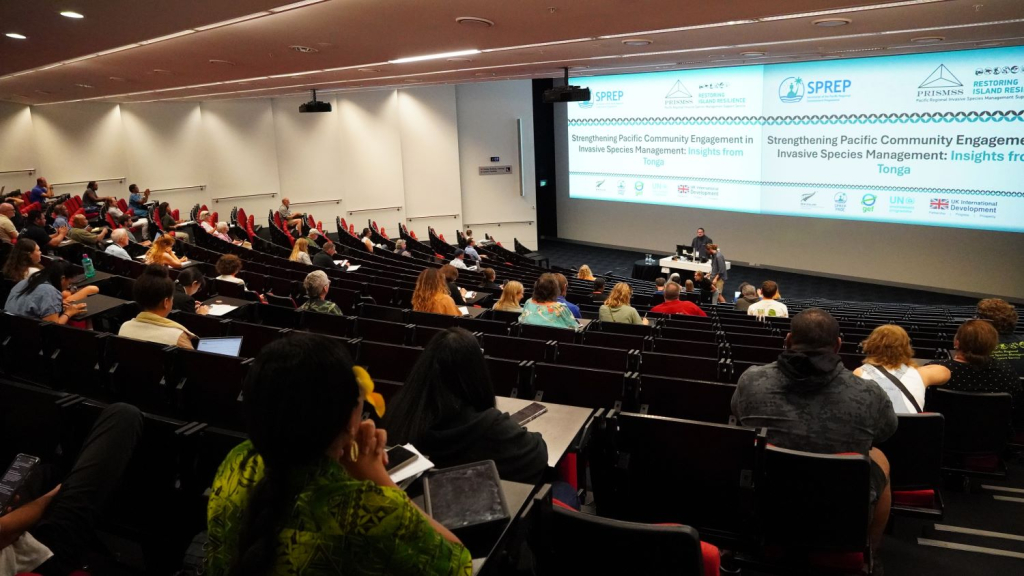
The study suggests that offering incentives, whether in the form of learning opportunities, modest financial support, or endorsements from respected local institutions such as villages or churches, can further strengthen engagement.
Monitoring participation by subgroup ensures that efforts remain inclusive and responsive to community needs.
Traditional knowledge also plays a vital role in effective biosecurity management. The research emphasises the importance of documenting and integrating cultural practices and local ecological knowledge into formal programmes.
“Collaborating with elders, faith based organisations, and cultural leaders reinforces community ownership and ensures that biosecurity actions are grounded in values and practices that have guided resource stewardship for generations.”
“This fusion of traditional and scientific knowledge strengthens the legitimacy and sustainability of interventions.”
Enhancing inclusion and representation emerged as another core recommendation. The study found that despite high motivation, youth and people with disabilities were under represented in decision making processes, and women’s groups were not consistently involved in leadership roles.
Establishing forums and leadership development pathways for these groups can help address representation gaps. Setting measurable inclusion targets and regularly assessing progress ensures accountability and helps create a more equitable and effective biosecurity governance structure.
Improving monitoring and evaluation systems is also essential for long term success. The research recommends participatory monitoring approaches that involve community members directly in data collection and assessment processes.
“By disaggregating data by age, gender, education level and disability status, programme managers can identify disparities and tailor interventions accordingly as such data driven approaches support continuous improvement and transparency, ensuring that communities see tangible results from their involvement.”
Overall, the research identified critical gaps in knowledge, participation, communication, leadership, cultural integration and inclusion that undermine effective invasive species and biosecurity management in Tonga.
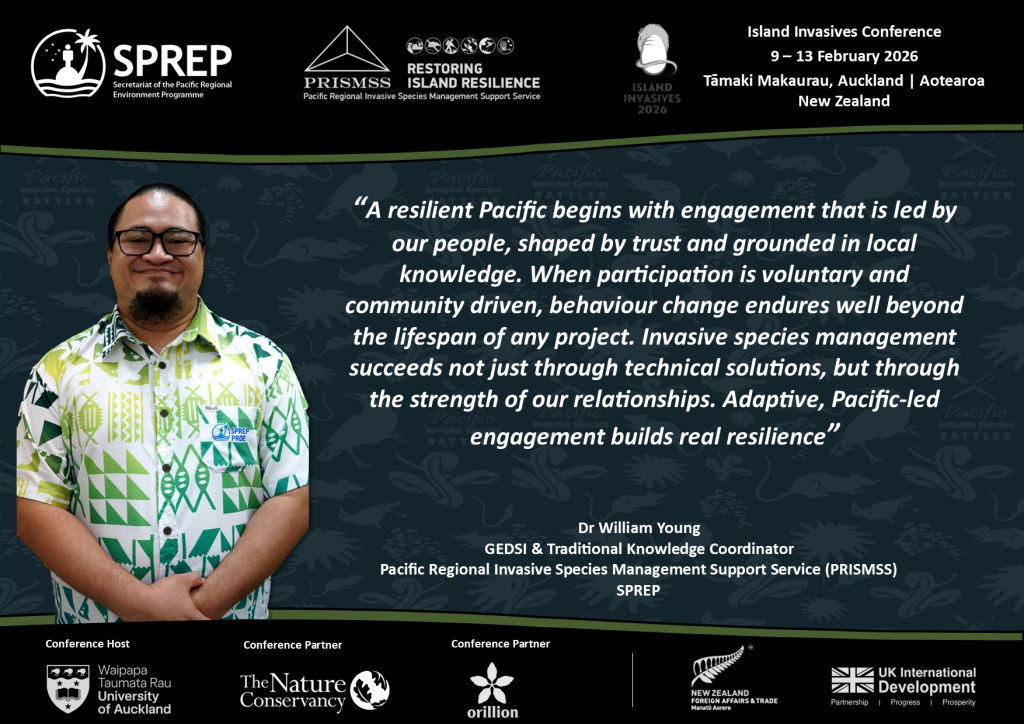
Dr William Young concluded by sharing that, “investing in adaptive, Pacific-led engagement is essential for building long-term island resilience, as when communities trust the process and see their knowledge reflected, participation becomes voluntary rather than enforced, which is critical for long-term invasive species management where sustained behaviour change is required beyond the life of a project.”
“Effective invasive species management in the Pacific depends as much on relationships as on technical solutions.”
SPREP Invasives Species Adviser commented that “addressing these gaps will require a combination of strengthened education, better communication strategies, deeper cultural integration and more inclusive decision making processes.”
“Together, these measures can support a more resilient, community centred and sustainable approach to protecting Tonga’s biodiversity and safeguarding the wellbeing of its communities and through our PRISMSS programmes we are providing that assistance.”
The research was enabled by the New Zealand Ministry of Foreign Affairs and Trade (NZMFAT), the Secretariat of the Pacific Regional Environment Programme (SPREP), PRISMSS, Vava’u Environmental Protection Association (VEPA) and its community ambassadors, the Tongan Government through MEIDECC Tonga, the participating communities of Vava’u and independent consultants Ms Elizabeth Palu and Ms Kelvina Barrett-Manako.
Co-authors of the research paper include SPREP Invasive Species Adviser, Mr David Moverley, Mr Dominic Sadler, PRISMSS Manager and Mr Steve Menzies from Flinch Marketing.
For Tonga and for Pacific islands facing the intersecting pressures of climate hazards and invasive species, the path to enhanced biosecurity is built on respect for local knowledge, inclusive engagement and the practical mechanics of trust.
Island Invasives 2026 was held from 9–13 February 2026 in Tāmaki Makaurau (Auckland), Aotearoa New Zealand, hosted by the University of Auckland. The conference goal is knowledge transfer to accelerate uptake of eradication methodologies and enhance biodiversity and the lives of people on islands around the world. With more than 300 experts from regions as diverse as the Pacific, Caribbean, Mediterranean, and the Indian Ocean, the conference is showcasing cutting edge methodologies, case studies, and emerging technologies, all aimed at protecting island biodiversity and improving community livelihoods. New Zealand, globally recognised for its leadership in island restoration, hosts the event as a demonstration of national commitment to ecological resilience, conservation science, and large scale eradication success.
About PRISMSS: The Pacific Regional Invasive Species Management Support Service (PRISMSS) is a service designed to facilitate the scaling up of operational management of invasive species in the Pacific. The SPREP Center of Excellence, PRISMSS brings together experts to provide support within the Pacific region with a focus on protection of indigenous biodiversity and ecosystem function. As a service provider, PRISMSS provides a comprehensive suite of support services in a cohesive, effective, efficient, and accessible manner to Pacific Island countries and territories.
Restoring Island Resilience (RIR): The PRISMSS - Restoring Island Resilience (RIR) is a New Zealand-PRISMSS collaboration project that aims to improve Pacific Island Countries and territories livelihoods and resilience to climate change by reducing the impact of invasive species on natural and agricultural ecosystems through the six PRISMSS programmes.
PRISMSS Powered by: New Zealand Foreign Affairs & Trade, UK International Development, GEF, United Nations Environment Programme & SPREP.
PRISMSS Partners: Bioeconomy Science Institute, Birdlife International, Earth Sciences New Zealand, New Zealand Department of Conservation, Island Conservation, the Pacific Community and SPREP.
PRISMSS Programmes: Protect Our Islands (POI), Protect Our Islands (POI), War On Weeds (WOWs), Natural Enemies Natural Solutions (NENS), Resilient Ecosystems Resilient Communities (RERC) and Protect Our Marine Areas (POMA).
For additional information please contact Mr Dominic Sadler, PRISMSS Manager on dominics@sprep.org or Mr Nitish Narayan, PRISMSS Communications & Liaison Officer on nitishn@sprep.org