


After six intensive months of classroom learning and on-the-job training, a new generation of Pacific meteorological technicians graduated today from the Basic Instructional Package for Meteorological Technicians (BIP-MT) programme, a World Meteorological Organization (WMO)-accredited entry-level qualification for operational meteorologists.
The programme was hosted by the Fiji Meteorological Service (FMS), with regional support from the Secretariat of the Pacific Regional Environment Programme (SPREP) through the European Union-funded Intra-ACP Climate Services and Related Application (ClimSA) Project and the Weather Ready Pacific (WRP) programmes.
The graduation, held at the Tanoa International Hotel, celebrated the achievements of 12 regional students from Cook Islands, Kiribati, Nauru, Papua New Guinea, Samoa, Tonga, Tuvalu, Vanuatu and alongside eight students from Fiji, with almost half of the students being female.
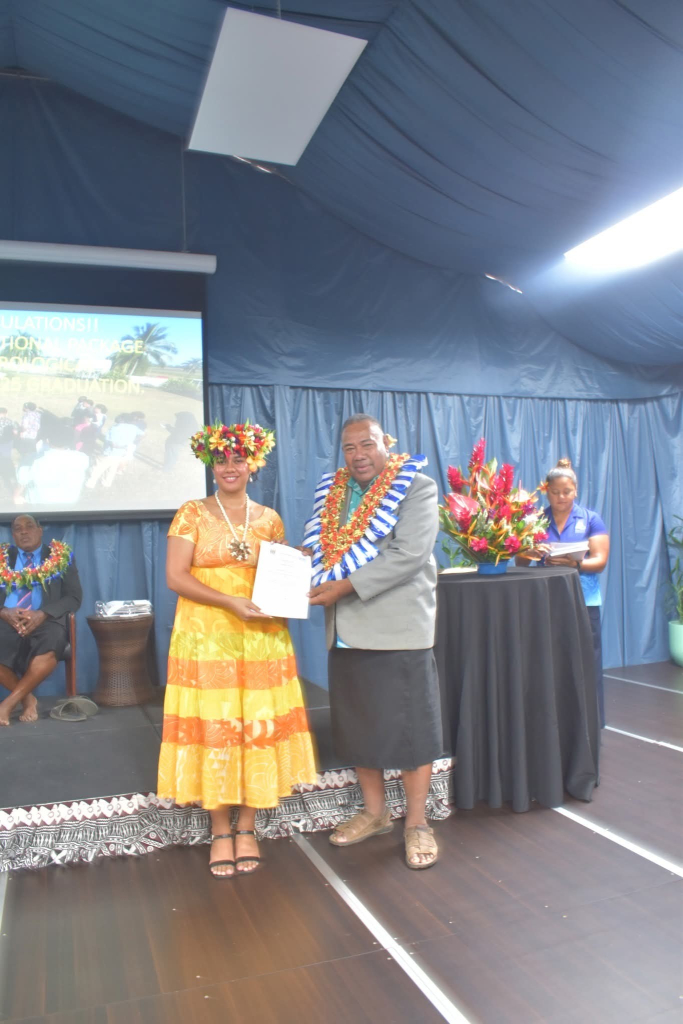
The event marked not only the completion of a technical qualification but a regional milestone – the strengthening of the Pacific’s ability to observe, interpret, and communicate the weather and climate information that saves lives and supports livelihoods.
The BIP-MT course trains participants to conduct surface and upper-air observations, operate and maintain instrumentation networks, apply WMO coding systems, and deliver timely, accurate forecasts critical to sectors such as aviation, agriculture, fisheries, and disaster risk management.
Over six months – four of classroom instruction followed by two months of on-the-job training – participants gained hands-on experience using real-time data from FMS’s national network. For many regional participants, this was their first exposure to advanced meteorological instruments and digital forecasting systems.
For Kiribati’s participant, the training offered vital knowledge for maintaining fragile equipment in remote atolls vulnerable to sea-level rise. The Samoan trainee shared how he plans to improve aviation weather observation procedures at Faleolo International Airport. Others from Vanuatu and Tonga said the course has given them the technical confidence to train junior observers back home, multiplying the benefits of the programme.
“What we’ve learned here doesn’t stay in Nadi,” said Romehael Rauraa from the Cook Islands, speaking on behalf of the graduates. “We go home with new skills, new discipline, and a sense of purpose — to serve our communities with excellence.”
Chief guest Mr. Paula Baleilevuka, Permanent Secretary for Public Works, Transport and Meteorological Services, congratulated the graduates for completing one of the region’s most demanding technical courses.
“You are now fully prepared to contribute to aviation safety, climate monitoring, and disaster preparedness across the Pacific,” said Mr. Baleilevuka. “The upcoming Regional Training Centre in Fiji will ensure that high-quality meteorological education continues to reach every corner of our region.”

He added that the Fiji Government’s partnership with SPREP, ClimSA, and WRP reflects the growing commitment to ensure Pacific Island nations remain at the forefront of regional climate resilience and innovation.
In his remarks, Mr. Salesa Nihmei, Director of Climate Science and Information at SPREP, congratulated the graduates and called for professionalism, accountability, and national service.
“The BIP-MT course builds the very foundation of our meteorological capacity in the region,” said Mr. Nihmei. “Every observation taken and every forecast issued depends on skilled technicians who understand the science and the responsibility that comes with it. We expect our graduates to take this knowledge home and apply it with discipline and integrity — because the Pacific depends on their commitment.”
Mr. Nihmei also thanked the Fiji Meteorological Service for its leadership, noting that its trainers had gone beyond teaching — mentoring students who faced challenges to ensure they achieved full accreditation. He emphasised that SPREP, through Weather Ready Pacific and ClimSA, remains fully committed to funding and facilitating future technical training, as part of a regional pathway toward a Pacific Regional Training Centre that is funded by the Government of Japan to be based in Fiji and launched in 2027.
The graduates’ success demonstrates the importance of investing in people as the backbone of climate resilience. As they return to their home countries, these newly trained technicians will strengthen national observation networks, enhance the accuracy of daily weather forecasts, and improve the quality of climate data used for long-term planning. Collectively, their work will contribute to a stronger Pacific Early Warning System, ensuring communities receive more accurate, localised information in times of extreme weather.
The ceremony concluded with emotional reflections, traditional music, and a group photograph capturing the pride of 177 days of hard work and solidarity.
“This graduation is more than a ceremony; it is a reaffirmation of regional unity and commitment to excellence,” said Mr. Nihmei. “Together, we are building a Pacific region that is weather-ready, climate-smart, and resilient.”
SPREP extends its sincere appreciation to the Government of Fiji, Fiji Meteorological Service, Weather Ready Pacific funded by the Government of Australia, New Zealand and the United Kingdom and ClimSA funded by the European Union, whose support made the 2025 BIP-MT Programme possible. Special thanks go to the dedicated trainers and to the students’ families and employers for their encouragement throughout the six-month journey.