

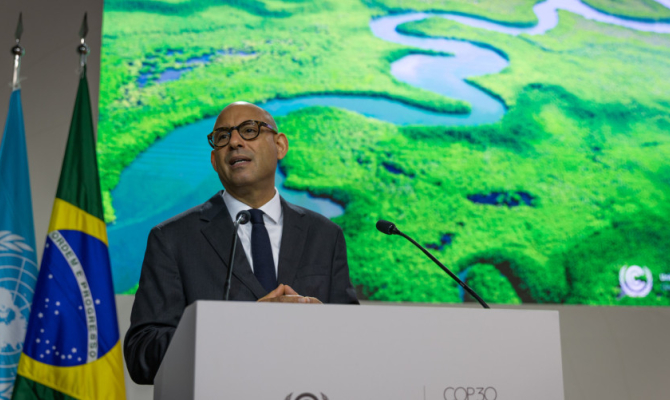
10 November 2025, Belem - The 30th Conference of the Parties to the UN Framework Convention on Climate Change (UNFCCC) has opened with a strong message from the UN Climate Change Executive Secretary, Mr Simon Stiell, to thousands of delegates in Belem Brazil.
“Friends let me be clear: in this arena of COP30, your job here is not to fight one another – your job here is to fight this climate crisis, together,” he said.
Mr Stiell was amongst the speakers during the official opening of the world’s leading forum for tackling the climate crisis, a ceremony peppered with Brazilian dancing, singing and glimpses of the amazing Amazon forest.
The ceremony also featured the President of Brazil, His Excellency Luiz Inácio Lula da Silva, outgoing COP29 President, Mukhtar Babayev and COP30 President, André Corrêa do Lago.

“We find ourselves here in Belém, at the mouth of the Amazon. And we can learn a lot from this mighty river,” he told a room full of world leaders, climate change negotiators and COP delegates.
“The Amazon isn’t a single entity, rather a vast river system supported and powered by over a thousand tributaries. To accelerate implementation, the COP process must be supported in the same way - powered by the many streams of international cooperation. Because individual national commitments alone are not cutting emissions fast enough.”
Held from 10-21 November, COP30 takes place amidst a myriad of global challenges. On the climate crisis, scientists say the planet is on course to temporarily breach the 1.5°C warming limit set by the Paris Agreement. That overshoot could still be short-lived, experts warn, but only if countries act fast to ramp up efforts on cutting emissions, adapting to climate impacts, and mobilising finance.
The meeting billed the “COP of truth” faces intense pressure to agree on indicators to measure adaptation and a roadmap to quadruple the new collective quantified goal on climate finance. Countries’ latest round of national climate plans (NDCs) will also be in the global spotlight.
“We don’t need to wait for late NDCs to slowly trickle in, to spot the gap and design the innovations necessary to tackle it. Not one single nation among you can afford this, as climate disasters rip double-digits off GDP,” added Mr Stiell.
“To falter whilst mega-droughts wreck national harvests, sending food prices soaring, makes zero sense, economically or politically. To squabble while famines take hold, forcing millions to flee their homelands, this will never be forgotten, as conflicts spread.
“While climate disasters decimate the lives of millions, when we already have the solutions, this will never, ever be forgiven.”
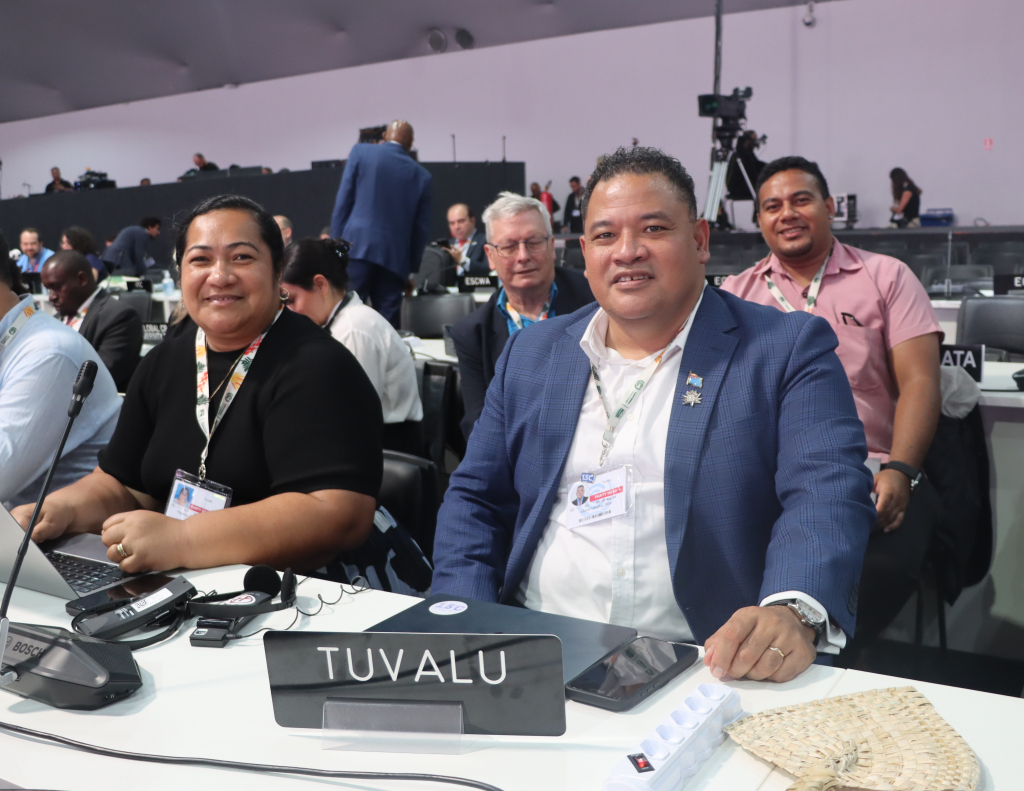
In Belem, Pacific delegations have made the long trip to Belem to advocate for the survival of Pacific communities who continue to be at the forefront of climate change impacts.
Pacific delegations will engage in two weeks of crucial negotiations on tackling the climate crisis with urgency and ambition, to ensure the goal of 1.5 to stay alive.
The Secretariat of the Pacific Regional Environment Programme (SPREP), as Chair of the One-CROP (Council of Regional Organisations of the Pacific), has the mandate as coordinator of Pacific climate change action to lead work on enhancing Pacific engagement at COP30.
In 2015, governments adopted the Paris Agreement on climate change and committed to limit the rise in the global average temperature to “well below” 2°C above pre-industrial levels, pursuing efforts to limit it to 1.5°C.
SPREP’s Head of Delegation and Director of Climate Change Resilience, Ms Tagaloa Cooper said: “1.5 is still within reach. The signs and the daily lived reality we see in the Pacific are alarming, but we cannot give up – achieving a 1.5 world is still achievable but we must act fast. A course correction is imperative to ensure a resilient Pacific where our people can thrive.”
As COP30 opens, the work for everyone in Belem has been cut out.
“We must move much, much, faster on both reductions of emissions and strengthening resilience. The science is clear: we can and must bring temperatures back down to 1.5C after any temporary overshoot,” said Mr Stiell.
“Lamenting is not a strategy. We need solutions. In Belém, we’ve got to marry the world of negotiations to the actions needed in the real economy.”
he 30th Conference of the Parties to the UN Framework Convention on Climate Change (UNFCCC) is taking place from 10-21 November 2025 in Belem, Brazil.
It is being attended by Pacific leaders and their delegations, who are advocating for the survival of Pacific communities who continue to be at the forefront of climate change impacts.
Support for our Pacific Islands at COP30 from members of the Council of Regional Organisations of the Pacific (CROP) is through the One CROP mechanism led by the Secretariat of the Pacific Regional Environment Programme.
Members of one CROP include: The Secretariat of the Pacific Regional Environment Programme (SPREP) – Lead, Pacific Islands Development Program, Pacific Islands Forum Fisheries Agency, Pacific Island Forum Secretariat, Pacific Community.
A key part of amplifying the One Pacific Voice at COP30 is the Moana Blue Pacific Pavilion and the Pacific Delegation Office. The Moana Blue Pacific Pavilion at COP30 is a Pacific partnership with the Governments of Australia and New Zealand managed by the Secretariat of the Pacific Regional Environment Programme (SPREP).
The Pacific Delegation Office at COP30 is a Pacific partnership with the New Zealand Government managed by the Secretariat of the Pacific Regional Environment Programme (SPREP).
To learn more about the Pacific at COP30 please visit: https://www.sprep.org/cop30
Photo Credit Main photo: Kiara Worth | UN Climate Change