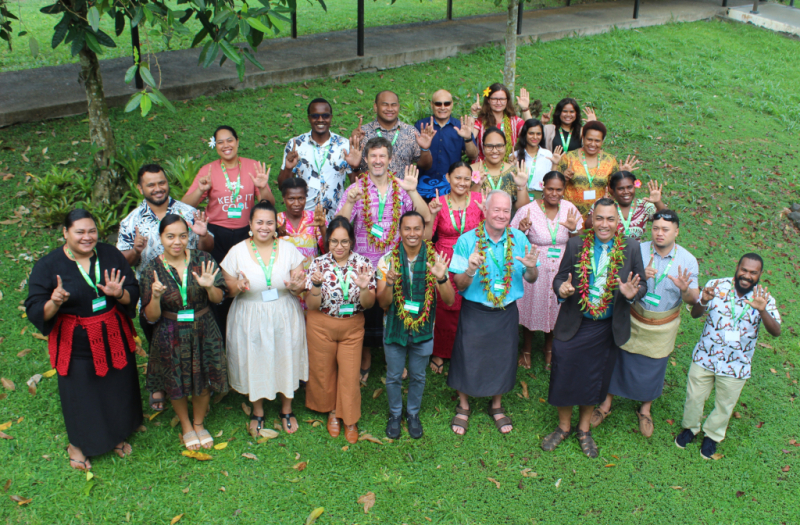

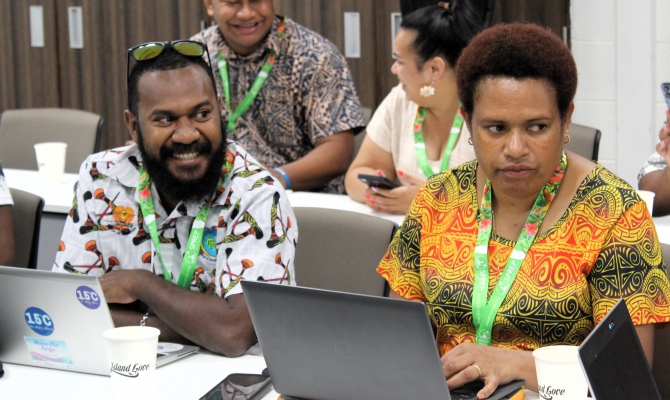
11 August 2025, Apia, Samoa – “Our fight against climate change must continue.” This was the message from the Government of Palau’s National Climate Change Coordinator, Mr. Xavier Matsutaro, and the driving force behind the three-day regional capacity building development training for young Pacific climate change negotiators.
Hosted at the Pacific Climate Change Centre, the training brings together youth from ten Pacific island countries to equip them with the skills, knowledge, and understanding they will need to engage in negotiations under the United Nations Framework Convention on Climate Change (UNFCCC).
The young negotiators will be learning from some of the Pacific’s more senior officials, who have been involved in negotiations in the climate change space for many years, some even going back to the very first Conference of the Parties (COPs) to the UNFCCC, as well as technical experts from One-CROP who provide support to Pacific delegations at these COPs.
Mr. Matsutaro reflected on when he was first called to negotiate for Palau in 2013, entering the space with very little knowledge of the UNFCCC process, and felt that he was not well prepared for such an undertaking. He said that he and the Pacific have come a long way, and the Pacific Small Island Developing States are now a well-coordinated machine that speak with one Pacific voice at the UNFCCC COPs.
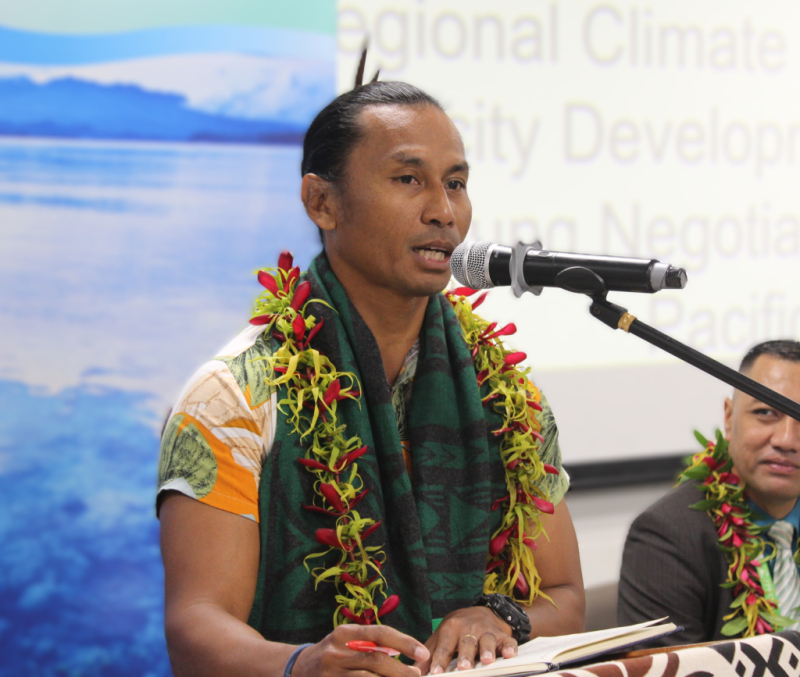
“The work must continue, and the earlier you have to start developing, the better it will be for all of us,” he said.
“You have the benefit of training opportunities such as this so that you’re not learning from doing, you’ll have a good foundation to stand on so that when you go to the UN you’ll be much more effective and have a much better starting point than we did.”
“We are giving our youth the exact same support that we, as senior officials, receive from the One-CROP, which includes the technical support that is coordinated by the Pacific Islands Forum Secretariat (PIFS), the Secretariat of the Pacific Community (SPC), the Secretariat of the Pacific Regional Environment Programme (SPREP), and other regional organisations in the Pacific,” he added.
“So buckle up, everyone. There is a lot of work to do and a lot of learning to be done.”
Mr. Tim Breese, SPREP’s Climate Change Adviser stressed the importance of youth participation in the training, stating that, “You have a very important role to play because you’re not just the future of our fight against climate change in the Pacific, but you are also the present.”
“It’s an opportunity for you to show your leadership skills and what you can offer because we have a fight in our hands to protect our region and the world from the impacts of climate change,” Mr. Breese said.
Throughout the course of the three-day workshop, Mr. Breese said that the training will aim to find the right balance in terms of understanding the big picture with the UNFCCC negotiations and the specific expectations and interests of Pacific SIDS in those discussions. It will also be an opportunity for the youth participants to get down to the substance of some of the key issues that are most important to the Pacific.
Mr. Espen Ronneberg, SPC’s Senior Adviser on Climate Change Multilateral Environmental Agreements, has been involved in climate change negotiations since 1992, and echoed the sentiments on the importance of the Pacific youth carrying on this work, and that they can also provide new ideas for the senior officials who are currently involved in negotiations.
“I recall a quote that Samoa’s Ambassador Ali’ioaiga Feturi Elisaia used to say, that no one has a monopoly on good ideas and that you can learn something new every day. Likewise, we can learn from you and how you react to what we will be presenting and how you interpret issues which may give us a new perspective that we haven’t thought of yet,” Mr. Ronneberg said.
The regional capacity building training is being held from 11 – 13 August, and is attended by young officials from Cook Islands, Fiji, Nauru, Niue, Palau, Papua New Guinea, Republic of the Marshall Islands, Samoa, Solomon Islands, Tonga, and Vanuatu. It is an initiative that is jointly supported by the Government of Palau, Climate Youth Negotiators Academy, Pacific Islands Forum Secretariat, the Pacific Community, and the Secretariat of the Pacific Regional Environment Programme through the Strengthening Pacific Leadership in International Climate Change Engagement (SPLICE) Project funded by the Government of Australia.
For more information, please contact Mr. Tim Breese, SPREP’s Climate Change Adviser, at timb@sprep.org.