


Give to Gain IWD2026: The first of a three-part series that highlights Women in Micronesia this International Women’s Day. It forms part of the Federated States of Micronesia National Adaptation Plan Project funded by the Green Climate Fund, implemented by SPREP in partnership with the Government of FSM and Haskoning New Zealand.
Global evidence confirms that climate change impacts are not experienced equally. The Intergovernmental Panel on Climate Change (2022) highlights that climate risks interact with existing social and economic inequalities, increasing vulnerability for women and girls. UN Women (2024) reports that women are more likely to depend on climate-sensitive livelihoods and to carry primary responsibility for securing food and water and providing unpaid care.
Across the Pacific, including in Micronesia, women often carry the greatest burden of climate impacts because of the roles they hold in their families and communities. Women are responsible for securing food and water, caring for children and elders, and holding households together during times of disruption (UNDP 2025). When droughts intensify, crops fail, water sources become contaminated, or typhoons damage homes, it is women who stretch limited resources further, travel longer distances, and manage the daily consequences of these changes.
Climate change magnifies existing inequalities. It increases workloads, health risks, and economic vulnerability (UN Women 2024).
But women are not only vulnerable. They are also essential to climate solutions. Women hold deep knowledge of local ecosystems, food systems, and community networks.
They are often first responders during disasters and leaders in recovery. Yet they remain underrepresented in formal climate decision-making. When women are meaningfully included in leadership and planning, climate responses are stronger and more effective.
This is the principle behind Give to Gain: when women are supported to lead, communities gain resilience.
In Micronesia, this reality is visible every day. Recognising and strengthening women’s leadership is not only about equity — it leads to stronger, more effective climate action. This is a story about the Women of Micronesia.
Women’s leadership is not optional in climate action. It is fundamental. When women gain, we all gain.
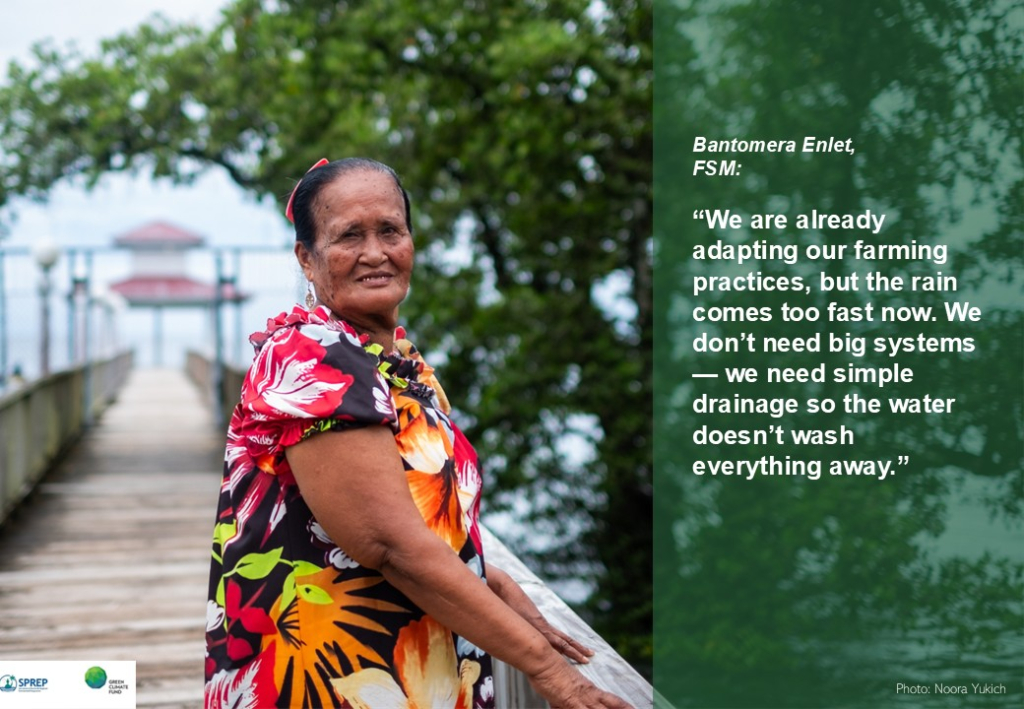
Profile of Ms Bantomera Enlet of FSM: When crops fail, women carry the burden
Bantomera Enlet has grown up and lived her life on the island of Onei, in the Federated States of Micronesia.
Bantomera has been farming on the high lands in Onei for more than fifty years. She began when she was young, when her first child was still unborn. Like many families in Micronesia, her land is not just a source of food, but a way of life. Farming means independence, dignity, and the ability to provide — not only for her own family, but for others as well.
She knows what the seasons used to feel like. That is why she knows something has changed.
Today, farming is no longer shaped by predictable cycles. The heat comes stronger and stays longer. Crops bloom, but do not last. The sun feels heavier — not only on people’s bodies, but on the plants themselves. “If we feel it,” she says, “why wouldn’t the plants feel it too?”
At the same time, rain has become more extreme. On the hills, water no longer arrives gently. It rushes downhill, gathering speed, with nowhere to go. Soil loosens. Gardens slide. A season’s work can disappear overnight. Water is no longer only a source of life — it has become something that must be carefully managed.
Bantomera does not speak of climate change through theories or statistics. She speaks of it through food.
Coconuts still grow, but they no longer taste the way they once did. Taro patches closer to the coast are turning salty after king tides, leaving families without their most important staple. These changes may seem small from the outside, but together they reshape what it means to live securely.
So, people adapt.
When king tides flood coastal villages, families raise cooking fires on stacked stones so meals can still be made. When animals are at risk of drowning, pigs and chickens are released so they have a chance to survive. During storms, families shelter in caves, bringing what food and water they can, sharing resources until the danger passes. Women prepare meals not only for their own households, but for others who arrive with less.
This is resilience practiced daily, without labels.
Women like Bantomera carry much of this load. As farmers, mothers, and community leaders, they organise food, care for the injured using local remedies, and find ways for families to endure. What frustrates her is not change itself. People here have always adapted. What frustrates her is the distance between plans and reality.
Over the years, many visitors have come to talk about climate change. There have been workshops, meetings, and discussions about what should be done. The words are often good. The plans sound promising. But too often, they stop there.
For farmers like Bantomera, support is not complicated. Simple drainage channels could slow and guide floodwaters.
Small investments in tools and irrigation could protect crops. Practical measures could make farming safer and more reliable. These are not abstract needs — they are solutions already imagined by the people living with the impacts.
hen asked whether she feels seen in planning, Bantomera answers quietly: she does not see herself there. “I feel invisible”. Not because she lacks ideas, but because those ideas rarely turn into action. After years of repeating the same needs, many people stop asking. Not out of anger, but because experience has taught them what question will, and will not, be answered.
She speaks with gratitude about the few organisations that respond with action, such as her local Women’s Council — those that provide tools, seeds, and direct support. For her, these small interventions matter more than promises. They allow farmers to keep going. They restore a sense of being valued.
Bantomera’s message is clear: People here are ready. They are already adapting. What they need is for planning to meet practice — and for action to follow words.
Did you know?
Women are central to household food production and security in the Pacific — yet climate change is increasing food insecurity, with nearly 64 million more women than men affected globally. Source: UNSDA, Gender Snapshot 2025
This is part one of a three-part series profiling Women in Micronesia for the Give to Gain International Women’s Day wave with SPREP. We’ll be sharing two more profiles this week as part of this series. This International Women’s Day let’s Give to Gain, together! For the full Women in Micronesia resource please visit: https://library.sprep.org/content/international-womens-day-2026-women-micronesia