

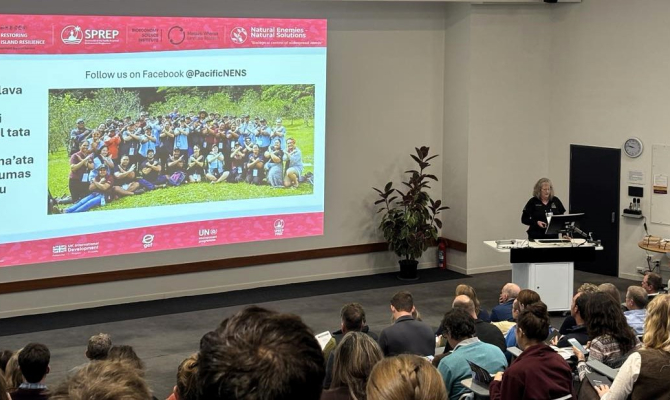
12 September 2025, Christchurch, New Zealand - Pacific delegates have reaffirmed the urgent need to transform science into practical solutions in the fight against invasive plants, following their participation in the 17th International Conference on the Ecology and Management of Alien Plant Invasions (EMAPI), held 2–5 September at Lincoln University, Christchurch.
The event gathered over 160 experts from more than 25 countries under the theme “From Ecology to Action: Innovative Solutions for Plant Invasion Management.” Sessions showcased cutting-edge research, biological control breakthroughs, and community-led initiatives aimed at halting the ecological damage caused by invasive species.
For Pacific Island Countries and Territories (PICTs), the stakes are high as invasive weeds threaten native biodiversity, disrupt ecosystem services, and undermine health, wellbeing, and food security. Limited resources make management difficult, and climate change is expected to intensify the problem in the years ahead.
Responding to this urgent need for more on the ground action against invasive species, the Pacific Regional Invasive Species Management Support Service (PRISMSS) was formed by the Secretariat of the Pacific Regional Environment Programme (SPREP) in 2019.
PRISMSS aims to provide required support to PICTS to strengthen invasive species management, through its six regional programmes in partnership with technical partners. Alien plant invasions are addressed in four of the PRISMSS programmes, being the Protect Our Islands (POI), War On Weeds (WOW) and Resilient Ecosystems-Resilient Communities (RERC) all led by SPREP, and the Natural Enemies – Natural Solutions (NENS) programme led by the Bioeconomy Science Institute (BSI), formerly known as Manaaki Whenua-Landcare Research.
At EMAPI, BSI presented an overview of NENS work in the Cook Islands, Fiji, Marshall Islands, Niue, Samoa, Tonga, Tuvalu, and Vanuatu. PRISMSS NENS Technical Lead for the Pacific, Ms Lynley Hayes, said the presentation highlighted “the achievements, challenges, lessons learned, and opportunities to build on this work to support our Pacific neighbours and other developing countries.”
Countries that had Pacific representatives to the conference included Niue, Tonga, Tuvalu and the Republic of Marshall Islands. The GEF 6 Regional Invasives Project (RIP) Project Manager Ms Isabell Rasch-Mulitalo commented that, “the Pacific Island countries’ participation was supported by the GEF 6 RIP, their attendance is especially significant, given that our region faces heightened vulnerability due to the unique ecosystems and limited resources for invasive species management.”
“Their participation not only fosters regional collaboration but also equips the Pacific Island communities with the latest tools, knowledge, and partnerships to enhance biosecurity and safeguard biodiversity across the Pacific.”
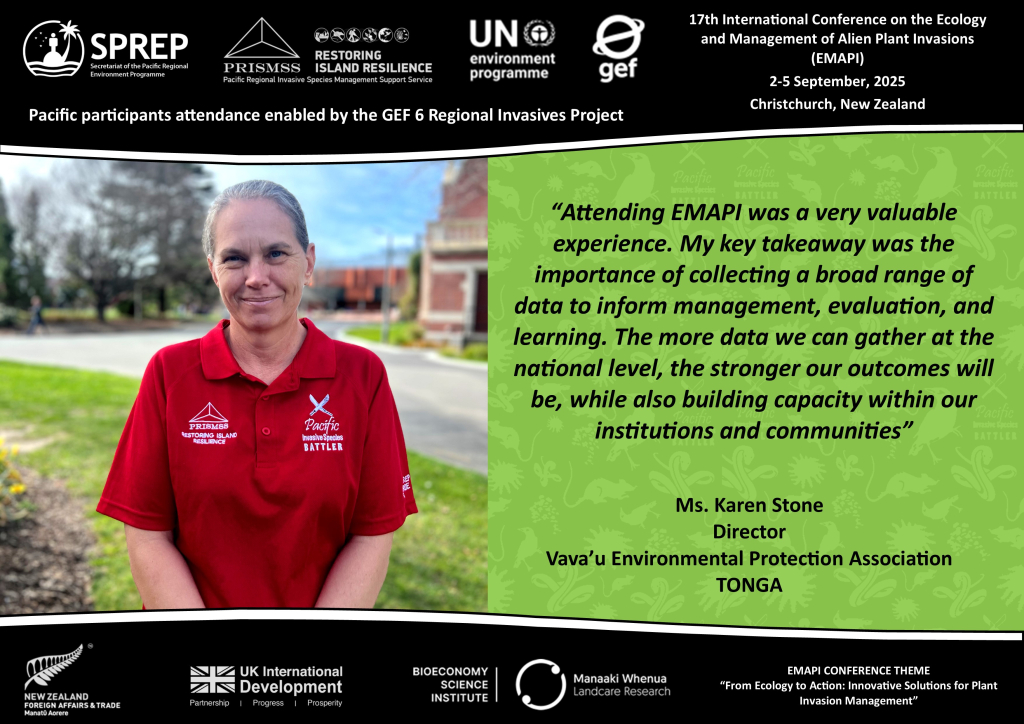
Ms Karen Stone from the Vavau Environment Protection Authority shared that, “attending EMAPI was a very valuable experience, and my key takeaway was the importance of collecting a broad range of data to inform management, evaluation, and learning.”
“The sessions provided practical insights for invasive plant management in my country, particularly in the areas of risk management and analysis mapping and I found the discussions on how these tools can also serve as community engagement and reporting mechanisms especially useful.”
“Overall, participation in EMAPI was highly beneficial for both me and my country as it not only expanded my technical knowledge but also showcased innovative ways of presenting information to enhance community engagement.”
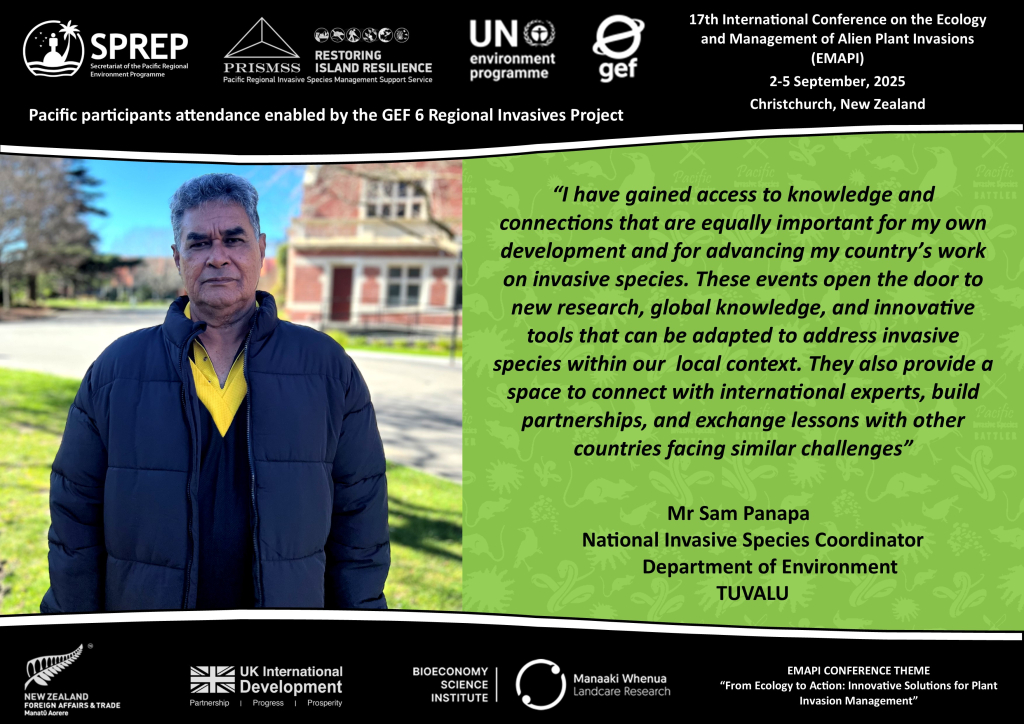
Mr Sam Panapa, Tuvalu National Invasive Species Coordinator commented that, “my most valuable takeaway was learning how ecological principles guide practical invasive plant management, from prevention and early detection to effective control.”
“I also saw how combining science with community engagement, policy, and long-term monitoring is essential for lasting success.”
“The conference provided valuable insights and strategies that are directly relevant to managing and preventing invasive plants in my home country. I learned about the importance of strong biosecurity measures to stop new introductions, risk assessment tools to prioritise threats, and rapid response frameworks to contain new incursions before they spread.
“For my country, the insights gained can inform better policy development, strengthen technical capacity, and support more effective, science-based management programmes. Sharing our own experiences also raises awareness of our unique challenges and attracts potential support for national and regional initiatives.”
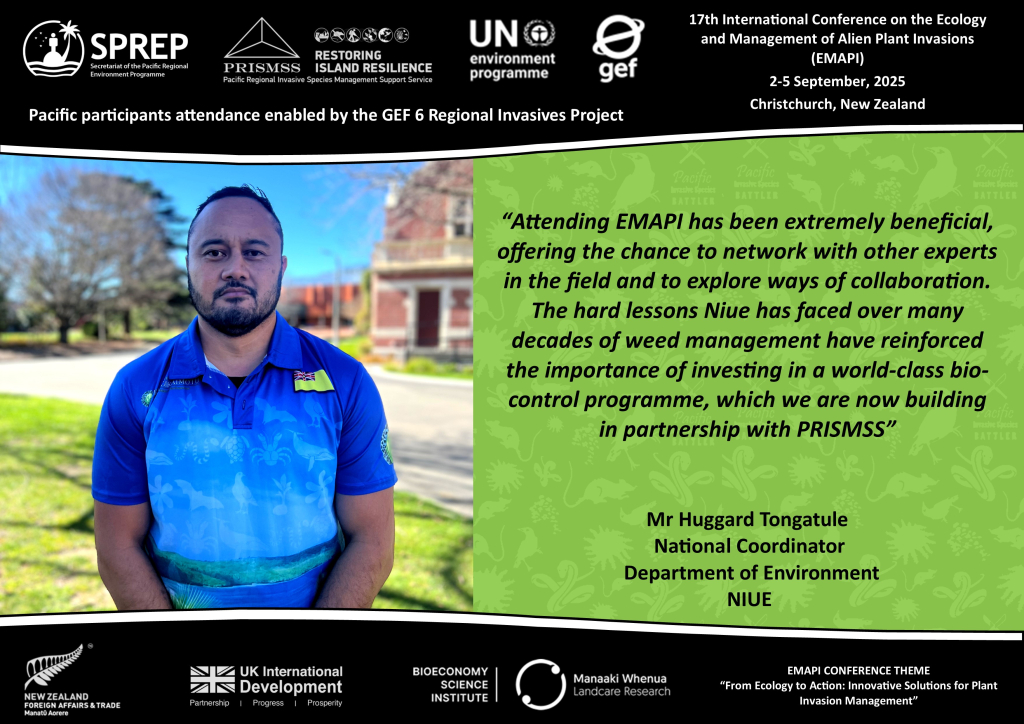
Mr Huggard Tongatule from the Niue Department of Environment reflected on that, “the most valuable takeaway from the EMAPI Conference was the opportunity to learn about the excellent work happening in the field of invasive weed management, not only in New Zealand but also globally.”
“This knowledge is highly relevant and can support our PRISMSS War on Weeds and Natural Enemies Natural Solutions programmes in Niue.”
“Collaboration across communities, agencies, and partners is essential for long-term success and attending EMAPI has been extremely beneficial, offering the chance to network with other experts in the field and to explore ways of collaboration. “
“The hard lessons Niue has faced over many decades of weed management have reinforced the importance of investing in a world-class biocontrol programme, which we are now building in partnership with PRISMSS.”
SPREP, through PRISMSS, will continue to enable capacity building for PICTs to enhance invasive species management in the region through partnership, sustainable solutions and community empowerment.
--------------------------------------------------------------------------------------------------------------------------------------
The GEF 6 Regional Invasives Project (RIP) is funded by the Global Environment Facility, implemented by the United Nations Environment Programme, and executed by the Secretariat of the Pacific Regional Environment Programme (SPREP). The Project works primarily in the Marshall Islands, Niue, Tonga, and Tuvalu and has a regional component. Implementation of the GEF 6 RIP is supported by the Pacific Regional Invasive Species Management Support Services (PRISMSS).
For more information on the GEF 6 Regional Invasives Species Project (GEF 6 RIP), please contact the Project Manager Ms Isabell Rasch-Mulitalo, at isabellr@sprep.org
About PRISMSS: The Pacific Regional Invasive Species Management Support Service (PRISMSS) is a coordinating mechanism designed to facilitate the scaling up of operational management of invasive species in the Pacific. PRISMSS, which is led by the Secretariat of the Pacific Regional Environment Programme (SPREP) brings together experts to provide support within the Pacific region with a focus on protection of indigenous biodiversity and ecosystem function. As a service provider, PRISMSS provides a comprehensive suite of support services in a cohesive, effective, efficient, and accessible manner to Pacific Island countries and territories.
Restoring Island Resilience (RIR): The PRISMSS - Restoring Island Resilience (RIR) is a New Zealand-PRISMSS collaboration project that aims to improve Pacific Island Countries and territories livelihoods and resilience to climate change by reducing the impact of invasive species on natural and agricultural ecosystems through the six PRISMSS programmes.
PRISMSS Powered by: New Zealand Foreign Affairs & Trade, UK International Development, GEF, United Nations Environment Programme & SPREP
PRISMSS Partners: Birdlife International, Earth Sciences New Zealand, New Zealand Department of Conservation, Island Conservation, Manaaki Whenua Landcare Research, Pacific Community and SPREP
PRISMSS Programmes: Natural Enemies Natural Solutions (NENS), Predator Free Pacific (PFP), Protect Our Islands (POI), Protect Our Marine Areas (POMA), Resilient Ecosystems Resilient Communities (RERC), War On Weeds (WOWs)
For additional information please contact Mr Dominic Sadler, PRISMSS Manager on dominics@sprep.org or Mr Nitish Narayan, PRISMSS Communications & Liaison Officer on nitishn@sprep.org