

20 October 2025, Port Vila, Vanuatu – Climate scientists have identified that the global mean sea level rose faster in the 20th century than any prior century over the last three millennia, and that 2024 was recorded as the hottest year on record, and the first year to pass the 1.5 °C threshold.
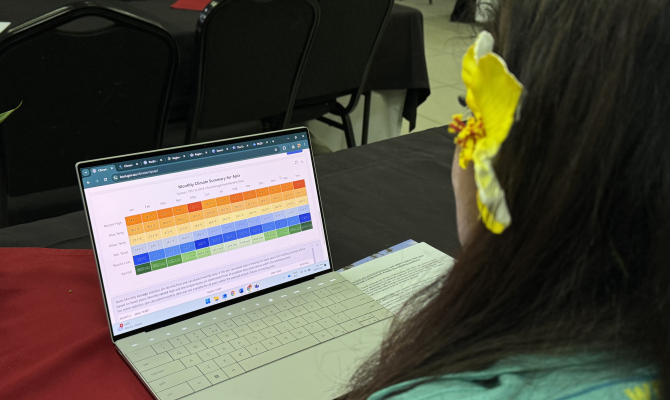
This week, a tool that will allow climatologists in the Pacific to access information and long-term trends in climate and allow for informed decision-making, is being introduced to representatives from 15 Pacific National Meteorological and Hydrological Services (NMHSs).
A two-day workshop funded by the Climate and Oceans Support Program in the Pacific (COSPPac) Phase 3 is being held in Port Vila, Vanuatu to introduce the Climate Indices for Pacific Sectoral Applications (CIPSA) portal to the Pacific NMHSs, allowing participants to discover how to make the most of this tool in their respective countries, and the upgrades and enhancements available that were not part of the existing Pacific Climate Change Data Portal.
The CIPSA portal, developed by the Australian Bureau of Meteorology, provides historical information and trends in mean and extreme climate indices, which are derived from daily temperature and rainfall data. This information is relevant for multiple sectors such as agriculture, health, and water. The indices are also useful for assessing climate change, specifically the changes in temperature and rainfall extremes.
“The new CIPSA portal will allow COSPPac to better support climate-sensitive sectors in the Pacific such as agriculture, water, and renewable energy,” said Mr. Simon McGree, Pacific Climate Services Technical Lead at the Bureau.
He added, “The portal offers significant enhancements, including letting the user know if the long-term change in rainfall or air temperature is statistically significant.”
Mr. Salesa Nihmei, Director of the Secretariat of the Pacific Regional Environment Programme’s (SPREP) Climate Science and Information Programme, remarked that SPREP is very pleased with the portal upgrade, and reiterated on the importance of ensuring that the climate data is useful and usable for Pacific governments and communities.
“With Vanuatu recently securing an advisory opinion from the International Court of Justice on climate obligations under the Paris Agreement, and applying for Loss and Damage funding, the question becomes: how do we turn data into policy to support access to these opportunities?”
He also noted the timeliness of the workshop, with the Conference of the Parties to the UN Framework Convention on Climate Change (UNFCCC COP), the annual global climate change meeting, taking place next month in Belém, Brazil.
“This is how we ensure the data we collect becomes useful. Otherwise, they’re just numbers.”
Some of the participants attending the CIPSA Portal training also agreed on the usefulness and usability of the tool, and that it will make a big difference in their work in the climate space.
“The new CISPA tool will further strengthen our work at the Niue Meteorological Service by transforming homogenised climate data into user-friendly products with clear visualizations, enabling informed decision-making for policymakers and key sectors,” says Ms. Racquel Tanaki New.
“The portal allows us to present data in multiple formats charts, graphs, and more. It’s all about getting the information out to our stakeholders,” added Mr. Bouchard Solomona from the Cook Islands Meteorological Service.
For some, the portal validates the work that they are already doing within their respective Met Services.
“At Fiji Met, we already analyse trends in sea level, temperature, and rainfall. The data that is available through the CISPA portal helps validate our analyses,” said Mr. Douglas Fong.
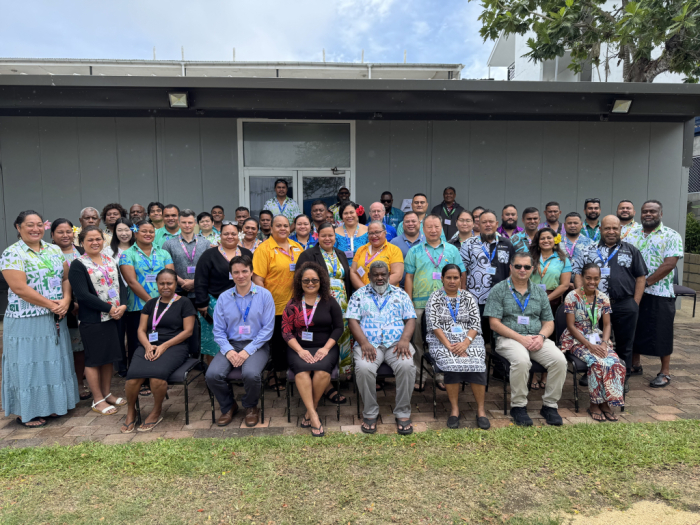
The Climate Indices for Pacific Sectoral Application training workshop is being held from 20 – 21 October 2025 at the Melanesian Hotel in Port Vila, Vanuatu. The training is being conducted by the Australian Bureau of Meteorology, and attended by representatives from the Cook Islands, Federated States of Micronesia, Fiji, Kiribati, Republic of the Marshall Islands, Niue, Papua New Guinea, Solomon Islands, Tokelau, Tonga, Tuvalu, and Vanuatu. It is also attended by representatives from the Apec Climate Centre, the Pacific Community, University of Hawaii, and SPREP.
For more information, please contact Mr. Simon McGree at simon.mcgree@bom.gov.au.