

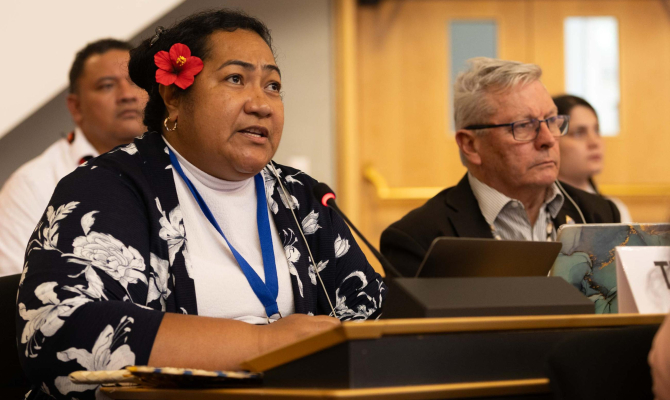
With just 30 hours left before the close of the resumed fifth session of negotiations for a global plastics treaty, Pacific Small Island Developing States (PSIDS) have expressed deep disappointment over a new draft text they say fails the very communities it is meant to protect.
At 3 p.m. today, Chair of the Intergovernmental Negotiating Committee (INC-5.2), Ambassador Luis Vayas Valdivieso of Ecuador released a streamlined Draft Text Proposal, intended to reflect compromise positions after more than a week of closed-door talks among over 184 countries. An hour later, delegates were called to plenary to discuss the proposal, leaving little time to review text.
Once countries took the floor, it became clear: the majority could not accept the text in its current form, describing as “unacceptable,” “unbalanced,” and “not a basis for further negotiations.” Key provisions from earlier drafts were omitted, including the article on production, there is no mention of chemicals, and a reference to the ‘full life cycle” of plastics in a previous draft has also been removed.
“These omissions undermine the balance, fairness, and effectiveness of the instrument, and risk delivering a treaty that fails to protect our peoples, cultures, and ecosystems from the existential threat of plastic pollution,” said Ms. Pepetua Latasi, Chair of PSIDS and Tuvalu’s Permanent Secretary for the Ministry of Home Affairs, Climate Change and Environment. “Many of our red lines have been crossed.”
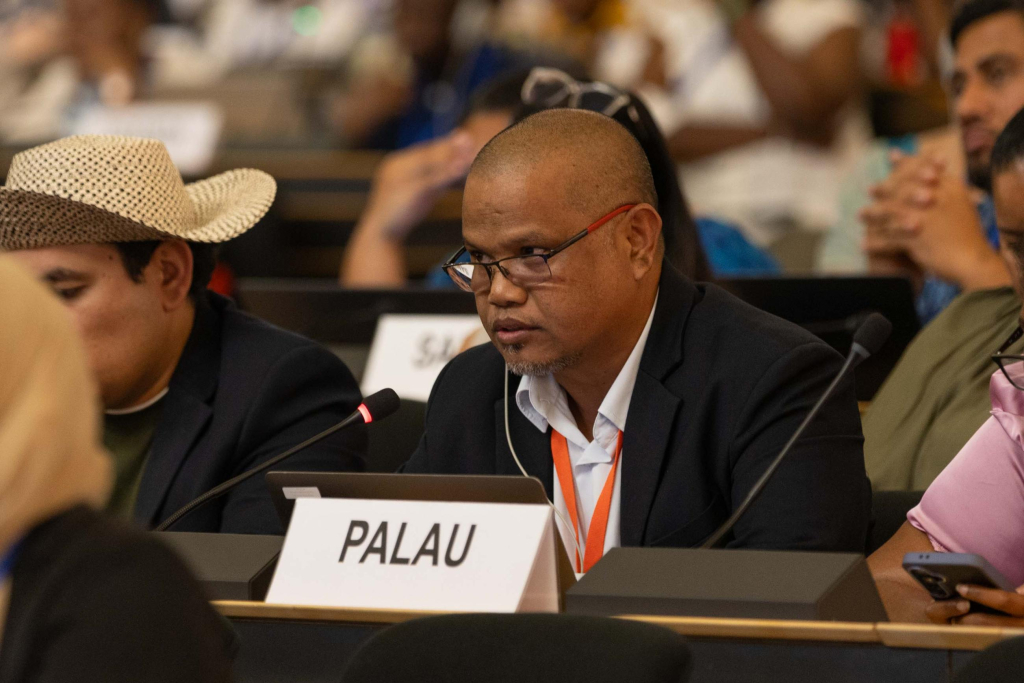
Chair of the Alliance of Small Islands States (AOSIS) and Palau’s Minister of Agriculture, Fisheries and Environment, Hon. Steven Victor said he was extremely concerned about the low level of ambition in this text.
“Finalising an agreement for the sole reason of finalising an agreement is not what made us travel thousands of miles to Geneva, nor the other INCs. Finalising an agreement that is equitable and effective to end plastic pollution and deliver on the mandate we agreed to three years ago is why we are here.”
The mandate stems from United Nations Environment Assembly (UNEA) Resolution 5/14, adopted in 2022, which calls on countries to develop a comprehensive, legally binding instrument to address plastic pollution across its full life cycle — from fossil fuel extraction and production to end-of-life management.
Delegates also raised concerns over the lack of transparency and clarity in the proposed path forward. They stressed that regional groupings need sufficient time to consult and coordinate before engaging the Chair on the text.
“Consultations with regional groups individually do not allow us to benefit from the exchange of views,” Hon. Victor said, warning that the rushed process risks undermining inclusivity and consensus.
More than 100 countries from the High Ambition Coalition to End Plastic Pollution, plus friends, shared similar sentiments. Panama’s lead negotiator, Juan Carlos Monterrey Gómez, rejected the draft outright, saying it could not serve as a basis for negotiations and that their red lines had been “spat on and burned.” “This is not ambition; it is surrender,” he said.
The European Union also deemed the proposal “not acceptable,” criticising it for lacking “clear, robust and actionable measures,” while Kenya noted that it contained “no global binding obligations on anything.”
The Chair of INC after hearing concerns from various parties proposed to holding regional and other consultations later in the evening, and convening a Heads of Delegation meeting on Thursday morning, 14 August. The Chairs team will work on the second iteration of the draft text overnight following the consultations.
More than 3,700 participants from 184 countries are attending the negotiations at the Palais des Nations in Geneva, Switzerland, which concludes tomorrow.
It follows INC 5, which took place in November/December 2024 in Busan, Republic of Korea. That meeting was preceded by four previous sessions: INC-1, which took place in Punta del Este in November 2022, INC-2, which was held in Paris in June 2023, INC-3, which happened in Nairobi in November 2023, and INC-4, held in Ottawa in April 2024.
The second part of the fifth session of the Intergovernmental Negotiating Committee to develop an international legally binding instrument on plastic pollution, including in the marine environment (INC-5.2), is taking place from 5 to 14 August 2025 at the Palais des Nations in Geneva, Switzerland.
The Pacific Islands are represented by the Cook Islands, Federated States of Micronesia, Fiji, Kiribati, Marshall Islands, Nauru, Niue, Palau, Papua New Guinea, Samoa, Solomon Islands, Tonga, Tuvalu and Vanuatu through the support of the Government of Australia through the Pacific Ocean Litter Project (POLP), and the United Nations.
They are supported by the Secretariat of the Pacific Regional Environment Programme (SPREP), working with partners from the Pacific Islands Forum Secretariat (PIFS), Office of the Pacific Ocean Commissioner (OPOC), The Pacific Community (SPC), Forum Fisheries Agency (FFA), Environmental Investigation Agency (EIA), Centre for International Environmental Law (CIEL), University of Wollongong, WWF and Massey University.
Photos: Kiara Worth_IISD.ENB