

By Puaseiese A Pedro, Office of Prime Minister Tuvalu
“Loss and damage from climate change spares no one, not even the dead.”
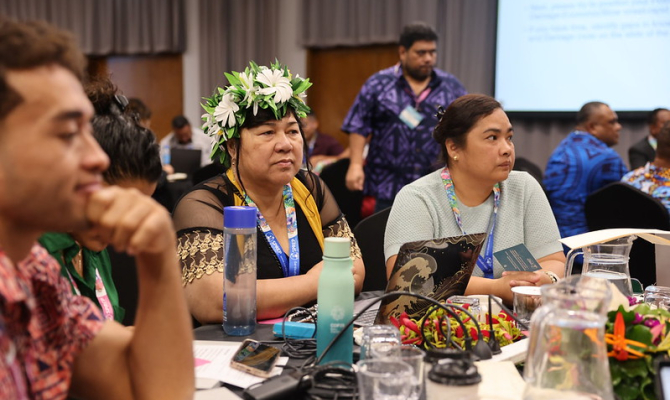
The warning comes from Lucille Apis-Overhoff, Assistant Secretary, Department of Environment, Climate Change and Emergency Management, Federated States of Micronesia (FSM), speaking at the Pacific Loss and Damage Dialogue in Samoa.
FSM is an ocean nation of roughly 100,000 people across four states and hundreds of small islands, with about 7,002 km2 of land and nearly 3 million km2 of ocean.
Ms. Apis-Overhoff described the intimate ties between people and place.
“When a child is born, the umbilical cord is buried and a tree is planted to feed future generations.”
Today, she said, those sacred bonds are being broken as coastal erosion and storm surge expose graves and coffins.
“We have a symbiotic relationship with the land and now even the dead are not safe from loss and damage.”
She warned that traditional livelihoods and knowledge are already disappearing.
“We’re losing traditional fishing knowledge and practices, some of our fish are moving away,” she said, noting elders who carry vital knowledge are passing before it can be shared. This loss, she added, threatens cultural continuity and practical resilience.
Food security and ceremonial life are under threat.
Apis-Overhoff gave the example of fermented breadfruit, a preservation method that can last decades: “Outer islands can’t do that anymore. People are resorting to plastic sheets instead of natural leaves.” Saltwater intrusion and salinization, she said, are also eroding the plants used for healing and local medicines: “Salinization prevents us from growing the herbs and plants we use for healing.”
Despite these losses, Apis-Overhoff expressed hope and concrete action through international support. “We are very happy and pleased to be part of the loss and damage capacity building project because it helps us build readiness to access climate finance… define loss and damage, and develop baselines,” she said, pointing to capacity building, national definitions, and state-level dialogue as immediate priorities.
She acknowledged real constraints, limited administrative capacity and high staff turnover, but remained determined, “We must document what is being lost, strengthen local institutions, and unlock finance and technical support to protect our culture, food security and biodiversity.”
Filomena Nelson, Climate Change Adaptation Advisor of the Secretariat of the Pacific Regional Environment Program (SPREP) closed the dialogue by urging unity, action and hope, stressing that Pacific peoples, especially youth, must lead responses and that practical tools like robust data and flexible finance can open doors. She reminded delegates that the region’s strength lies in collective action and continual effort.
The Pacific Regional Loss and Damage Dialogue 2025 is held from 11-12 August at Taumeasina Island Resort. It follows the inaugural Pacific Youth Dialogue on Loss and Damage, held from 7- 8 August, at the same venue in Samoa.
The Pacific Regional Loss and Damage Dialogue 2025 and the inaugural Pacific Youth Dialogue on Loss and Damage are made possible with funding support from the Loss and Damage Capability and Capacity (LDCC) Project with the Government of New Zealand.
Hosted by the Secretariat of the Pacific Regional Environment Programme (SPREP), the dialogues bring together Pacific governments, youths, civil society, academia, NGOs, and the private sector to collectively advance the region’s priorities on Loss and damage.
This story was produced by the Pacific Media Team covering the meetings. Their attendance is made possible with funding support from the Loss and Damage Capability and Capacity (LDCC) Project with the Government of New Zealand.
For more information, please contact SPREP Climate Change Adaptation Adviser, Ms Filomena Nelson filomenan@sprep.org , SPREP Climate Change Loss and Damage Officer, Ms Jessica Rodham jessicar@sprep.org or Media and Public Relations Officer, Mr Keni Lesa sosikenil@sprep.org