

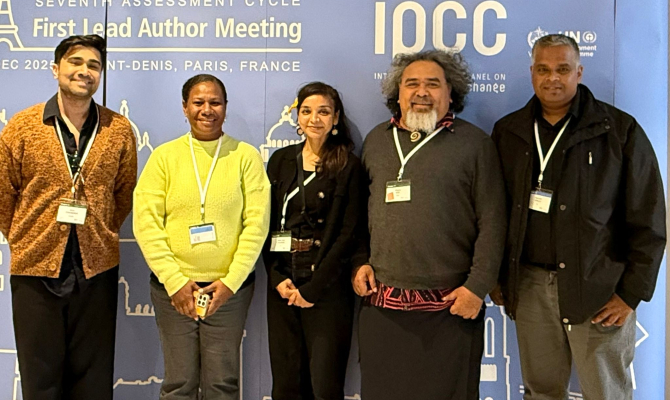
17 December 2025, Paris - The Intergovernmental Panel on Climate Change (IPCC) convened its first lead author meeting to commence drafting the Seventh Assessment Report (AR7) in Paris from 1-5 December 2025.
Seven experts affiliated with Pacific institutions and serving as Authors and Expert Reviewers for the AR7 were among more than 600 authors, representing more than 100 countries, at the gathering
The Pacific Authors and Expert Reviewers include Dr. Sindra Sharma, of Fiji who is the International Policy Lead, Pacific Islands Climate Action Network (PICAN). She was joined by Dr. Awnesh Singh, of Fiji, Associate Professor and Acting Director, Pacific Centre for Environment and Sustainable Development (PACE-SD),University of the South Pacific (USP), Dr. Alvin Chandra, of Fiji/Australia, Associate Professor (Adjunct) Climate Change, The University of Queensland, Dr. Ramendra Prasad, of Fiji, Associate Professor and Head of the Science Department at the University of Fiji, Lau Dr. Viliamu Iese, of Samoa and Tuvalu, Senior Research Fellow, University of Melbourne, Ms. Kisolel Posanau, of Papua New Guinea, Climate Researcher and Dr. Morgan Wairiu, of Solomon Islands, Pro-Chancellor Solomon Islands National University.
Dr. Sharma is the IPCC coordinating Lead Author for Smal Island Developing States (SIDS) chapter. She reiterated that for the Pacific, the IPCC remains the best available science to guide the region.
“Undermining the science and the IPCC reports serve neither people nor planet,” she said “It is therefore critical IPCC science informs the next global stocktake. Small Island Developing States will continue to uphold the integrity of science while ensuring it evolves to be more inclusive, grounded in the realities of our islands, and accountable to those living the consequences of inaction.”.
Dr. Awnesh Singh said his role in AR7 significantly expands his professional experience in the Pacific region and reinforces his expertise in leading international collaborations, integrating diverse global perspectives. It provides an opportunity to contribute valuable insights to the global scientific community while specifically highlighting the unique context and vulnerabilities of small island states within the assessment process.
Lau Dr. Viliamu Iese, who enters the AR7 fray with a distinguished career as an academic in climate research policy, emphasised the critical need for climate resilience, sustainable development, and the integration of Indigenous knowledge into reports including IPCC.
“It is a great honor to be a lead author and contribute to connecting our Pacific Science to the IPCC. I am grateful to the PCCC-SPREP and IPCC focal points, and IPCC Trust Fund for their continuous support,” he said.
Lau also serves as a representative of Regional Area V to the Research Board of the World Meteorological Organisation (WMO) and a member of the Drafting Team of the High-Level Panel of Experts in Food Security and Nutrition for a global report
“Preserving, strengthening and promoting Indigenous Peoples’ food and knowledge systems and traditional practices for sustainable food systems.” Dr. Iese is the Lead Author for the IPCC Chapter 17 in Working Group 2 – Agriculture, food, forestry, fibre and fisheries.
Dr. Alvin Chandra, Lead Author, Responses to Losses and Damages, reflected on how crucial IPCC evidence will be to the Pacific region.
“Pacific SIDs are already confronting hard and soft limits to adaptation (e.g., declining freshwater, disappearing land, increased cyclone intensity). Scientific evidence on Responses to Losses and Damages as part of the 7th Assessment Cycle will be central to galvanising timely and meaningful responses to losses and damages, providing policy-relevant insights that can guide urgent near-term decisions and strengthen resilience for most vulnerable communities in the Pacific Islands,” said Dr Chandra.
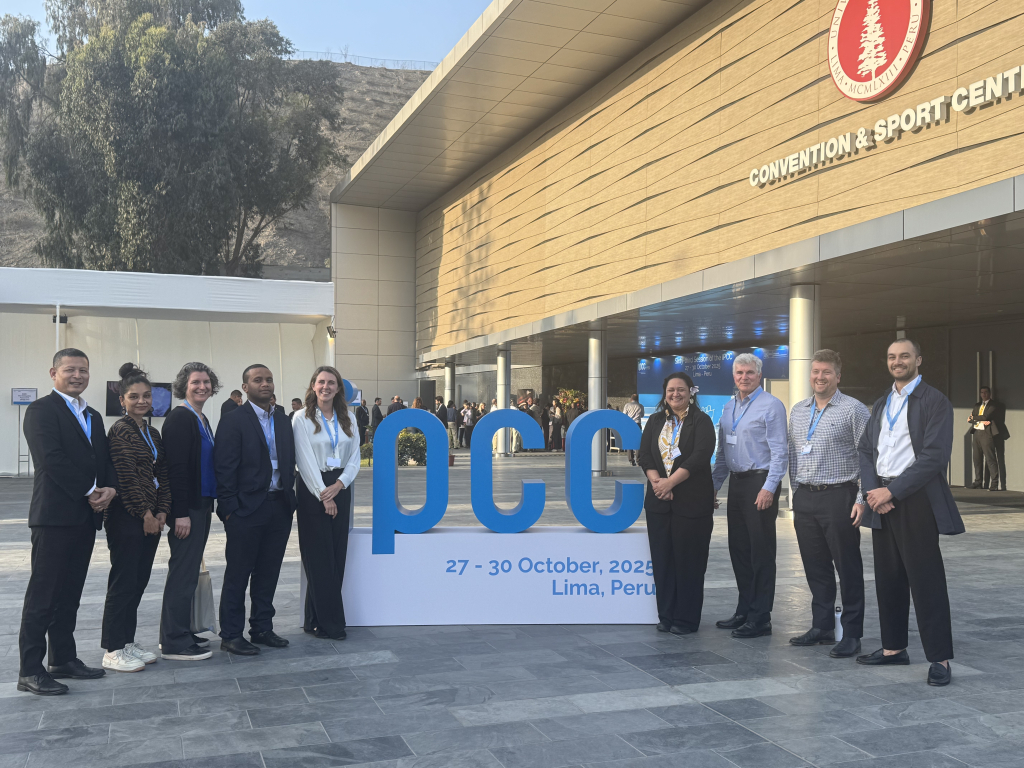
SPREP Director of Climate Change Resilience, Ms Tagaloa Cooper, applauded the key role played by the Pacific authors and expert reviewers, amplifying the One Pacific Voice and the region’s climate change goals in the process. She acknowledged the support of the Australian and New Zealand Governments, working with the Pacific Climate Change Centre, to strengthen engagement with the IPCC through supporting regional write-shops with Pacific climate researchers.
The write-shops address gaps in published climate academic literature through partnering Pacific climate experts with researchers from Australia’s Commonwealth Scientific and Industrial Research Organisation. This project will see several Pacific co-authored climate academic papers delivered in time for inclusion in the IPCC’s next assessment while also building the capacity of Pacific climate experts in publishing their own climate literature.
IPCC assessments provide governments, at all levels, with scientific information that they can use to develop climate policies. Findings are key inputs into the international negotiations to tackle climate change. For example, the IPCC’s Special Report on Global Warming of 1.5⁰C provided the critical scientific evidence that demonstrates the substantial differences in climate impacts between 1.5°C and 2°C of warming for the Pacific including in sea level rise, drought and coral reef survival.
Manager of PCCC, Ms Ofa Kaisamy, said that strengthening Pacific engagement in the IPCC is crucial because the reports are vital sources of climate information and climate impact evidence-base for both international and domestic policy. This necessity drives the development of the Pacific's capacity to contribute effectively to the upcoming Pacific Pre-Conference of the Parties (COP), COP 31, and subsequent negotiations. “Limiting global temperature rise to 1.5°C is an urgent global priority for safeguarding the Pacific Islands,” she said. “Beyond this, adaptation becomes impossible, leading to irreversible damage to ways of life, biodiversity, and livelihoods due to sea level rise, extreme weather events, and ocean acidification."
The Pacific Meteorological Council (PMC) in August 2023 endorsed for the PCCC hosted at SPREP to coordinate and build capacity of Pacific community to strengthen their engagements in the IPCC processes. The priority is to enhance regional coordination, harmonisation, ongoing technical support and development of best-practice, scientific knowledge products, services and technical capacity to enable practical application of IPCC assessment findings in the Pacific.
The Pacific Climate Change Centre (PCCC) is the regional Centre of excellence for climate change information, research, capacity building, and innovation, hosted at the Secretariat of the Pacific Regional Environment Programme (SPREP) in Apia, Samoa. As a Centre of excellence, the PCCC is mandated to provide practical information, support, and training to address the adaptation and mitigation priorities of Pacific Island communities.
The PCCC is underpinned by strong partnerships with Pacific Governments, applied research institutions, donors, civil society, and the private sector. The PCCC is a partnership between the Governments of Japan and Samoa. It is funded under grant aid through JICA for Samoa as the host country of SPREP. Additionally, the Centre receives generous funding and support from the Governments of New Zealand and Australia.