

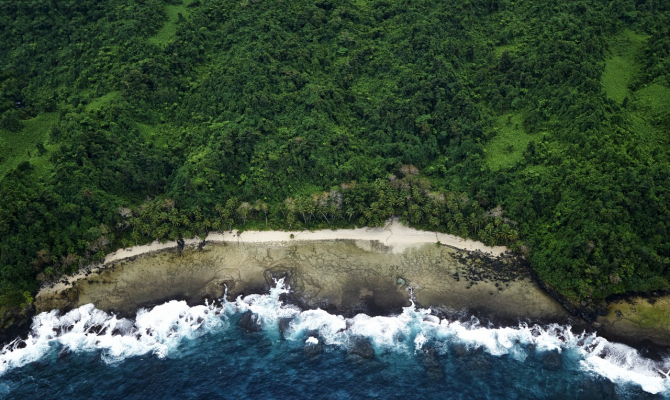
Once known for its rich forests, fertile soils, and diverse birdlife, Fiji’s Garden Island of Taveuni has in recent years witnessed the impacts of deforestation, unsustainable land clearing, and a changing climate. Areas once dense with native trees have been left bare, soils have become infertile, and bird species that once defined Taveuni’s soundscape have disappeared. Along the coast, the loss of mangroves has further exposed communities to strong waves, erosion, and the decline of coastal marine life.
But across the island, communities are taking action to heal their land and sea, reviving traditional stewardship practices and restoring the ecosystems that sustain their livelihoods.
Through the Pacific Ecosystem-based Adaptation to Climate Change (PEBACC+) project, implemented by the Secretariat of the Pacific Regional Environmental Programme (SPREP) together with the Fiji Ministry of Forestry and Fisheries, 13 landowning units on Taveuni have embarked on a large-scale tree planting program to restore degraded landscapes and strengthen their climate resilience. Along the coast, one coastal community is taking the lead to advocate mangrove planting in affected coastline areas through the engagement of women and youth groups.
To date, 63 hectares (ha) of degraded area (land and coastal) are being restored through replanting, breathing new life into areas that were once destroyed. These efforts also promote traditional custodianship of land, ensuring that communities themselves lead in maintaining and monitoring the restored areas.
Monitoring 60.5 ha of the replanted forest area this year showed that while the majority of sites are performing well, there are some sites that are struggling to keep up to the needed maintenance to reach the 80% survival target. This presents a valuable opportunity to strengthen community management and reinforce long-term stewardship, with plans for replacement planting and renewed care. Encouragingly, some sites have already taken their own initiative sourcing seedlings and replanting without project support, which shows strong ownership and a promising sign of sustainability beyond the project’s involvement.
.png)
rate in their tree replanting efforts. Behind are 2-year-old trees planted through the project.
In parallel, the replanting initiative has extended to the coast, completing 7.5 ha of mangrove restoration, equivalent to 23,764 seedlings planted between June 2024 and September2025. These mangroves will serve as natural barriers against storms and nurseries for marine life, while also strengthening local food security over time.
Most of the landowning units that the project has been working with have planted native trees such as koka, vesi, kaudamu, dilo, bauvudi, etc., which have also included fruiting trees for those sites that needed them since October 2023.
“Our plan is for the native trees to support tourism, especially bird watching,” said Viliame Seru, Leader for the Duivosavosa community. “The soil here was once fertile until we cleared it for farming. Now we see the consequences of that decision. Through native tree replanting, we know the soil will slowly restore its fertility.”
For Seru and his community, restoration is not just about trees; it’s about reconnecting with the land and securing future livelihoods.
In Bouma, two mataqali have planted to date a total of 2,780 native tress across 10 hectares under the PEBACC+ project, achieving an estimated 80% survival rate since the recent monitoring. “We tell the youth this is for them, for clean air, for the trees that will one day build their homes, and for the soil that feeds them,” said Fabiano of Vidawa Mataqali. Noting that importance of tree planting, these two mataqalis have extended their planting initiative through further support from Ministry of Forest under a separate initiative.
Along the coast of Tikina Wainikeli, the Women’s Group of Navakacoa led by Akeneta Moce has mobilised her village youth, and men in extensive mangrove planting efforts.
“Where we planted mangroves, we’ve started to see small fish again, sometimes even bigger ones,” Moce said with pride. “The children were screaming with excitement when they saw fish swimming through the mangroves we planted the other day.”
During the first monitoring in March 2024, a large number of mangrove seedlings planted in November 2023 did not survive. Although this was discouraging, it did not dampen the spirit of the community. Instead, it motivated them to reflect on the causes, draw lessons, and adjust their approach for future planting efforts.
When the community carried out the next planting, around 11,000 seedlings, they applied what they had learned, including selecting better planting locations, cluster planting, wilding vs propagule planting, timing their work with suitable tides and species type. As a result, the latest monitoring in September 2025 recorded a survival rate of more than 80%, a significant improvement from the initial attempt. This progress has shown the community’s resilience, willingness to learn, and strong commitment to restoring their mangrove ecosystem. Their persistence has been rewarded; not only are we seeing mangroves taking root, but we have also noticed that there is a return of fish number to the sites we have planted and closer to the shore. We have noted schools of fish. “Mangroves are bringing food and will also be bringing income over time back to our village,” Moce added.
.png)
Visible Results and Renewed Hope
From the hills of Bouma to the coastlines of Navakacoa, the ecological revival is becoming visible. Forest bird such as doves, parrots, and the kula bird are slowly returning to reforested areas, signaling habitat recovery.
“Since we’ve been engaged in the replanting program through PEBACC+ and Ministry of Forestry, we are now seeing birds that once disappeared,” said Rafaele Vuniwai of Bouma. “Even parrots can now be seen along the roadside.”
For Iosefo Rapuga, Turaga ni Mataqali of Naituku, the work carries deep meaning. “We reforest the land to restore our natural ecosystem as created by God. Climate change is caused by man, and it is our duty to repair what has been damaged,” he said.
From the mountain ridges to the mangrove-lined shores, Taveuni’s communities are showing that restoration is possible when local knowledge, collective action, and environmental care come together.
“Trees are so important, especially in this changing climate,” said Mikaele from Lavena. “We are starting to see birds return and the soil fertility restored. My advice to the next generation is simple: protect our trees and continue to reforest our land,” added the Turaga ni Mataqali.
Through their commitment and partnership with PEBACC+, Taveuni’s people are not only restoring their environment, but they are also safeguarding the legacy of Fiji’s Garden Island for generations to come.
PEBACC+ is a regional project implemented by SPREP and funded by the Kiwa Initiative through its donors the European Union, Agence Française de Développement (AFD), Global Affairs Canada, Australian Government Department of Foreign Affairs and Trade (DFAT), and New Zealand Ministry of Foreign Affairs and Trade (MFAT), with co-financing from the French Facility for Global Environment (FFEM). This four-year project seeks to strengthen the resilience of ecosystems, economies, and communities to the impacts of climate change in Fiji, New Caledonia, Wallis and Futuna, Solomon Islands, and Vanuatu. The project will develop, sustain, and institutionalize Ecosystem-based Adaptation to climate change in these five countries and territories.