

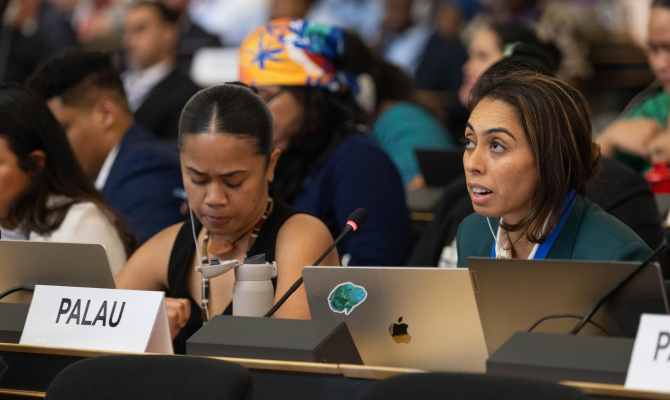
With just four days left to conclude negotiations on an international legally binding instrument on plastic pollution, the Alliance of Small Island States (AOSIS) is calling for trust, cooperation, and substantive problem-solving to deliver the ambition needed to end plastic pollution.
“As we move into the final stretch, SIDS will not stand by while our future is bartered away in a stalemate of ‘you first—no, you first,’” said H.E. Ambassador Ilana Seid, Chair of AOSIS and Permanent Representative of Palau to the United Nations.
“This dangerous brinkmanship—pitting finance against obligations—has a real price: a dying ocean, collapsing biodiversity, and an ever-growing burden on those least responsible for this crisis. And we call on all parties to work together and bridge divides so we can move forward.”
Speaking on behalf of 39 small island developing states at the stocktake plenary of the second part of the fifth session of the Intergovernmental Negotiating Committee (INC-5.2), Ambassador Seid called out the painfully slow pace of talks, warning that the process was mired in “a web of informals upon informals” that has stretched small delegations, like Pacific SIDS, to breaking point.
“Inconsistent modalities, untimely communication, and procedural irregularities have made it increasingly difficult to work efficiently,” she said, noting that this had even resulted in inaccuracies in the latest assembled text. Palau called on the Chair to guarantee SIDS are present and represented in all convenings, including small informal groups convened by Members or the Chair.
“We are here to work. This is a collective call for trust, for cooperation, and for focus. We have four days to deliver an equitable, inclusive, and effective agreement.”
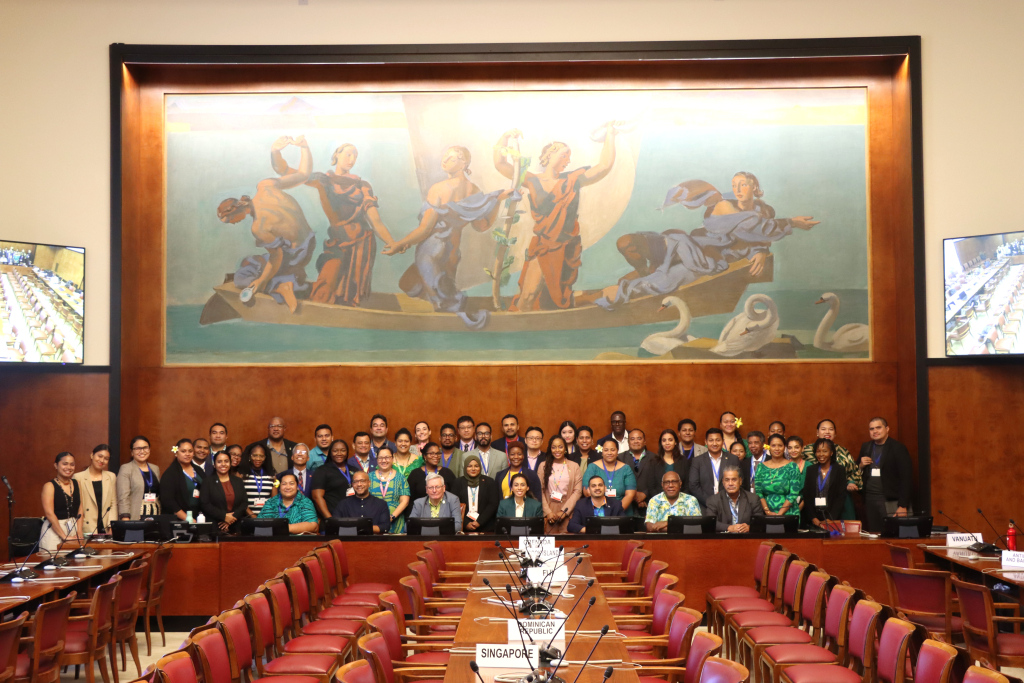
Palau reiterated that any future treaty must reflect their special circumstances, well-established in other multilateral agreements. “We can only accept a treaty in which we see ourselves—one that offers an equitable pathway for SIDS to address plastic pollution and fully recognises our special circumstances, both in the principles of the agreement and in its operative provisions,” Ambassador Seid said.
The special circumstances of SIDS in relation to the triple planetary crisis of climate change, biodiversity loss and plastic pollution, refers to their small size and small economies which makes them inherently susceptible to external economic and financial shocks.
SIDS bear a disproportionate burden from transboundary plastic pollution, and have long called for the treaty to address existing pollution in the marine environment, including obligations within and beyond national jurisdiction, robust cooperation mechanisms, and the financing necessary for large-scale clean-up.
Palau has also made it clear that equitable and effective access to funds is non-negotiable. “SIDS are supportive of all developing countries having access to finance,” Ambassador Seid stressed. “However, we can only accept a treaty which guarantees undiluted, particular treatment for SIDS and LDCs (Least Developed Countries).”
The plenary on Saturday allowed delegates to take stock of progress—or lack thereof—as co-chairs of the various contact groups reported back on the status of negotiations. Much of the first week has been spent behind closed doors, wrestling with heavily bracketed, complex text.
Negotiators face a challenging task to deliver a final treaty text by the August 14 deadline, with the ‘assembled text’ now swollen to more than 1,100 brackets, up from 370 in the original draft Chair’s text when talks resumed on Tuesday.
Ambassador Ilana Seid stressed that AOSIS will not waver. “Our people expect no less than an agreement that ends plastic pollution, protects our precious marine environment, and transforms the way we produce and consume plastic,” she said.
“Our ocean, our people, and our planet cannot wait.”
The second part of the fifth session of the Intergovernmental Negotiating Committee to develop an international legally binding instrument on plastic pollution, including in the marine environment (INC-5.2), is taking place from 5 to 14 August 2025 at the Palais des Nations in Geneva, Switzerland.
The Pacific Islands are represented by the Cook Islands, Federated States of Micronesia, Fiji, Kiribati, Marshall Islands, Nauru, Niue, Palau, Papua New Guinea, Samoa, Solomon Islands, Tonga, Tuvalu and Vanuatu through the support of the Government of Australia through the Pacific Ocean Litter Project (POLP), and the United Nations.
They are supported by the Secretariat of the Pacific Regional Environment Programme (SPREP), working with partners from the Pacific Islands Forum Secretariat (PIFS), Office of the Pacific Ocean Commissioner (OPOC), The Pacific Community (SPC), Forum Fisheries Agency (FFA), Environmental Investigation Agency (EIA), Centre for International Environmental Law (CIEL), University of Wollongong, WWF and Massey University.
Photo: Kiara Worth_IISD-ENB