

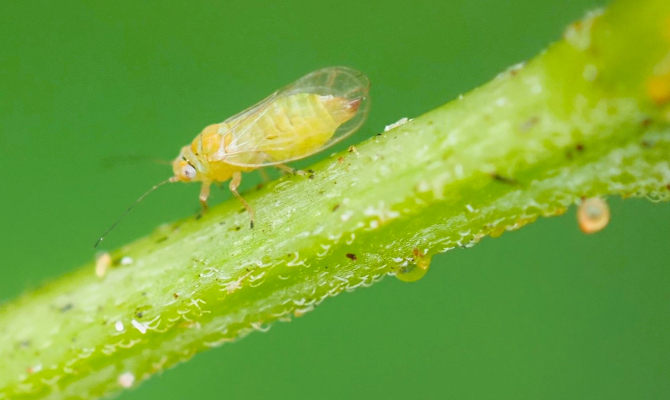
26 November 2025, Majuro, Republic of Marshall Islands - The Republic of Marshall Island’s (RMI) Ministry of Natural Resources and Commerce (MoNRC) has recently released the leucaena psyllid (Heteropsylla cubana), a tiny but mighty leaf-feeding insect, that naturally only targets leucaena (Leucaena leucocephala) which is highly invasive there.
This represents another step towards restoring balance using natural and sustainable solutions for RMI’s unique island ecosystems. The release was part of the GEF-6 Regional Invasives Project Terminal Review and Knowledge Sharing workshop events which recently concluded in Majuro.
The release was made possible through SPREP’s Centre of Excellence, the Pacific Regional Invasive Species Management Support Service (PRISMSS). It was delivered under the PRISMSS Natural Enemies – Natural Solutions (NENS) programme, led by the New Zealand Bioeconomy Science Institute (BSI) with funding from the New Zealand Ministry of Foreign Affairs and Trade (NZMFAT) and the United Kingdom International Development, as part of the PRISMSS Restoring Island Resilience (RIR) project.
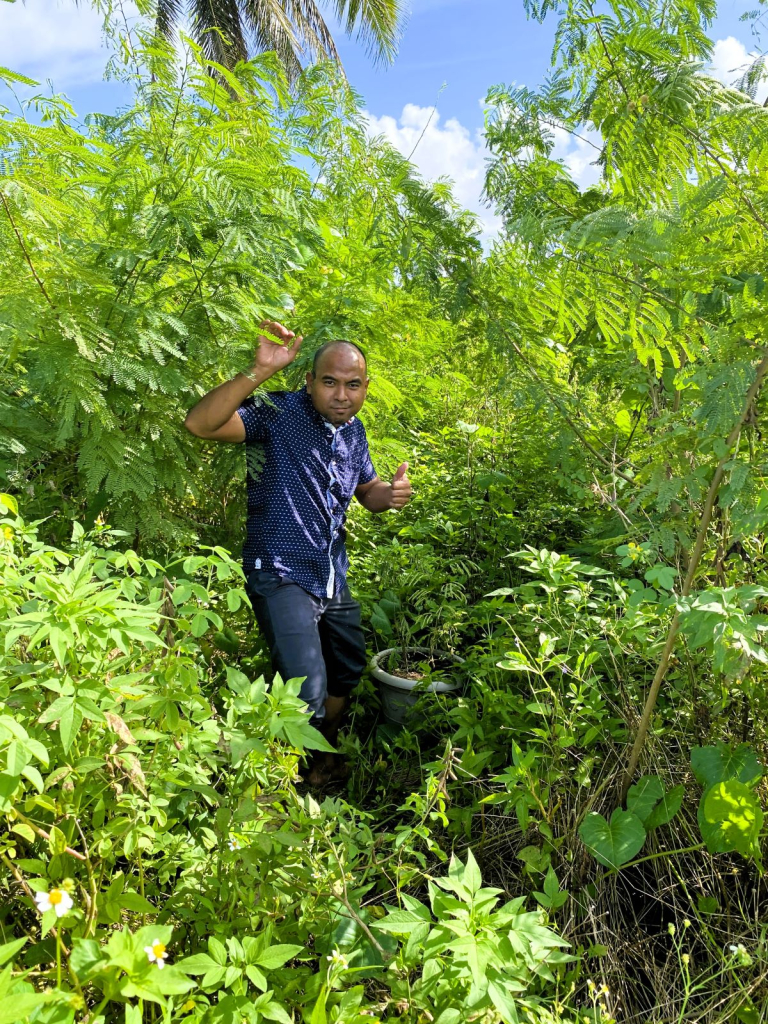
The Marshall Islands, a low-lying atoll nation, is home to unique native vegetation that has long been vital to the survival and wellbeing of its people. However, new and invasive plants like leucaena are changing the landscape and weakening the islands’ resilience to climate change.
Leucaena has become an aggressive invader in many tropical and subtropical regions and is listed in the top 100 of the world’s worst invasive plant species. It is considered a major weed across the Pacific, spread both accidentally and intentionally for its beneficial properties such as fodder for animals, nitrogen fixing for agriculture, wood for building materials and fires, shade, and soil stabilisation.
This invasive plant is a fast-growing shrub or small tree which forms dense thickets. It produces large numbers of seeds, with vigorous seedling establishment, rapidly crowding out other plants and can quickly outcompete and replace other vegetation, disrupting natural successional processes.
Coastal areas, semi-natural areas, roadsides, plantations, hedgerows, recreational areas and agricultural land are placed at risk, with biodiversity reduced. Ecological processes such as nutrient cycling and soil chemistry are affected making it difficult for other plants to grow.
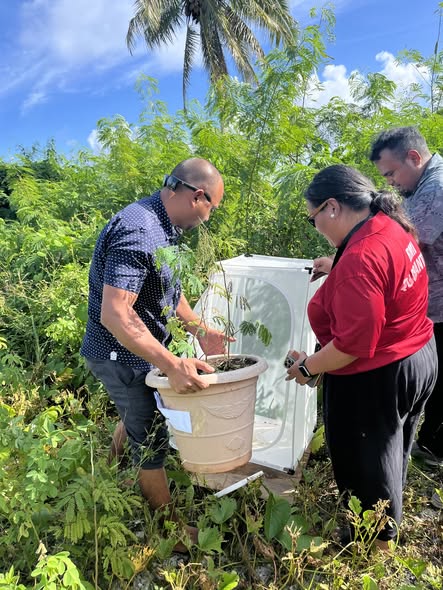
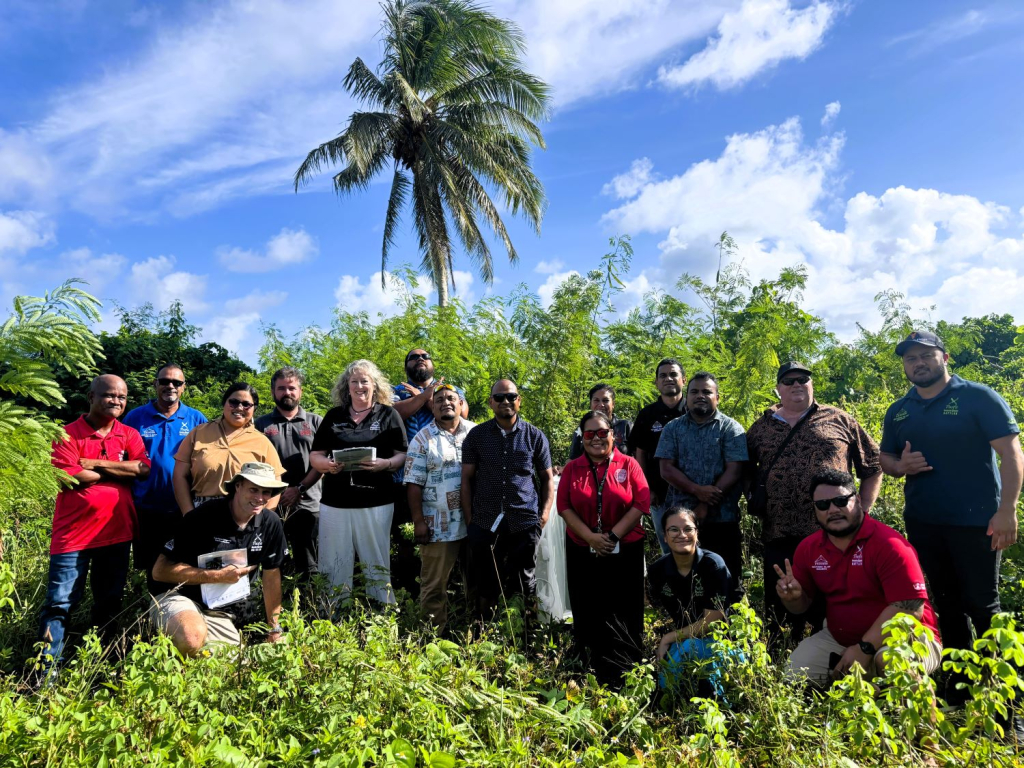
This event was witnessed by representatives from SPREP, MoNRC, Quarantine and Forestry Divisions, Niue Environment Department and Island Conservation. Mr Isidore Robert, RMI Director of the National Disaster Management Office and Ms Silver Wase, RMI Chief of Quarantine, were given the honour of making the release.
Ms Silver Wase shared that “leucaena has significantly affected our native vegetation and the livelihoods of our people as it grows aggressively and outcompetes many of our traditional and medicinal tree species, reducing the diversity and usefulness of our natural landscapes.”
“The introduction of the psyllid will greatly support our efforts to manage this invasive plant as our division is small and tasked with many responsibilities, so having an effective, sustainable tool like this will make a meaningful difference in controlling leucaena across the Marshall Islands.”
PRISMSS NENS programme, technical lead Ms Lynley Hayes shared that, “leucaena poses real risks to local farming and ecosystems. It can be mildly toxic to livestock and should make up no more than 10 percent of a pig’s diet to avoid reduced growth.”
“Because leucaena quickly colonises disturbed ground and is likely to spread faster as climate change alters landscapes, its impacts will only grow unless we improve management now.”
“The psyllids released originate from a colony collected from the Cook Islands in 2023 and through the NENS programme were also released in Tuvalu in 2024 where they have established. This is only the second natural enemy to be released against a weed in the Marshall Islands and the first on Majuro.”
The leucaena psyllid, both nymphs and adults, feed on the soft growing tips of the plant, causing leaf shrivelling and dieback, gradually reducing the weed’s dominance without harming other plants. Originally from tropical America, the psyllid has already self-established on many Pacific Islands.
The PRISMSS NENS programme involves identifying natural enemies that specifically target the invasive species in its native habitat. These natural enemies are thoroughly researched and tested to ensure they are safe and effective, without harming native species or the environment.
Once approved by national regulatory authorities, the natural enemies are released, and their impact is closely monitored to assess their effectiveness. The intent is to reduce the population of the invasive species to manageable levels, allowing native ecosystems to recover and thrive.
SPREP Invasive Species Adviser, Mr David Moverley commented, “PRISMSS places emphasis on working with national agencies, local communities and technical partners to ensure biological control interventions are culturally acceptable and provide socio-economic benefit.”
“By building national capacity we are assisting RMI to evaluate whether natural enemies are appropriate for local conditions and to measure their impact and spread.”
“We must also understand that biological control is a long term, landscape scale tool and not an immediate fix, as it reduces a weed’s competitive ability and economic and ecological harm over years, not just in days or weeks."
“Our technical partners follow established protocols to test that natural enemies attack only the target weed and not native or economically important plants for communities.”
The PRISMSS NENS programme will work with its partners and continue to offer a Pacific adapted pathway by identifying safe natural enemies, building national capacity, making releases where appropriate, and monitoring social and ecological effects to restore balance and reduce long term costs for sustainable invasive species management.
The GEF 6 Regional Invasives Project (RIP) is funded by the Global Environment Facility, implemented by the United Nations Environment Programme, and executed by the Secretariat of the Pacific Regional Environment Programme. The Project works primarily in the Marshall Islands, Niue, Tonga, and Tuvalu and has a regional component. Implementation of the GEF 6 RIP is supported by the Pacific Regional Invasive Species Management Support Services (PRISMSS). For more information on the GEF 6 Regional Invasives Species Project (GEF 6 RIP), please contact the Project Manager Ms Isabell Rasch-Mulitalo, at isabellr@sprep.org
About PRISMSS: The Pacific Regional Invasive Species Management Support Service (PRISMSS) is a coordinating mechanism designed to facilitate the scaling up of operational management of invasive species in the Pacific. PRISMSS, which is led by the Secretariat of the Pacific Regional Environment Programme (SPREP) brings together experts to provide support within the Pacific region with a focus on protection of indigenous biodiversity and ecosystem function. As a service provider, PRISMSS provides a comprehensive suite of support services in a cohesive, effective, efficient, and accessible manner to Pacific Island countries and territories.
Restoring Island Resilience (RIR): The PRISMSS - Restoring Island Resilience (RIR) is a New Zealand-PRISMSS collaboration project that aims to improve Pacific Island Countries and territories livelihoods and resilience to climate change by reducing the impact of invasive species on natural and agricultural ecosystems through the six PRISMSS programmes.
PRISMSS Powered by: New Zealand Foreign Affairs & Trade, UK International Development, GEF, United Nations Environment Programme and SPREP.
PRISMSS Partners: New Zealand Bioeconomy Science Institute, Birdlife International, Earth Sciences New Zealand, New Zealand Department of Conservation, Island Conservation, Pacific Community and SPREP.
PRISMSS Programmes: Natural Enemies - Natural Solutions (NENS), Predator Free Pacific (PFP), Protect Our Islands (POI), Protect Our Marine Areas (POMA), Resilient Ecosystems Resilient Communities (RERC), War On Weeds (WOWs) For additional information please contact Mr Dominic Sadler, PRISMSS Manager on dominics@sprep.org or Mr Nitish Narayan, PRISMSS Communications & Liaison Officer on nitishn@sprep.org