

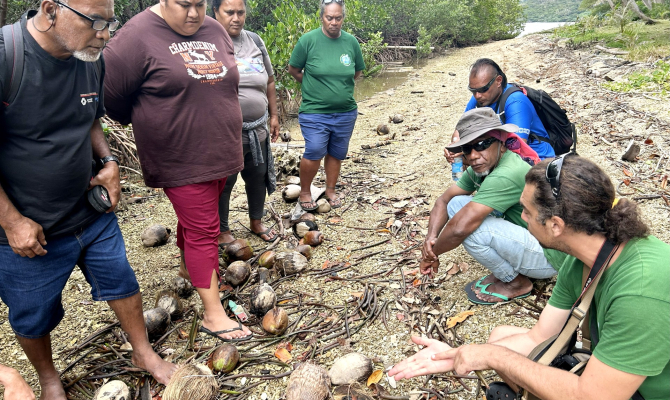
In a demonstration of regional cooperation and environmental stewardship, representatives from Wallis-et-Futuna joined a week-long Ecosystem-based Adaptation (EbA) Learning and Knowledge Exchange Event in New Caledonia, gaining practical skills and inspiration to tackle climate challenges at home.
Held from 16-23 August 2025, the event was organised under the Pacific Ecosystem-based Adaptation to Climate Change (PEBACC+) project, funded by the Kiwa Initiative and the French Facility for Global Environment. It brought together village association leaders and technical staff from Wallis-et-Futuna Environmental Service (STE) for immersive training in nature-based solutions.
For Mrs. Liogi Malia Viane of the Utufua Village Association, the experience was eye-opening. “The training was very different from what we do in Wallis,” she shared, “but it gave me new ideas, especially on mangrove planting and coastal erosion control. I feel proud and motivated to share this knowledge with my community.”
The event allowed participants to engage in hands-on activities, including mangrove restoration, sediment traps construction, and coastal vegetation rehabilitation. Site visits to Touho, Noumea, and Mont Dore showcased successful community-led initiatives using low-cost, scalable techniques as bamboo-made sediment traps, coconut leaves brushes, and low crest/high beach rock lines.
Ms. Sialehaamoa Malia Asopesio, a STE Climate Technical Agent, found confidence in applying EbA techniques such as vegetative barriers and monitoring. “All my expectations were met,” she said, “but I’d love to see even more peer exchanges in future events.”
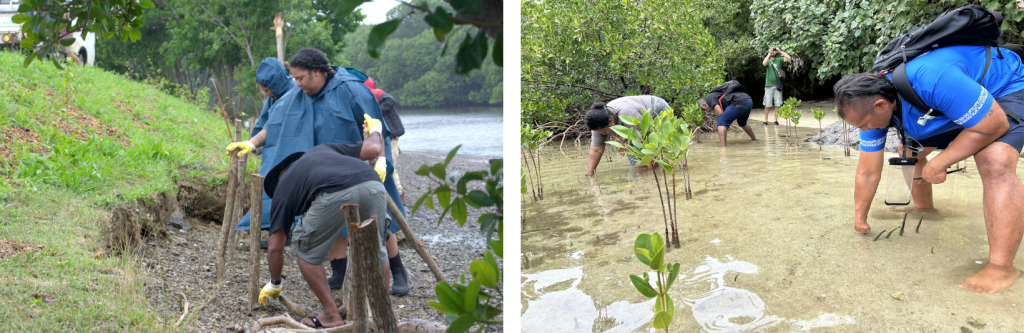
The learning wasn’t just technical; it was also personal. Mr. Tuulaki Jean-Louis, also from STE, reflected on the importance of ecosystem preservation. “This workshop was a success,” he said. “I plan to apply sediment cordons and propagule collection with my team back home.”
Other participants echoed the sentiment, noting increased confidence in applying EbA techniques and a strong desire to involve youth, customary authorities, and local communities in future initiatives.
For Ms. Falakika Ugatai, a Biodiversity Technical Agent from STE, the message was clear: EbA is about patience and persistence. “Adapting to climate change with nature is effective,” she said, “but it takes time. She added that more learning events such as this are needed.
The event emphasised inclusivity, with women, youth, and customary authorities actively engaged. Participants learned that restoration is not just about planting trees; it’s about nurturing relationships, respecting traditions, and building resilience for future generations.
Some of the key learnings highlighted by participants included the importance of rigorous field reconnaissance to locate seeds natural deposits, seeds selection and 2-3 years maintenance for mangrove survival, the value of adapting techniques to local cultural and ecological contexts, the role of local non-paid volunteers & village associations in sustaining restoration efforts beyond project cycles, and the potential of simple, labour-intensive methods to create jobs and restore biodiversity.
The event concluded with calls for continued regional collaboration, more peer exchanges, and further training in wetland monitoring and communication.
“This exchange perfectly captures the spirit of PEBACC+, Pacific communities learning from each other, restoring nature to build their own climate resilience,” said François Tron, PEBACC+ Coordinator for New Caledonia and Wallis-et-Futuna.
“We’re proud of the enthusiasm and leadership shown by Wallis-et-Futuna participants. When local people have the visual understanding and some hands-on practice of “how-to”, the tools, confidence, and connections to act, they become powerful stewards of their environment.”
The PEBACC+ project and its partners extend their gratitude to Association Ho Üt, Caledoclean, Conservation International, and the custodians of Sainte Marie Urban Park and La Coulée estuary for their generous sharing of knowledge.
PEBACC+ is a regional project implemented by SPREP and funded by the Kiwa Initiative through its donors, the European Union, Agence Française de Développement (AFD), Global Affairs Canada, Australian Government Department of Foreign Affairs and Trade (DFAT), and New Zealand Ministry of Foreign Affairs and Trade (MFAT), with co-financing from French Facility for Global Environment (FFEM). This four-year project seeks to strengthen the resilience of ecosystems, economies, and communities to the impacts of climate change in Fiji, New Caledonia, Wallis and Futuna, Solomon Islands and Vanuatu. The project will develop, sustain, and institutionalize EbA to climate change in these five countries and territories.
For more information, please contact: Setaita Tavanabola, Communications Officer, PEBACC+ Project, SPREP; email: setaitat@sprep.org.