

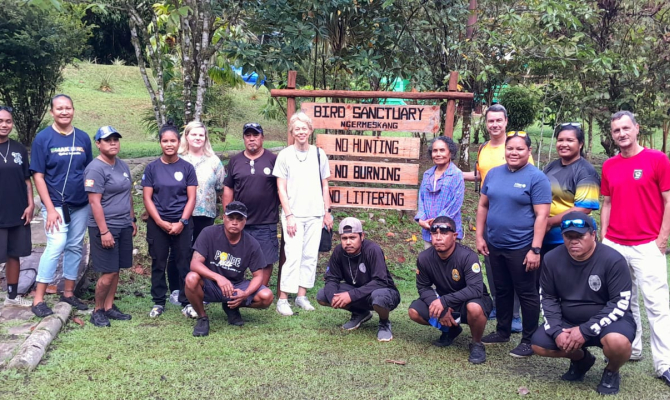
All three Micronesian nations host environmental conservation activities that are part of the Pacific BioScapes Programme, a European Union (EU) funded action, managed and implemented by the Secretariat of the Pacific Regional Environment Programme (SPREP).
They were visited recently by the Ambassador of the European Union to the Pacific, H.E. Barbara Plinkert, who viewed several Pacific BioScapes Programme sites in the North Pacific.
“Our targeted efforts under Pacific BioScapes play an important role in protecting both the environment and sustainable livelihoods of local communities in this part of the Pacific, thus promoting sustainable economic development,” said Ambassador Plinkert.
“We saw both on land and at sea that climate change impacts, sustainable resource use, and biodiversity protection are not distant or theoretical concepts, but are real challenges in everyday life in the region. Local communities are increasingly threatened by the impacts of climate change and human activities, with pressures from fishing, poaching, tourism interactions, construction, and mineral extraction increasingly endangering important terrestrial and marine ecosystems”.
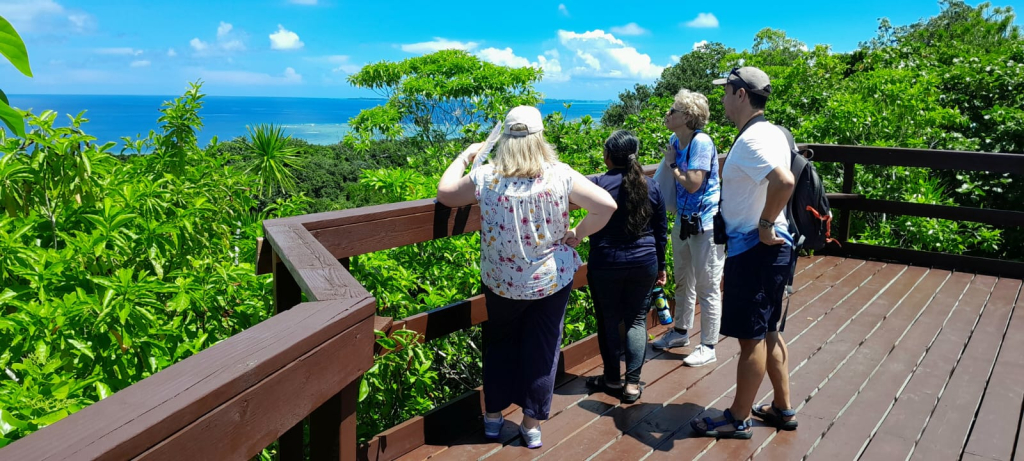
In Palau, there are currently 38 Protected Area Network (PAN) sites and 14 other protected areas that encompass extensive marine and terrestrial reserves, areas of high biodiversity and vulnerable habitats. 608,173 km² of marine waters and 221 km² of land are protected. But an achievement like this means the resources to manage such large areas can often be stretched. There can be limited capacity and resources for effective and sustainable management of these sites, gaps in the governance systems and structures to effectively support protected area management and human resource capacity limitations. Furthermore, there is great potential to further consider gender and human-rights issues within protected area management in Palau.
During the field visit to Palau, meetings took place with rangers from the Protected Area Network Office Authority and The Nature Conservancy who are being supported through Pacific BioScapes to increase site level management capacity across the country.
While in Palau, the team also spoke with Birdlife International regarding the Pacific BioScapes supported initiative to identify and strengthen the management of Key Biodiversity Areas (KBAs). These areas are 'sites contributing significantly to the global persistence of biodiversity’, in terrestrial, freshwater and marine ecosystems. The KBA identification process requires a highly inclusive, consultative, and bottom-up, approach focused on the national level when proposing sites to communities.
At least 550 KBAs in the Pacific region require re-assessment. Multiple standards need to be incorporated into a single KBA system and previous ‘top-down’ approaches to conservation may not have always incorporated important community perspectives. To support this process, the establishment of a national KBAs Co-ordinating Group in Palau is now taking place, whose facilitation is supported by Pacific BioScapes.
The Federated States of Micronesia (FSM) covers a large geographic zone with limited protected area coverage. Threats are faced from overfishing and climate change, whilst management capacity resources for protected areas are limited. Support for protected areas is crucial to counter these threats.
Considering this challenge, the recent EU visit included meetings with the Department of Resources and Development and presentations from the two technical advisors funded through Pacific BioScapes. The advisors are assisting implementation of the Protected Areas Network Policy Framework by supporting operations and providing capacity building at national, state and community levels. Their efforts will help move FSM toward the National Biodiversity Strategy and Action Plan vision: ‘the Federated States of Micronesia will have more extensive, diverse, and higher quality of marine, freshwater, and terrestrial ecosystems, which meet human needs and aspirations fairly, preserve and utilise traditional knowledge and practices, and fulfil the ecosystem functions necessary for all life on Earth’.
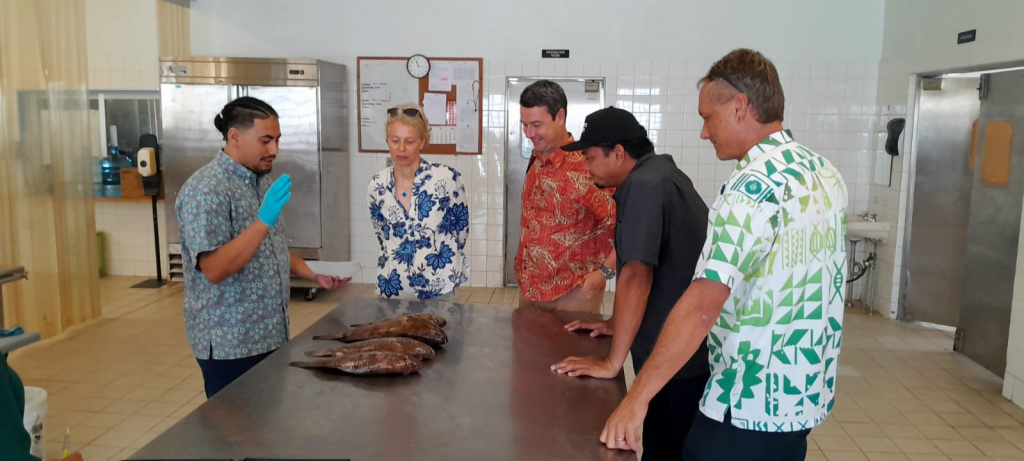
The final stop was the Marshall Islands where coral reef fisheries are fundamental for both food and the local economy. Grouper species make up nearly 20% of all fish caught in several islands, including Majuro and Arno, and many of these targeted groupers are especially vulnerable to uncontrolled exploitation. Currently there is no clear harvesting strategy or fisheries management policy in place for groupers and limited local capacity to monitor stocks. To discuss ongoing efforts, meetings took place with the Marshall Islands Marine Resources Authority and The Nature Conservancy who are being supported through Pacific BioScapes to develop robust evidence-based grouper harvest strategies and hold a coral‐reef fishery learning exchange to better develop national fisheries data analysis and assessments.
With such a range of activities taking place across Palau, FSM and the Marshall Islands, the visit and interest shown by the EU Ambassador marked a genuine milestone for SPREP and Pacific BioScapes in Micronesia.
“At the end of my visit to Micronesia, I am glad to witness that with EU funding the Pacific BioScapes programme is having a real impact. The various projects across the three countries visited are embraced by administrations, implementing partners, and the communities and people they serve - providing timely support exactly where it is needed!” said Ambassador Plinkert.
The Pacific Bioscapes Programme aims to contribute to the sustainable development of Pacific Small Island Developing States through the implementation of regional activities and 30 national activities taking place across a diversity of ecosystems in the Cook Islands, Fiji, Kiribati, Republic of the Marshall Islands, Federated States of Micronesia, Palau, Papua New Guinea, Samoa, Solomon Islands, Tonga and Vanuatu.
For more information please visit: https://www.sprep.org/bioscapes