

By Inoke Rabonu, Fiji Sun
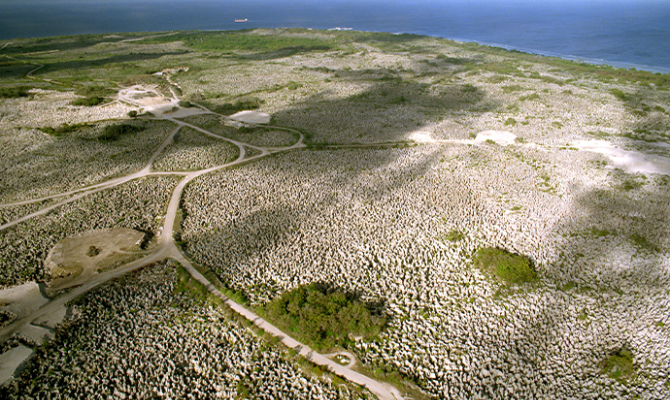
Nauru is facing a climate adaptation challenge unlike most other Pacific nations -- nearly 80% of its land is degraded from decades of phosphate mining, leaving precious little space to house communities threatened by sea level rise.
Kalvary Porte, Project Manager at Nauru’s Climate Action Division, told the Pacific Climate Change Roundtable in Apia that the country’s survival hinges on transforming this damaged land into climate-resilient communities.
“Food, water, energy and displacement, these are our security threats in the face of climate change,” Porte said.
“With so much land degraded, every square meter must be used wisely.”
The solution is the Higher Ground Initiative (HGI), a master plan to rehabilitate mined land and build “smart villages” that combine green housing, renewable energy, water security, and food production.
The plan was designed after an all-of-government process that produced over 1,000 pages of technical reports, informed by a climate vulnerability assessment.
The first HGI project, a smart village on eight hectares of government-owned land, will feature 100 single-family lots, 40 apartments, commercial spaces, and extensive green areas.
All homes will integrate solar power, rainwater harvesting, and energy-efficient designs that Nauruans can build and maintain themselves.
Porte said the approach is deliberately long-term, resisting the temptation for quick fixes like imported container homes.
“It would not have significantly improved the broader resilience of our communities or our economy,” he said.
“We need good planning and good urbanism to provide adequate housing, increase food production, restore ecosystems, and create jobs.”
With rising seas threatening up to 20% of Nauru’s current housing, the smart village model is designed to scale up into larger townships if necessary — potentially housing the entire population.
“This is what greater security will look like for us in Nauru,” Porte said. “To build something worthwhile, you need to be bold and visionary.”
The Pacific Climate Change Roundtable (PCCR), guided by the theme “1.5 to stay alive and thrive,” is taking place at Taumeasina Island Resort from 13-15 August. The PCCR is attended by Pacific governments, youths, civil society, academia, NGOs, and the private sector to engage collectively through the use of interactive activities to share their experiences amongst peers, bolster their networks and utilise the event to initiate new partnership opportunities.
The PCCR follows the Pacific Regional Loss and Damage Dialogue 2025 and the inaugural Pacific Youth Dialogue on Loss and Damage, at the same venue in Samoa.
This story was produced by the Pacific Media Team covering the meetings. Their attendance is made possible with funding support from the Loss and Damage Capability and Capacity (LDCC) Project with the Government of New Zealand.
PHOTO CREDIT: Much of Nauru's interior has been mined for phosphate.
Image: John Gollings/ Monash University