


30 July 2025, Suva, Fiji - The critical importance of building strong national systems to safeguard the movement of hazardous waste across the blue Pacific was a key message delivered by the Secretariat of the Pacific Regional Environment Programme (SPREP) during the Small Island Developing States (SIDS) Capacity-Building Training Programme on the Jaipur Declaration on 3R and Circular Economy, held 23-25 July 2025.
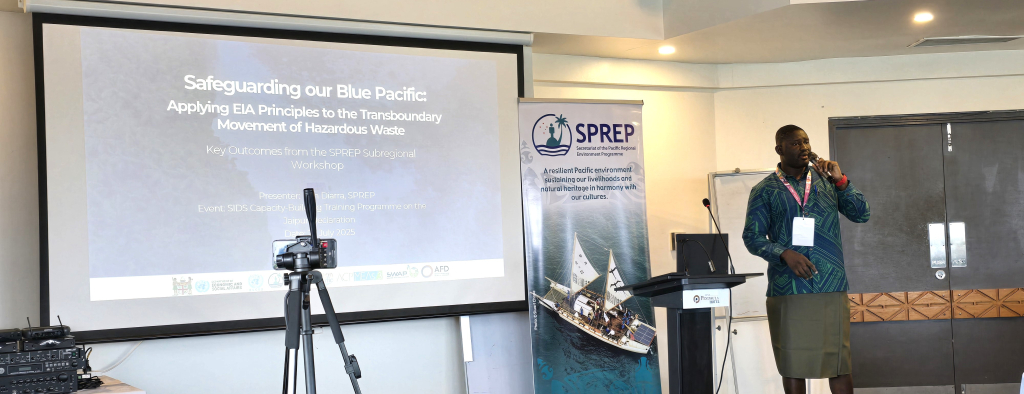
SPREP Pacific Network for Environmental Assessment (PNEA) Technical Officer, Mr. Ivan Diarra presented the outcomes of a regional workshop held in Samoa in June which engaged environmental and maritime officials from seven Pacific Island countries, and produced a clear, country-driven consensus on the primary obstacles to safe waste management.
“The safe and secure transport of hazardous waste for offshore disposal is one of the main challenges for countries in the region. A first of its kind, we hosted a regional workshop in Samoa to understand how the principles of Environmental Impact Assessment (EIA) which include risk assessment, stakeholder engagement, monitoring and management can inform how we safely manage the transboundary movement of such waste. The workshop enabled us to identify the entry points for environmental safeguarding of this complex process.”
Mr Diarra highlighted the key outcomes of the workshop which included the urgent need to formalise national inter-agency coordination between environment and maritime authorities, modernising outdated legal frameworks to align with the Waigani Convention, and the need for a unified commitment to formally integrate EIA as a core risk management tool in all transboundary movement approvals.
These steps are essential for a resilient Circular Economy in the Pacific. By establishing a safe, transparent, and reliable system for managing hazardous residuals that cannot be processed in-country, Pacific nations can advance circular solutions for other waste streams.
Mr Dexter Brechtefeld from the Nauru Rehabilitation Corporation highlighted an ongoing challenge of shipping hazardous waste, namely asbestos off island.
"There is still a significant amount of asbestos in Nauru. So far, with assistance from SPREP, we've managed to ship one container off island. More than ten containers remain, posing a serious health hazard. Although we’ve relocated them to the topside area, people continue to access the containers, break them open, remove the contents, and reuse them despite the risks."
"The government has limited authority to intervene on private land and landowners have rights and control over their own property under the Constitution of Nauru. This makes enforcement challenging."
"We need to review and revise existing legal and institutional frameworks to ensure the system works effectively. It’s essential that people are empowered and encouraged to take responsibility for their own safety, and that of their families and children."
The Jaipur Declaration makes reference to the Basel Convention, which the Waigani Convention is modelled upon , and aims to protect human health and the environment against the adverse effects resulting from the generation, management, transboundary movements and disposal of hazardous and other wastes.
With the increase of hazardous waste in the Pacific, it is crucial for nations to consider incorporating EIA principles to ensure their safe transboundary movements. Ensuring that all risks are assessed and all parties involved are thoroughly consulted, through these nations can further advance their Circular Economy Goals under the Jaipur Declaration while also reaffirming their commitment to the Waigani and Basel Conventions for an environmentally resilient Pacific.
The Consultation for the Cleaner Pacific 2036 Strategy and Small Island Developing States (SIDS) Capacity-Building Training Programme on the Jaipur Declaration on 3R and Circular Economy is supported by the European Union initiated capacity building project phase 3 titled, "Capacity Building related to Multilateral Environmental Agreements (MEAs) in African, Caribbean and Pacific (ACP) Countries", implemented by UN Environment executed by SPREP.
For more information on SPREPs work on Environmental Impact Assessment, please contact Puta Tofinga, putat@sprep.org or Ivan Diarra, ivand@sprep.org
For more information on SPREPs work on the Transboundary Movement of Hazardous Waste, please contact Susana Telakau, susanat@sprep.org