

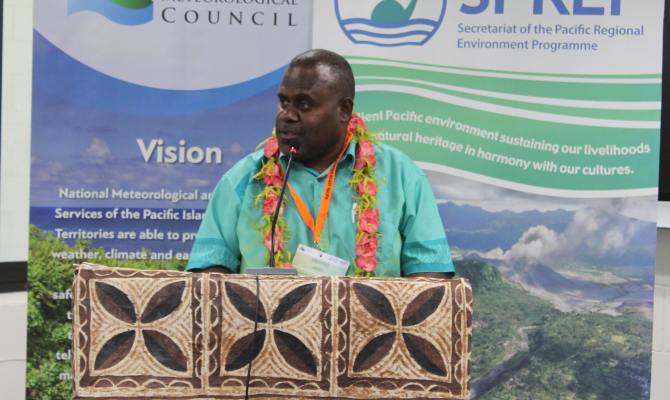
4 August 2025, Apia, Samoa – A gathering of Pacific National Meteorological and Hydrological Services (NMHSs) Directors and technical partners is taking place in Apia this week to not only review and take stock of their collective journey over the past ten years, but to celebrate the successes and milestones achieved under the Pacific Island Meteorological Strategy (PIMS) 2017-2026.
The PIMS is recognised by Pacific NMHSs as the navigational chart for future development of Meteorological Services in the region. It was recommended during the Sixth meeting of the Pacific Meteorological Council (PMC) meeting held in Nadi, Fiji in 2023 that there be a review of the current PIMS which lapses in 2026 in preparation for the development of the PIMS 2027 – 2036.
According to the Chair of the PMC and Director of the Vanuatu Meteorological and Geohazards Department, Mr. Levu Antfalo, the PIMS 2017-2026 marked a decade of growth, innovation, and strengthened cooperation which enabled the Pacific NMHSs and partners to achieve a great deal together.
“Through the current Strategy, we have established Regional Centres of Excellence such as the Regional Training Centre, the Regional Climate Centre, and the Regional Instrument Centre, which are now cornerstones of capacity building, technical excellence, and service deliver for Pacific NMHS,” Mr. Antfalo said during his keynote address.
“We also deepened the role of the PMC Panels in guiding regional development across areas such as Education and Training, Aviation, Marine, Climate Science, Infrastructure, and Research, as well as strengthening the early warning capabilities of our Pacific NMHSs, with notable improvements in end-to-end Multi Hazard Early Warning Systems across many of our countries,” he added.
Regional initiatives that have strengthened collaboration between Pacific NMHSs and its donors and technical partners have also resulted in improved regional climate services. Initiatives such as the Climate and Oceans Support Program in the Pacific (COSPPac), the Weather and Climate Information Services Programme (WISER), the Climate Risks and Early Warning Systems (CREWS), and the Weather Ready Pacific (WRP) Programme, were acknowledged by Mr. Antfalo as milestones achieved under the current PIMS.
The vision for the PIMS 2027-2036 is that it will be anchored to the 2050 Strategy for the Blue Pacific Continent and also to be more results-based, measurable and transformational. The new Strategy will look to clearly define strategic outcomes to be achieved as a region, link the 2050 Strategy to national plans and local impact, provide a structure that enables donors and partners to align their investments, and finally to offer a platform for accountability, where NMHSs, partners, and SPREP can coordinate, deliver, and track progress.
Mr. Antfalo did not mince his words when he stressed the importance of the work that still lies ahead, as the Pacific gears up to develop a new PIMS that will guide them for the next ten years, stating clearly that, “The stakes are high – climate change is accelerating, disasters are increasing, and our region is at the frontlines.”
“We must go beyond business-as-usual. We must be bold in our vision, and intentional in our planning,” the PMC Chair challenged.
This challenge was echoed by Mr. Salesa Nihmei, Director of SPREP’s Climate Science and Information Programme, who said to those in the room, “This is your space. This is your opportunity to help shape how the consultations will be done over the next few months and the way we will work together for the next ten years.”
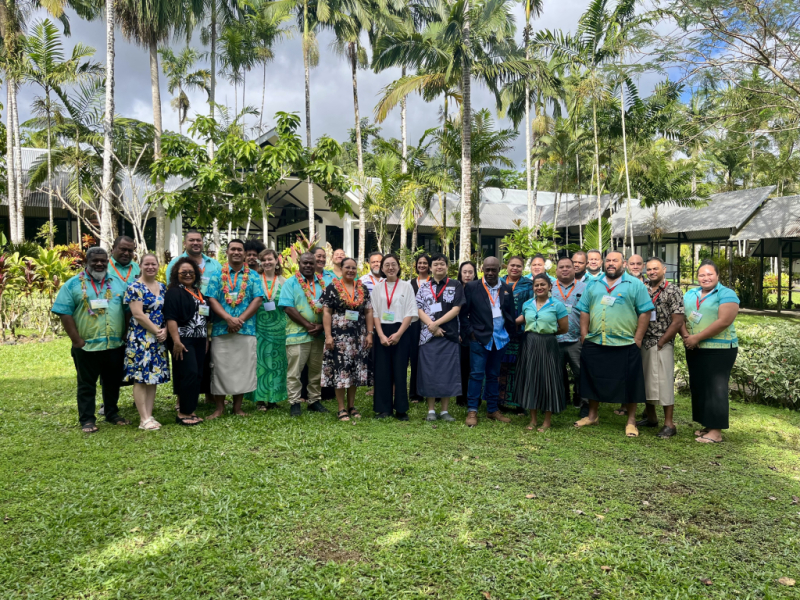
“We aim for this new strategic plan to be presented at the eighth Pacific Meteorological Council (PMC-8) and fourth Pacific Ministerial Meeting on Meteorology (PMMM-4) in 2026,” Mr Nihmei added.
Pacific Met Directors from Fiji, Niue, Tonga, Vanuatu, Papua New Guinea, Samoa, Federated States of Micronesia, Palau, as well as representatives from Earth Sciences New Zealand, Korea Meteorological Institute and SPREP are present at the week-long meetings which will also include the presentation of the Weather Ready Pacific Investment Plan, a review of the Green Climate Fund One Pacific Plan proposal, and a workshop hosted by the Korea Meteorological Institute to introduce new technologies developed and used by Korea’s meteorological services and identify the needs of Pacific NMHSs and how they can support these efforts to enhance climate resilience in the region.
The meetings are co-funded by the European Union-funded Intra-ACP Climate Services and Related Applications (ClimSA) Programme, the Korean Meteorological Institute and the Weather Ready Pacific Programme.
For more information, please contact Mr. Salesa Nihmei, Director – Climate Science and Information Programme – at salesan@sprep.org.