

By Ednal Palmer, In-Depth Solomons
As Pacific leaders prepare for the Regional Loss and Damage Dialogue 2025 in Apia next week, two young Solomon Islanders are part of a pack of ambitious young Climate Change advocates across the Pacific who in Samoa to be part of a Climate Change dialogue on Loss and Damage.
Roderick Rollands and Melissa Horokou have been active in the Climate Change space and are familiar with the rigorous processes and challenges it takes for youth voices to be heard and actioned by policy makers.
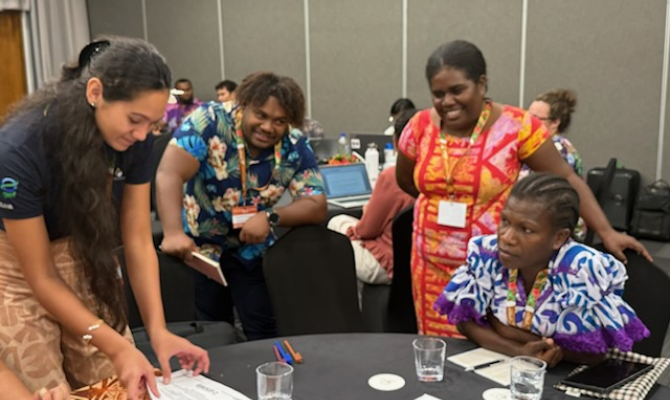
This week, at a youth climate change dialogue hosted by the Secretariat of the Pacific Regional Environment Programme (SPREP), the young Solomon Islanders are stepping up to the plate as informed influencers bridging the realities of frontline communities with the decision-making halls of power.
For many of these youth, the climate crisis is not an abstract idea—it’s an everyday experience.
Rising sea levels, saltwater intrusion, food insecurity, and disappearing coastlines are challenges they live with, not just read about.
Now, for the first time, they have come to share testimonies and experiences in order to devise a compelling case to be presented to policy makers, leaders and partners in a Climate Change - Loss and Damage Dialogue from August 11- 15.
“We are not here to tick the box of youth inclusion. We are here because we want our stories heard, and there is urgency from our communities,” said Melissa Horokou from the Ministry of Climate Change in the Solomons.
Horokou added that if policies are created without the input of youths and those who work with affected communities, they will miss realities on the ground.
Beyond Symbolism – Youth as Strategic Voices
The SPREP-organized youth dialogue is the first part of a broader effort to ensure youth voices are central in shaping regional climate strategies before leaders meet with donor partners and key climate policymakers next week.
Rodrick Hollands of the Solomon Islands, in appreciating the opportunity for youths to freely discuss, said the initiative is not just about empowering youth—it’s about utilizing them as a critical asset in crafting grounded, equitable, and community-informed climate responses.
Participants from across the Pacific are engaging in a dialogue to understand Loss and Damage, formulate a youth presentation for a Climate Change dialogue next week, strengthen relations amongst Pacific youth advocates, and enhance their professional network.
“Loss and Damage clearly define the negative experiences and losses of our people, although people enjoying huge landmasses may not understand, it is the reality we Pacific Island countries are bracing daily,” Hollands added.
A New Generation of Climate Diplomats
With support from SPREP, the young Pacific Islanders now have a name to call the impacts their people are facing back in their communities - Loss and Damage..
They are also forming coalitions with other Pacific youth, ensuring the region’s next generation is clear on the concept and speaks with one voice.
“We want to be in the room where decisions are made—not just after they’ve been made,” Horokou said, appreciating the opportunity to present their case to next week's dialogue.
Their messages are grounded, and they do not shy away from the emotional weight of climate loss. Stories of ancestral burial grounds disappearing under water and the relocation of entire communities add urgency to their advocacy.
Youth Participation as Policy Innovation
SPREP’s approach to facilitating this dialogue reflects a growing recognition that youth participation is not a box-ticking exercise—it’s an innovation in policymaking.
“Young people bring fresh perspectives, local knowledge, and an unmatched sense of urgency,” said SPREP Climate and Resilience Director Tagaloa Cooper-Halo.
“If we are serious about climate resilience, we must treat youth as co-designers of solutions.”
Looking Ahead: From Dialogue to Impact
As these young climate advocates return to their home islands, their journey doesn’t end in Apia. Many will be part of national delegations in future high-level forums, some will work with NGOs on local adaptation projects, and others will hold their own governments accountable for turning commitments into action.
But for now, in the heart of Samoa, they’ve already achieved something powerful: reframing the narrative of youth from passive recipients to proactive policy shapers.
“We’re not just leaders of tomorrow,” said Hollands. “We are standing up now, because Climate Change cannot wait for us to become leaders.”
The inaugural Pacific Youth Dialogue on Loss and Damage, guided by the theme “Navigating our Future” is held from 7- 8 August, Taumeasina Resort, Samoa. This precedes the Pacific Regional Loss and Damage Dialogue 2025 to be held from 11-12 August at the same venue in Samoa.
The inaugural Pacific Youth Dialogue on Loss and Damage and the Pacific Regional Loss and Damage Dialogue 2025 are made possible with funding support from the Loss and Damage Capability and Capacity (LDCC) Project with the Government of New Zealand.
Hosted by Secretariat of the Pacific Regional Environment Programme (SPREP), the dialogues bring together Pacific governments, youths, civil society, academia, NGOs, and the private sector to collectively advance the region’s priorities on Loss and damage.
This story was produced by the Pacific Media Team covering the meetings. Their attendance is made possible with funding support from the Loss and Damage Capability and Capacity (LDCC) Project with the Government of New Zealand.
For more information, please contact SPREP Climate Change Adaptation Adviser, Ms Filomena Nelson filomenan@sprep.org , SPREP Climate Change Loss and Damage Officer, Ms Jessica Rodham jessicar@sprep.org or Media and Public Relations Officer, Mr Keni Lesa sosikenil@sprep.org