

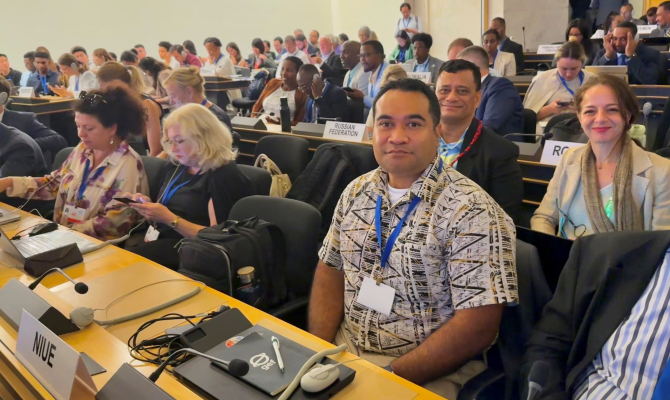
As the final negotiations for a legally binding global plastics treaty intensify in Geneva, Niue has again sounded the alarm on the mounting health and environmental toll of plastics on Pacific communities.
“The world is facing a worsening plastics crisis, and we in the Pacific are on the frontlines, paying a heavy price for a problem we did not create,” said Haden Talagi, Director of Niue’s Department of Environment.
“It begins at production. Without a global cap on virgin plastic production, we’re only treating the symptoms while the disease continues to spread.”
More than 184 countries are participating in the second part of the fifth session of the Intergovernmental Negotiating Committee (INC-5.2) process in Geneva, Switzerland. This week’s critical talks could redefine humanity’s relationship with plastics and determine the future health of our planet.
Niue, like other Pacific Small Island Developing States (PSIDS), does not produce plastic polymers or their chemical constituents. Yet, the Pacific is among the most disproportionately affected by plastic pollution and the toxic chemicals found in plastics. Due to geographic isolation, limited economic resources, and inadequate waste infrastructure, there are few safe, sustainable options for managing plastic once it enters the region.
“Much of the plastic that enters the region stays here, slowly breaking down into micro- and nano-plastics. In the process, these fragments release toxic chemicals into the environment, contaminating soil, water, marine life, food systems, and even human bodies,” Mr. Talagi said.
His warning echoes the findings of a new scientific review published in the respected medical journal, The Lancet, which describes plastics as a “grave, growing, and under-recognised danger” to human and planetary health. The review highlights that the materials used in plastics cause serious harm at every stage of the plastic lifecycle — and at every stage of human life.
The review outlines how plastics cause extensive damage to health from extraction to disposal, including air pollution from burning plastic, toxic chemical exposure during manufacturing, and the growing threat of micro- and nano-plastics, now found in human blood, breast milk, placentas, and even brains.
“The impact of plastics and the toxic chemicals used throughout their production is deeply concerning for the health of our Pacific people,” said Mr. Talagi. “These substances are infiltrating our environment, our food systems, and ultimately, our bodies — creating serious risks from infancy through to adulthood. For our remote island communities, where healthcare systems are limited, the long-term uncertainty is even more concerning. This is not just an environmental crisis, it is a human health crisis unfolding across the Pacific.”
The Lancet review estimates that plastics are responsible for at least USD 1.5 trillion in health-related costs each year. Plastic production has increased by more than 200 times since 1950 and is set to almost triple to more than a billion tonnes a year by 2060. 8 billion tonnes of plastic is now polluting the entire planet, the review highlighted.
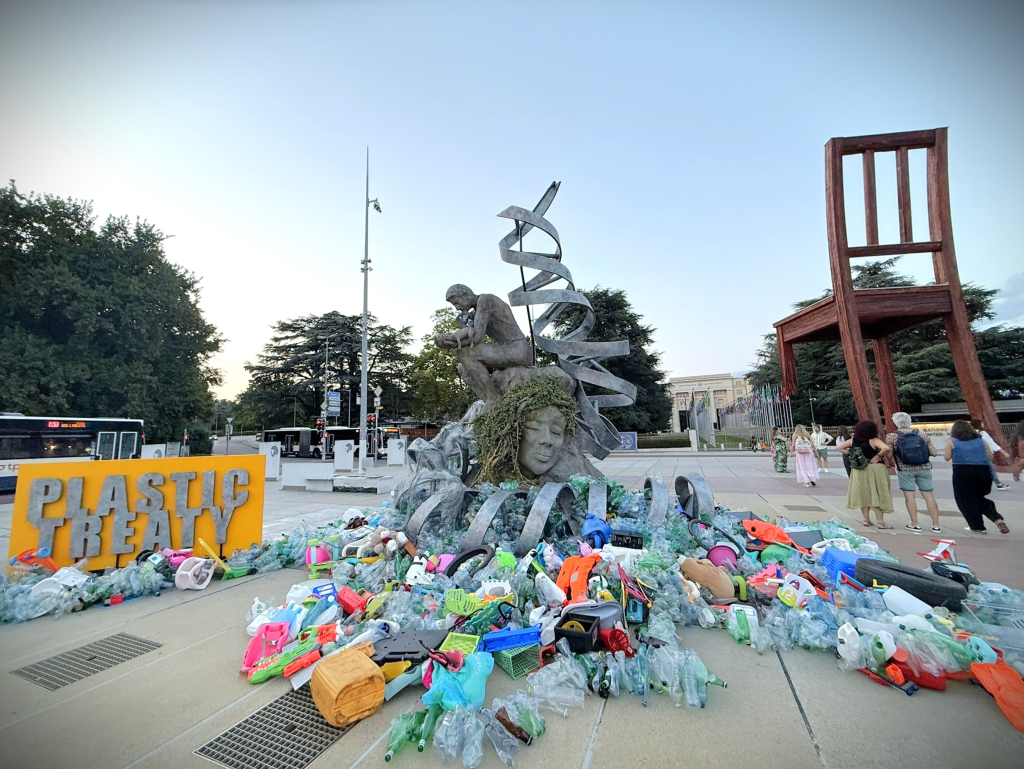
More than 100 countries, including PSIDS, support a global cap on plastic production and are calling for upstream measures that address pollution at its source. This includes cutting virgin plastic production, phasing out harmful and toxic chemicals in plastics, and jolimited solutions like recycling and cleanup alone.
However, proposals to limit production and regulate chemicals have faced fierce opposition from petrochemical-producing states and industry lobbyists.
The review also highlights how chemicals commonly used in the production of plastics, such as Bisphenol A (BPA) and phthalates, are associated with birth defects, cancer, impaired fertility, and developmental disorders, with the most vulnerable populations being infants, children, and pregnant women.
The Lancet review is the first in a planned series of scientific reports that will track plastic’s health impacts over time. The goal is to provide policymakers with independent, credible evidence to support strong national and regional measures.
The second part of the fifth session of the Intergovernmental Negotiating Committee to develop an international legally binding instrument on plastic pollution, including in the marine environment (INC-5.2), will take place from 5 to 14 August 2025 at the Palais des Nations in Geneva, Switzerland.
The Pacific Islands are represented by the Cook Islands, Federated States of Micronesia, Fiji, Kiribati, Marshall Islands, Nauru, Niue, Palau, Papua New Guinea, Samoa, Solomon Islands, Tonga, Tuvalu and Vanuatu through the support of the Government of Australia through the Pacific Ocean Litter Project (POLP), and the United Nations.
They are supported by the Secretariat of the Pacific Regional Environment Programme (SPREP), working with partners from the Pacific Islands Forum Secretariat (PIFS), Office of the Pacific Ocean Commissioner (OPOC), The Pacific Community (SPC), Forum Fisheries Agency (FFA), Environmental Investigation Agency (EIA), Centre for International Environmental Law (CIEL), University of Wollongong, WWF and Massey University.