

By Ednal Palmer, In-Depth Solomons
What began as a humble conversation beneath an Abalolo tree in Vanuatu has now echoed through the halls of the world’s highest court.
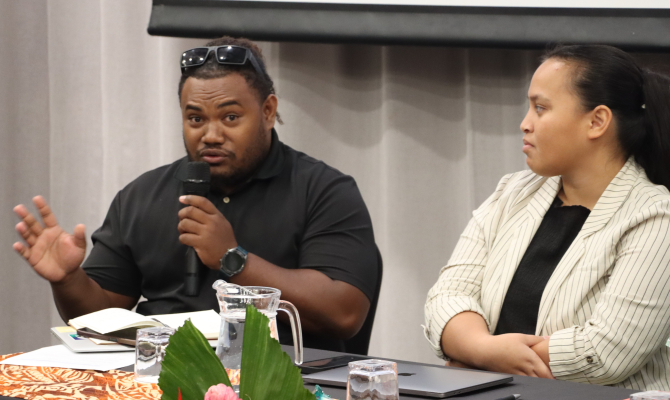
In a stirring address to youth gathered in Apia, Samoa, for the inaugural Youth Dialogue on Loss and Damage, Solomon Islands youth representative and lawyer, Rodrick Hollands recounted a remarkable journey — one that started with a dream and ended in a historic milestone: bringing the issue of climate change before the International Court of Justice (ICJ).
The young lawyer, a graduate of the University of the South Pacific (USP) Emalus Campus in Vanuatu, was amongst a small group of law students who in 2019 dared to believe that Pacific voices could influence international law.
“We dreamed it, we did it, we achieved it,” Rodrick told a captivated room full of young climate advocates from across the Pacific.
The Roots of the Movement
Under the shade of the Abalolo tree on USP’s Vanuatu campus, a small group of students gathered regularly — not for class, but to imagine how they could make the world listen to the Pacific’s climate crisis.
What united them was a shared frustration: despite being among the least responsible for climate change, their island homes faced some of its worst consequences.
"It was all voluntary," Rodrick explained. "We were just students, but we started researching what viable options we could take. The more we dug, the more we saw potential in pursuing an ICJ advisory opinion, building on from previous campaigns."
Their campaign was bold and unprecedented. The idea? To get the ICJ to issue an advisory opinion on the responsibility of nations for climate-induced loss and damage.
A Road Paved with Resistance
The road was anything but smooth. Early attempts to gain support fell flat. In 2019, when the group presented the idea to the Pacific Islands Development Forum in Fiji, it was dismissed outright.
“They told us it wasn’t a viable option and advised us to drop it,” Rodrick recalled. “We were heartbroken. But we didn’t stop.”
Instead, they adapted. They read extensively, contacted climate authors, and built relationships with legal experts.
They lobbied — not with money, but with passion and persistence. Knowing only states could bring matters to the UN General Assembly, they turned to the Vanuatu Ministry of Foreign Affairs.
“After a few tries, the Foreign Minister finally listened to us,” Rodrick said. “That was our breakthrough.”
From Dream to Reality
With the backing of Vanuatu’s government, their cause gained momentum. Petitions were drafted. Alliances were formed. And finally, the campaign culminated in a request submitted to the International Court of Justice — marking a groundbreaking moment in the global fight for climate justice.
In 2023, the ICJ agreed to issue an advisory opinion on the obligations of states regarding climate change — a landmark moment spearheaded by the Pacific youth.
“For now, it’s just an opinion — it has no teeth to bite,” said Vanuatu youth advocate Hendricks Tabi, “but it’s a huge milestone. It gives us grounding for future policies and decisions.”
Inspiring the Next Wave
Rodrick’s story moved the room in Apia, where youth are gathering to chart a path forward on climate loss and damage.
The current youth dialogue facilitated by SPREP, is putting together a plan to present a unified strategy to leaders and policymakers in the upcoming formal dialogue from August 11 to 15.
“Some told us this would never work,” Rodrick said. “But this journey taught us something — when doors close, we find windows. When no one listens, we make them hear.”
For many in the room, the message was clear: real change doesn’t always start in boardrooms — sometimes, it starts under a tree.
The inaugural Pacific Youth Dialogue on Loss and Damage, guided by the theme “Navigating our Future” is held from 7- 8 August, Taumeasina Resort, Samoa. This precedes the Pacific Regional Loss and Damage Dialogue 2025 to be held from 11-12 August at the same venue in Samoa.
The inaugural Pacific Youth Dialogue on Loss and Damage and the Pacific Regional Loss and Damage Dialogue 2025 are made possible with funding support from the Loss and Damage Capability and Capacity (LDCC) Project with the Government of New Zealand.
Hosted by Secretariat of the Pacific Regional Environment Programme (SPREP), the dialogues bring together Pacific governments, youths, civil society, academia, NGOs, and the private sector to collectively advance the region’s priorities on Loss and damage.
This story was produced by the Pacific Media Team covering the meetings. Their attendance is made possible with funding support from the Loss and Damage Capability and Capacity (LDCC) Project with the Government of New Zealand.
For more information, please contact SPREP Climate Change Adaptation Adviser, Ms Filomena Nelson filomenan@sprep.org, SPREP Climate Change Loss and Damage Officer, Ms Jessica Rodham jessicar@sprep.org or Media and Public Relations Officer, Mr Keni Lesa sosikenil@sprep.org