

By Sanjeshni Kumar, Pacnews
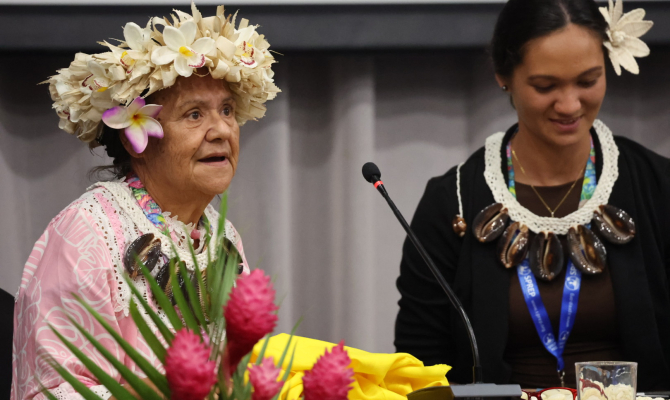
Climate change is reshaping life in the Cook Islands, from the food on the table to the survival of cultural traditions, says Cook Islands National Council of Women (CINCW) Secretary, Taputu Mariri.
Speaking about the growing impacts of climate change-induced loss and damage, Mariri described how unpredictable weather patterns, sea encroachment, and prolonged dry spells are affecting communities across the islands.
“The land is barren and dry, only nono (fruit of the Morinda citrifolia tree) and tutu (Colubrina asiatica) grow there,” she said, using a local saying that compares dry islands with those that have plenty of fresh water.
“Some islands are better off; others are already feeling severe losses.”
For Mariri, the impacts are deeply personal. In her presentation to delegates from across the pacific attending a Climate Loss and Damage dialogue in Samoa, she shared a photo of her extended family, and posed the questions: “Who is impacted by loss and damage? Families.
“My children, their partners, my grandchildren — we are all affected.”
She said climate stress is forcing young people to move away, leaving communities with fewer hands to work and breaking the link needed to keep cultural traditions alive.
“We see houses with no young people, only the elderly,” she said.
“And when a family member falls sick, caregiving responsibilities are often on women, meaning losing the chance to earn an income.”
On the environmental front, Mariri spoke sadly about the loss of food sources that once sustained island life.
“When I was young, we ate octopus every day during the season. Today, the abundance is gone — fish, shellfish, and even native plants have disappeared from some areas.”
CINCW’s own surveys across the islands reveal that women in agriculture, fisheries, and handicraft-making are facing reduced crops and income instability due to shifting weather and rising seas. This affects household food security and places an even heavier caregiving burden on women after disasters like cyclones and droughts, especially in the Pa Enua Tokerau (North Cook Islands).
High swells have already battered parts of Rarotonga’s southern coast, washing seawater onto roads without warning.
“Last week, the sea came right up to the road. It’s sad what’s happening in our community,” Mariri said.
For vulnerable groups, including people with disabilities, the elderly, and isolated Pa Enua (outer Island) communities, recovery from climate disasters is even slower.
Meanwhile, youth face a loss of cultural identity as sacred sites and traditional knowledge are eroded by rising seas.
Mariri’s words echo those of CINCW President Vaine Wichman, who told the International Court of Justice last December: “We are the custodians of many natural and cultural artforms and traditions.”
She explained, “Our women producers are not able to attract resources and support to assist in protecting the raw materials they rely on. This is a gender equality issue because women's food and handicraft products are not clearly acknowledged in the production side of the country's national accounts.”
Mariri’s message was clear: climate change is not an abstract future threat, it is an everyday reality already disrupting livelihoods, traditions, and family life across the Cook Islands.
The Pacific Regional Loss and Damage Dialogue 2025 is held from 11-12 August at Taumeasina Island Resort. It follows the inaugural Pacific Youth Dialogue on Loss and Damage, held from 7- 8 August, at the same venue in Samoa.
The Pacific Regional Loss and Damage Dialogue 2025 and the inaugural Pacific Youth Dialogue on Loss and Damage are made possible with funding support from the Loss and Damage Capability and Capacity (LDCC) Project with the Government of New Zealand.
Hosted by the Secretariat of the Pacific Regional Environment Programme (SPREP), the dialogues bring together Pacific governments, youths, civil society, academia, NGOs, and the private sector to collectively advance the region’s priorities on Loss and damage.
This story was produced by the Pacific Media Team covering the meetings. Their attendance is made possible with funding support from the Loss and Damage Capability and Capacity (LDCC) Project with the Government of New Zealand.
For more information, please contact SPREP Climate Change Adaptation Adviser, Ms Filomena Nelson filomenan@sprep.org , SPREP Climate Change Loss and Damage Officer, Ms Jessica Rodham jessicar@sprep.org or Media and Public Relations Officer, Mr Keni Lesa sosikenil@sprep.org